Probability Evaluation
ProvSQL computes probabilities by reducing a provenance circuit to Boolean form and then dispatching to one of several evaluation methods. This page explains the dispatch architecture, gives the background on the central data structures (d-DNNF, Tseytin encoding, weighted model counting, tree decomposition), and ends with a step-by-step guide for adding a new method. See Probabilities for the user-facing description of the existing methods.
The continuous-random-variable surface layers an analytical / hybrid path on top of this Boolean machinery; the architecture of that layer is documented separately in Continuous Distributions. The sections below cross-link to the relevant arms of the hybrid evaluator and the conditional inference path.
Architecture
The entry point is the SQL function probability_evaluate,
bound directly to the C function probability_evaluate (in
probability_evaluate.cpp), which calls
probability_evaluate_internal. That function loads a
GenericCircuit from the persistent circuit store via
getGenericCircuit; the Boolean view is only built later, at
the dispatch point. (provenance_evaluate_compiled is the
semiring dispatcher, described in Semiring Evaluation; it is
not on the probability path.)
probability_evaluate_internal receives the method name (or
the requested guarantee) and dispatches through the
MethodCatalog singleton: each method is a
ProbabilityMethod subclass registered with
MethodCatalog::registerMethod at static-initialisation time,
and the catalog either resolves an explicitly named method or runs
its cost-based chooser over the admissible ones. Two declarative
flags shape the dispatch: handlesMultivalued() (the BID →
Boolean rewrite of gate_mulinput blocks is applied centrally
before any method that does not handle blocks natively – only
independent opts out), and producesDD() / buildDD() for
the d-DNNF constructors the makeDD auto route selects among.
Two gate types short-circuit the chooser entirely: a
gate_conditioned root is evaluated as the conditional
P(target ∧ evidence) / P(evidence), and a gate_mobius root is
non-Boolean and routes directly to the mobius method (see
below).
Background: d-DNNF, Tseytin, Knowledge Compilation
Computing the probability that a Boolean formula evaluates to true
when its variables are assigned independently is  -hard
in general, but tractable for structured representations. The
two structures ProvSQL exploits are d-DNNF and tree
decomposition, both of which give linear-time probability
evaluation in the size of the structure. The methods that ship
with ProvSQL all reduce to one or the other.
-hard
in general, but tractable for structured representations. The
two structures ProvSQL exploits are d-DNNF and tree
decomposition, both of which give linear-time probability
evaluation in the size of the structure. The methods that ship
with ProvSQL all reduce to one or the other.
d-DNNF
A deterministic decomposable negation normal form (d-DNNF) is a
Boolean circuit built from AND, OR, NOT, and variable
leaves, satisfying two structural properties:
Decomposability: for every
ANDgate, the variable sets of its children are pairwise disjoint. This means the children represent independent events, and the probability of the AND is the product of the children’s probabilities.Determinism: for every
ORgate, the children represent mutually exclusive events. This means the probability of the OR is the sum of the children’s probabilities – no inclusion- exclusion correction is needed.
Together these two properties make a single bottom-up traversal
sufficient to compute the probability:
dDNNF::probabilityEvaluation does exactly that. The
implementation in dDNNF.cpp uses an explicit stack
instead of recursion to avoid blowing the call stack on very deep
circuits, and memoises intermediate results so that shared
sub-circuits are evaluated only once.
A general Boolean formula is not a d-DNNF. Producing a d-DNNF
from an arbitrary formula – knowledge compilation – is the
expensive part; once you have it, evaluation is cheap. The
compilation and tree-decomposition branches of the
dispatcher both end in a dDNNF object that
dDNNF::probabilityEvaluation then walks.
Tseytin Encoding
External knowledge compilers (d4, c2d, dsharp,
minic2d) and the weightmc model counter all consume
Boolean formulas in DIMACS CNF format. Producing CNF from a
ProvSQL Boolean circuit is the job of
BooleanCircuit::TseytinCNF (in BooleanCircuit.cpp),
whose string output each caller writes into its own
@c provsql::ScopedTempDir before invoking the tool.
The Tseytin transformation introduces one fresh variable per
internal gate of the circuit, then writes a small set of clauses
that encode the gate’s semantics. For an AND gate
 , that’s one
binary clause
, that’s one
binary clause  for every child, plus
one big clause
for every child, plus
one big clause
 .
.
OR is dual. NOT becomes two two-literal clauses. A unit
clause forcing the root variable true is added at the end.
For weighted model counting (and the d4 compiler when built with
weight support), Tseytin also emits two w lines per leaf
variable: w <v> <p> giving the probability of the corresponding
ProvSQL input gate, and w -<v> <1-p> for the negative literal –
so the SAT-side of the pipeline knows the weights to multiply
through.
The output is dumped to a temporary file under /tmp;
BooleanCircuit::compilation then invokes the chosen
compiler with that file and reads the result back. The invocation
goes through run_external_tool (external_tool.cpp),
which honours the provsql.tool_search_path GUC by prepending
its value to PATH for the duration of the call. The tool runs
via /bin/sh -c in its own process group: while it runs the
backend polls for a pending cancel, and on statement_timeout /
pg_cancel_backend it SIGKILLs the whole group (so a tool
that ignores SIGINT or forks a worker into another process group,
as KCBox/Panini does, is still stopped) and then raises the interrupt
via CHECK_FOR_INTERRUPTS. Before composing the command line, the same call site pre-flights
the binary with find_external_tool, so a missing tool
fails with an actionable error rather than letting the shell return
exit 127. After the call, the wait status is decoded by
format_external_tool_status to distinguish “not found”,
“killed by signal”, and “ran and exited nonzero”. The same trio
is used by BooleanCircuit::wmcCount for the weighted model
counters and by DotCircuit::render for graph-easy.
Note
The two steps this pipeline rests on are machine-checked in the ProvSQL Lean 4 library. The Tseytin transformation is proved equisatisfiable with the circuit it encodes (Circuit.tseitin_equisat), and both bottom-up probability evaluators are proved correct against the sum-over-valuations semantics: the read-once one with its inclusion-exclusion correction at ⊕ gates (Circuit.prob) and the direct-summation one licensed by decomposability and determinism (Circuit.probDD). That the tuple-level probabilities these compute are the ones the possible-worlds semantics asks for is randomWorld_evaluateAnnotated; for queries with aggregate comparisons anywhere, the same statement is AggQuery.boolean_pqe (non-empty answer) and AggQuery.tuple_pqe (marginal of an answer tuple).
Knowledge Compilers and the NNF Format
All four supported external compilers (d4, c2d,
dsharp, minic2d) produce a d-DNNF in the NNF text
format – a line-oriented representation where each line is one
node:
L lit– a leaf literal (positive or negative).A k c1 c2 ...– an AND of children, given by
their node indices.
children, given by
their node indices.O j c i1 ... ic– an OR of children; the first
field
children; the first
field  is the conflict variable (
0when none), so the parser reads two integers before the child indices.
Modern d4 also emits a few extra node kinds (a / o / f
/ t for constants, and a decision-tree variant); the parser
in BooleanCircuit::compilation handles both the legacy
and the d4-extended dialects. The result is a
BooleanCircuit (with the d-DNNF invariants) that gets
returned to the caller and walked by
dDNNF::probabilityEvaluation.
The Panini compiler from KCBox ships with five target-language
modes (OBDD, OBDD[AND], Decision-DNNF, R2-D2,
CCDD) selected by the --lang flag. ProvSQL exposes the
first three; the R2-D2 and CCDD languages are rejected
upstream because both emit K (kernelize) nodes encoding
literal-equivalence constraints over a shared kernel variable,
breaking the decomposability invariant of the resulting d-DNNF.
Panini’s output is not the NNF text format but a CDD-style
DOT-like syntax; the panini-* registry records run the same
generic compile path as the other compilers but tag their output
panini-dd, so BooleanCircuit::compilation reads them
back with BooleanCircuit::parsePaniniDD instead of the NNF
parser. It translates each C / D line into a decomposable AND
and each v ? t : f decision into an explicit OR-of-AND-NOT
structure over the corresponding input gate. A K node, if seen,
raises an explicit error.
After any external-compiler call, dDNNF::simplify runs a
single canonical pass over the result: empty-constant folding,
short-circuiting on opposite-type empty children, and single-child
AND / OR collapse. The same pass is run on the in-process
tree-decomposition route and on BooleanCircuit::interpretAsDD,
so callers see a structurally canonical d-DNNF regardless of which
backend produced it.
Helper Surfaces (Studio and SQL Introspection)
Four small SQL helpers expose intermediate pipeline artifacts to the user and to Studio:
tseytin_cnf.cpp(tseytin_cnf) returns the DIMACS CNF that the external compilers would otherwise receive.tree_decomposition_dot.cpp(tree_decomposition_dot) renders the min-fill tree decomposition as GraphViz DOT, with the treewidth and a per-bag input map embedded as comment lines so consumers can resolve a bag variable back to its provenance UUID.compile_to_ddnnf_dot.cpp(compile_to_ddnnf_dot) goes one step further: it runs the requested compiler (or the meta-routestree-decomposition,interpret-as-dd,default– all dispatched throughBooleanCircuit::makeDD) and returns the resulting d-DNNF itself as DOT.tool_available.cpp(tool_available) is a thin wrapper aroundfind_external_toolso a SQL client can check whether a given tool resolves on the backend’s PATH plusprovsql.tool_search_path– used by Studio to grey out unselectable compilers in the picker.
None of these helpers participate in the probability dispatcher; they are purely introspection surfaces sharing the same Tseytin / NNF / tree-decomposition primitives as the production methods.
Weighted Model Counting
BooleanCircuit::wmcCount drives every weighted model
counter through one registry-selected path: it looks the named tool
up in the external-tool registry (or, with no tool named, picks the
highest-preference counter whose binary resolves on PATH), writes
the weighted CNF in the
dialect the record’s parser implies, runs the record’s command
template, and reads the count back the same way. Two conventions
are understood: MCC-2024 weighted DIMACS with a c s exact result
line (ganak, sharpsat-td, dpmc), and the WeightMC
approximate counter’s own dialect, whose "delta;epsilon"
precision argument is turned into a --pivotAC value controlling
how many random hash constraints it samples. Unlike a knowledge
compiler none of these produce a d-DNNF; each returns a single
probability the function parses as a double.
Tree Decomposition
The tree-decomposition path is ProvSQL’s “no external tool” route to a d-DNNF. Conceptually, a tree decomposition of a Boolean circuit is a tree of bags (sets of variables) such that every constraint of the circuit is captured by at least one bag, and the bags containing each variable form a connected subtree. The treewidth is one less than the size of the largest bag; the smaller it is, the more amenable the formula is to dynamic programming.
TreeDecomposition.cpp builds a tree decomposition of the
circuit’s primal graph using a min-fill elimination heuristic,
then normalises it (TreeDecomposition::makeFriendly)
so that every bag has at
most two children and every leaf bag introduces exactly one
variable. dDNNFTreeDecompositionBuilder.cpp then walks
the bag tree bottom-up, enumerating per-bag truth assignments and
gluing them into a d-DNNF whose decomposability and determinism
follow from the bag-cover structure of the decomposition. The
worst-case cost is  ,
which is why ProvSQL caps the treewidth at
,
which is why ProvSQL caps the treewidth at
TreeDecomposition::MAX_TREEWIDTH (currently 10) and
falls back to compilation with d4 when that bound is
exceeded. The two treewidth heuristics ProvSQL relies on – the
cheap degeneracy lower bound (used for the cost estimate that
drives the chooser, see below) and the min-fill upper bound (the
elimination ordering that builds the decomposition here) – are
chosen following the experimental study of real-world graph
treewidth of [Maniu et al., 2019].
Both the min-fill elimination loop in the
TreeDecomposition constructor and the bottom-up d-DNNF
construction in
dDNNFTreeDecompositionBuilder::builddDNNF call
CHECK_FOR_INTERRUPTS in their hot loops so that
statement_timeout and pg_cancel_backend interrupt the
build promptly when the heuristic struggles on circuits close to
MAX_TREEWIDTH. The macro is conditionally compiled to a
no-op in the standalone tdkc binary via a TDKC guard.
Currently Supported Methods
Method string |
Implementation |
|---|---|
|
|
|
|
|
|
|
|
|
|
|
The Karp-Luby |
|
Whole-circuit |
|
|
|
Backward-compatible alias for |
|
Builds a |
|
The Olteanu-Huang-Koch anytime interval-bounds engine
([Olteanu et al., 2010], |
|
|
|
|
|
Cost-based chooser over the portfolio: the |
 worlds; capped at 64 inputs.
 in the clause count
 , so the chooser picks it over
  , removing the categorical clause-draw
variance); an adaptive
, removing the categorical clause-draw
variance); an adaptive  ,
so the round count adapts to the true acceptance probability
,
so the round count adapts to the true acceptance probability
![\Pr[F]/S \in [1/m,1]](../_images/math/f57889934fb8c15c79fd15586e1baa8b7d3eccc0.svg) – up to
– up to  ); reaching it before the target
downgrades the guarantee to the relative
); reaching it before the target
downgrades the guarantee to the relative Reporting the planner-time routes
Three rewrites replace a query’s ordinary lineage with a circuit of their
own – the safe-query (read-once) rewriter in safe_query.c, the
joint-width UCQ compiler (ucq_joint_evaluate.cpp) and the
reachability compiler (reachability_evaluate.cpp) – and then hand
that circuit to this dispatcher like any other. All three are resolved by
BooleanCircuit::independentEvaluation, which is really two
algorithms behind one entry point: a plain read-once sweep, and the
certified-island sweep (BooleanCircuit::evaluateCertifiedIsland)
taken at gates carrying DNNF_CERT_INFO. So without further information
all three, plus a genuinely read-once circuit, report independent.
Circuit production (planner) and evaluation (here) are separate steps, so
the circuit is the channel between them – the same one mobius uses
(a dedicated gate type) and inversion-free uses (a certificate in the
root’s extra). Each route marks the root it produces, on a gate the
route owns rather than on the root itself: a materialised root is addressed
by its shape, which another route or the ordinary rewriting may build too,
and a gate records only what follows from its address.
Route |
Where the mark lives |
|---|---|
|
|
|
the text |
|
|
Circuits stored by earlier versions carry bounded-jw as a tag in
info2 of the root itself; rootRoute() still reads it there.
rootRoute() in probability_evaluate.cpp reads the mark back
(walking down the transparent gate_annotation wrappers above a route’s
root, and stopping at one that names a route), and RouteMethod turns it
into three catalog members.
Their applicable() tests the tag, so exactly one of the four
independent-sweep methods is admissible on any circuit and their identical
estimatedCost never has to be tie-broken; IndependentMethod declines
whenever a tag is present. byName ignores applicable(), so naming
independent explicitly still works on a tagged root (it names the
computation, not its producer), while naming a route method on a root that
route did not produce is an error rather than a silent evaluation under the
wrong label.
The tag is only read off the route’s own root gate: a circuit that combines
route output with further provenance is no longer that route’s circuit and
reports as the ordinary evaluation it is. Because the tags are persisted
(in info1 / info2, and by name in the annotation’s text),
provsql_route is append-only like gate_type.
The probability methods do not funnel through
BooleanCircuit::makeDD: TreeDecompositionMethod and
CompilationMethod build their d-DNNF directly in buildDD(),
calling TreeDecomposition /
dDNNFTreeDecompositionBuilder and
BooleanCircuit::compilation respectively. makeDD remains
for the callers that need the d-DNNF artifact – shapley,
compile_to_ddnnf, ddnnf_stats (see below).
The external-compiler choice inside compilation resolves the
named tool against the external-tool registry, which supplies its
executable, command template and output parser. Once
a dDNNF has been produced, probability evaluation is a
single linear-time pass
(dDNNF::probabilityEvaluation), because the d-DNNF
structure guarantees decomposability and determinism.
Cost-selecting the d-DNNF construction route (makeDD auto)
Callers that need the d-DNNF artifact rather than a probability –
shapley / banzhaf / shapley_all_vars (and ProvSQL Studio’s
Contributions mode) – historically asked BooleanCircuit::makeDD
for a fixed interpret-as-dd → tree-decomposition → compiler ladder. Those
three routes are already first-class, cost-modelled members of the
probability method catalog (InterpretAsDdMethod /
TreeDecompositionMethod / CompilationMethod), so rather than carry a
second optimizer they share the catalog’s chooser: each d-D method overrides
producesDD() and factors its build into buildDD() (with
evaluate() reduced to buildDD(ctx).probabilityEvaluation()), and
MethodCatalog::chooseAndBuildDD runs the same uniform-cost search as
chooseAndRun over the producesDD() portfolio, returning the artifact.
provsql::makeDDAuto is the thin entry point (it builds an EvalContext
from the Boolean view alone, since these routes need no generic-circuit
state). interpret-as-dd – the artifact twin of independent, same
O(S) computation – carries the same O(S) cost so it is ranked first and
falls through (by throwing, dropped by the chooser) on a non-read-once
circuit, exactly as the ladder did.
This is the default route for the d-D-artifact callers (the empty method,
default and auto all map to it); the old fixed ladder stays reachable
through BooleanCircuit::makeDD’s fallback branch, which runs it for
any method name it does not recognise. It is not wired into the KC-inspection surfaces
(compile_to_ddnnf / ddnnf_stats / compile_to_ddnnf_dot): those
serialise via toNNF / report compiler stats and require a compiler-style
d-DNNF in negation normal form, which interpret-as-dd’s internal NOTs
violate, so they keep the external-compilation default.
Per-gate d-DNNF certificates and the island discipline
A gate_plus / gate_times gate whose info1 carries the
persisted certificate bits is deterministic / decomposable by
construction – stamped by the reachability and joint-width
compilers and by the certified HAVING enumerations. independent
and interpret-as-dd consume the certificates through an island
discipline: inside a certified region, sharing is licensed (the gate
is evaluated once and its probability reused), while an input shared
across two distinct islands – cross-island entanglement the
certificates cannot vouch for – throws, falling back to the general
methods. The island walk is iterative (path-like certified circuits
are as deep as the data) and registers a BID block’s key variable
once per island, so repair_key circuits stay on the linear route.
The approximate methods (monte-carlo, karp-luby, and weightmc /
wmc with an approximate counter) return an estimate that carries an
(eps, delta) error guarantee. probability_evaluate.cpp surfaces it as a
single machine-readable NOTICE so a UI can render it without re-deriving the
bound:
ProvSQL: approximation-guarantee: kind=<relative|additive> eps=<E> \
    [delta=<D>] [samples=<N>] [clauses=<M>] [tool=<name>]
emitted by the emit_guarantee helper. kind=relative is a
multiplicative guarantee (the estimate is within a factor 1 ± eps of the
true probability with probability at least 1 - delta), used by
karp-luby (over M clauses) and the approximate weighted counters;
kind=additive is the absolute Hoeffding bound (|estimate - p| <= eps)
used by monte-carlo. samples is the actual sample count: a fixed
budget, the Hoeffding count on monte-carlo’s adaptive path, or – for
karp-luby’s stopping rule – the number of rounds the run actually took
before the accept count crossed the threshold. The fields are omitted when
not applicable (no delta for the weighted counters, no samples /
clauses for the external tools).
The NOTICE is gated on provsql.verbose_level >= 5 so plain SQL evaluation
and the regression suite stay quiet; ProvSQL Studio raises the level to 5 for
evaluation and parses the NOTICE into the eval-strip bound, but its probability
benchmark drops it (it is per-method UI metadata, not a benchmark row).
Cmp-Probability Pre-Passes
Before the methods above run, probability_evaluate.cpp walks
the circuit through a chain of pre-passes that resolve specific
gate_cmp shapes to a Bernoulli gate_input carrying a
closed-form probability. Resolving a cmp here shrinks the
circuit fed to the downstream method ; in the best case the whole
HAVING comparator collapses to a single leaf, bypassing DNF
construction entirely.
The chain (in order) :
runHybridSimplifierfollowed by arunRangeCheckre-pass, both gated byprovsql.hybrid_evaluationand by the caller’ssimplifyflag (the moment path passesfalse) : the family-closure simplifier constant-foldsgate_arith, drops identity wires and collapses closed-form sums first, so that the re-pass – support-interval propagation throughgate_arithand decision of everygate_cmpdecidable from the support alone – benefits from the folding.runRangeCheckitself is universal across semirings and also runs at circuit-load time whenprovsql.simplify_on_loadis on.runHybridDecomposer(gated byprovsql.hybrid_evaluation) : base-RV-footprint partitioning + per-island marginalisation for continuous-RV cmps (see the hybrid section below).runAnalyticEvaluator: closed-form CDF for trivial RV cmp shapes (singleton baregate_rvvsgate_valuevia the family’sDistribution::cdf, or two bare RVs decided inrvVsRvDecidethrough the comparator-rule registry – Normal-Normal via the normal difference, Exponential-Exponential viaλ_X / (λ_X + λ_Y), Uniform-Uniform via the geometric area, plus the Lognormal / Weibull / Pareto same-family rules – with a generic Simpson quadrature covering every unregistered, including mixed-family, pair; see Continuous Distributions). Probability-specific (the resultinggate_inputcarries a numeric probability with no semiring meaning), so it runs here and not at load time.is_analytic_singleton_cmpin the hybrid decomposer mirrors this shape list so an independent two-RV cmp is left for the exact CDF rather than pre-empted by per-cmp Monte Carlo. The same per-family closed forms back the exact order-statistic means (i.i.d.E[max]/E[min]iniidOrderStatMean) and the conditional moments over an RV-vs-RV comparison (E[X | X op Y]by a one-dimensional quadrature intry_rvVsRv_conditional_moment, exact for uniforms), both insrc/Expectation.cpp.runCountCmpEvaluator(gated byprovsql.cmp_probability_evaluation, hidden diagnostic default on) : recognises HAVINGgate_cmp(gate_agg(COUNT, semimod children), gate_value(C))and replaces the cmp with a Bernoulli carrying the Poisson-binomial CDFPr(B op C)over the per-row contributor marginals. Each semimod’s K child is that row’s contributor sub-circuit – a singlegate_input, or (for a join) atimes/plus/monusof several leaves; a small read-once recursion (contributorProb) computes its probability. Soundness condition : every structural gate inside a contributor (input/times/plus/monus) hasref_count == 1– a single check that makes the contributors’ leaf sets pairwise disjoint, unshared with the rest of the circuit, and read-once, so the Poisson-binomial trials are independent (plusref_count(gate_agg) == 1, catching multi-cmp HAVING over a shared COUNT). The DP dispatches on the smaller side ofC(lower tail directly, or upper tail via inverted Bernoullis) forO(N x min(C, N - C))total cost per cmp. Two cmps on the same COUNT, which theref_count(gate_agg) == 1condition refuses, are resolved together when their only parent is onetimesgate (count > m AND count <= m + k, the two comparisons of anOFFSET m LIMIT kon a rank): their conjunction is the event that the count lies in the intersection of their intervals, a single Poisson-binomial range of costO(N x hi); the first cmp becomes that Bernoulli, the secondgate_one. Seesrc/CountCmpEvaluator.{h,cpp}.runMinMaxCmpEvaluator(same gateprovsql.cmp_probability_evaluation) : recognises HAVINGgate_cmp(gate_agg(MIN|MAX, semimod children), gate_value(C))and replaces the cmp with a Bernoulli carrying the closed-formPr(MIN/MAX(a) op C). Where the COUNT path needs a Poisson-binomial DP, MIN / MAX need none : partition the children on their per-row valuem_iagainstC, and the answer is a product of(1 - p_i)factors (MAX >= Cis1 - prod(1 - p_i)overm_i >= C,MIN >= Cisprod(1 - p_i)overm_i < Ctimes the non-empty factor, and so on for all twelve(MIN|MAX, op)combinations, the empty group excluded as in COUNT). Same shape match and independence certification asrunCountCmpEvaluator– both sharesrc/CmpEvaluatorCommon.{h,cpp}(matchAggCmp/computeRefCounts/contributorProb). Seesrc/MinMaxCmpEvaluator.{h,cpp}.runSumCmpEvaluator(same gateprovsql.cmp_probability_evaluation) : recognises HAVINGgate_cmp(gate_agg(SUM, semimod children), gate_value(C))and replaces the cmp with a Bernoulli carryingPr(SUM(a) op C). The running sum of the present rows’ integer weightsm_iis a weighted Poisson-binomial ; its full distributiondp[s] = Pr(sum = s)is built by a subset-sum convolution over the reachable range[sum of negative m_i, sum of positive m_i], and the answer issum_{s : s op C} dp[s]minus the empty-group world (whose empty sum is0). CostO(N x R)withRthe range – pseudo-polynomial (Ris linear in the weight magnitudes, hence exponential in their bit-length), so the pass declines above a range cap and falls back to the general path. Same shape match and independence certification as the COUNT / MIN-MAX evaluators (sharedCmpEvaluatorCommon). Seesrc/SumCmpEvaluator.{h,cpp}.The shape these three evaluators match (
matchAggCmp) admits constant arithmetic on the aggregate,agg + c,c + agg,agg - c,c - aggand-agg, folded into the comparator and the threshold. That arithmetic reaches the comparison when the aggregate is computed in a subquery and compared in the enclosing query, where the rewriter cannot fold it: the rank of a window function is one plus a count, andrk <= 3comparescount + 1with 3. The peeledgate_arithgates are subject to the same condition as thegate_agg,ref_count == 1(aggPrivateToCmp).runAggMarginalEvaluator(same gateprovsql.cmp_probability_evaluation) : the hierarchical marginal-vector engine for the safe join shapes the flat COUNT / MIN-MAX / SUM pre-passes cannot certify independent (detailed in the trichotomy section below).runHavingAlwaysTrueRewriter(unconditional) : the sound always-TRUE rewrite (COUNT <= KwithK >= Nand duals) thatrunRangeCheckdeliberately leaves undone.
Adding another closed-form cmp resolver (future discrete-RV
distributions…) follows the same shape : a runXxxEvaluator function
that walks gate_cmp gates, checks shape + independence (reusing
CmpEvaluatorCommon), computes the probability, calls
GenericCircuit::resolveCmpToBernoulli. Gate it on
provsql.cmp_probability_evaluation so all such evaluators
share one diagnostic switch.
HAVING Query Complexity: the Ré–Suciu Trichotomy
The closed-form HAVING evaluators above
(runCountCmpEvaluator, runMinMaxCmpEvaluator,
runSumCmpEvaluator) realise the tractable corner of a complexity
classification due to Ré and Suciu [Ré and Suciu, 2009] for a
HAVING predicate α(y) θ k over a tuple-independent probabilistic
database, with α ∈ {MIN, MAX, COUNT, SUM, AVG, COUNT(DISTINCT)} and
θ ∈ {=, ≠, <, ≤, >, ≥}. This section is the standing reference for
that classification; it outlives any single evaluator.
Two safety properties drive everything:
Skeleton safety – whether
sk(Q), the conjunctive query feeding the aggregate (theFROM/WHEREbody with the group-by and aggregated variables as head), is a self-join-free hierarchical CQ (Dalvi–Suciu safe, [Dalvi and Suciu, 2012]) – the same property the safe-query rewriter detects (find_hierarchical_root_atomsinsrc/safe_query.c).α-safety – a stricter, per-aggregate plan property. For
MIN/MAX/COUNTit coincides with skeleton safety; forSUM/AVG(Def. 15) andCOUNT(DISTINCT)(Def. 14) it is strictly stronger (e.g. even a single-tableSUMis #P-hard – Prop. 5).
The classification is best read as two layers.
Layer 1 – exact computation – is complement-symmetric. Because
Pr(α ≠ k) = Pr(nonempty) − Pr(α = k) and likewise
Pr(α < k) = Pr(nonempty) − Pr(α ≥ k),
Pr(α ≤ k) = Pr(nonempty) − Pr(α > k) – with Pr(nonempty)
trivially poly – each operator has the same exact complexity as its
complement ([Ré and Suciu, 2009], p. 1102). So = ≡ ≠,
< ≡ ≥, ≤ ≡ >, and the exact verdict depends only on the
aggregate’s safety, not on θ:
Aggregate |
|
|
|---|---|---|
|
P (read-once; safe-query rewriter) |
#P-hard |
|
P (Thm 1) |
#P-hard (Thm 2) |
|
P if CD-safe, else #P-hard (Thm 3/4) |
#P-hard (Thm 4) |
|
P if α-safe, else #P-hard (Thm 5/6, Prop 5) |
#P-hard (Thm 6) |
Layer 2 – approximation – applies only where exact is #P-hard, and is
direction-asymmetric. An FPTRAS gives relative error, and a relative
approximation of p is not one of 1 − p (a rare event near 0 is the
hard one), so complements with identical exact complexity get different
approximation verdicts. This is the trichotomy proper – safe /
apx-safe (an FPTRAS exists) / hazardous (no FPRAS):
|
verdict |
reference |
|---|---|---|
|
apx-safe (always; karp-luby) |
|
|
apx-safe (any unsafe |
Thm 8 |
|
hazardous |
Lemma 8 / Thm 11 |
|
apx-safe / hazardous (decidable) |
Thm 11 |
|
open |
pp. 1094, 1111 |
|
apx-safe |
Thm 10 |
|
hazardous |
Thm 11 |
|
open |
|
|
hazardous |
|
|
open (§6 covers only MIN/MAX/SUM) |
|
any |
open (excluded from the approximation analysis) |
|
Reading the two layers together (the source figure is Fig. 7, p. 1111, tabulating MIN/MAX/COUNT):
≠is not open for exact computation – it equals=– but is unclassified for approximation (the paper omits≠from §6, p. 1110).=lies inΘ≤ ∩ Θ≥(Θ≤ = {≤,<,=},Θ≥ = {≥,>,=}); forMIN/MAXit resolves to the hazardous side because Thm 8 (the only blanket FPTRAS) lists only the one-sided operators.MIN/MAXunsafe verdicts are blanket (Thm 8 / Lemma 8);COUNT/SUMwithΘ≤are per-query decidable (Thm 11);COUNT/SUMwith{≥, >}and unsafeskare open.The trichotomy is proven “for many” – not all –
(α, θ)pairs (p. 1093); the open cells above are precisely that gap.
EXISTS is the degenerate baseline, and ProvSQL already implements all of
it. The paper’s sixth aggregate, EXISTS, only tests group
non-emptiness – i.e. the plain Boolean conjunctive query – so it carries
no operator at all and its third (hazardous) class is empty: every
Boolean CQ has an FPTRAS (p. 1093). In ProvSQL this is not a gate_cmp
case but the default provenance of any grouped / projected tuple: the
gate_plus (OR) over the contributing tuples’ tokens, whose probability
is just Pr(lineage is true). Its HAVING form COUNT(*) >= 1 is
provably true on any non-empty group and is collapsed straight back to
that OR by the always-true rewriter (runHavingAlwaysTrueRewriter ->
GenericCircuit::resolveCmpToPlusOfKGates). So EXISTS is covered
end-to-end by the core pipeline – safe-query rewriter then
independentEvaluation when sk(Q) is safe (P), tree-decomposition /
d4 when it is not (#P-hard exact), and karp-luby for the always-available
FPTRAS (apx-safe) – with no dedicated HAVING evaluator. It is the
baseline the other five aggregates generalise.
What ProvSQL implements. The closed-form pre-passes
(runCountCmpEvaluator / runMinMaxCmpEvaluator /
runSumCmpEvaluator) compute the P / α-safe corner exactly
for independent private contributors (the read-once independence
certification in CmpEvaluatorCommon, a sufficient condition for
α-safety on a per-instance basis). runAggMarginalEvaluator
(src/AggMarginalEvaluator.cpp) extends this exact corner to the
hierarchical (laminar) join: a recursive marginal-vector engine that, at
each level, factors a block’s common root event (the ⊥ mixture),
convolves independent blocks (⊛⁺), and at a common-less Cartesian
product node R(a),S(a,b),T(a,c) multiplies the per-factor counts.
There a SUM whose value lives on one factor is S_f · M; a
branch-spanning but additively separable value (e.g. sum(b+c)) is
Σ_f sum_f · ∏_{g≠f} cnt_g, folded exactly from the per-factor joint
(sum,count) distributions (sumCountPMF); a multiplicatively
separable value (e.g. sum(b*c)) is ∏_f sum_f, the product of the
per-factor weighted sums (mulSeparableSumPMF, via a pivot identity so no
explicit factorisation is needed). A value that is neither (sum(b*c+b+c))
and a non-laminar shape (the triangle) self-gate back to enumeration. Pinned
by test/sql/having_safe_join_{count,agg}.sql.
The same evaluator also covers BID blocks for every aggregate
(COUNT / SUM / AVG / MIN / MAX): a repair_key block
surfaces as gate_mulinput contributors sharing a block-key child (mutually
exclusive, per-alternative probabilities), so each block is handled as a
categorical (at most one alternative present, the null arm contributing 0),
independent of the TID part. COUNT / SUM / AVG convolve the
block’s count / weighted-sum distribution; MIN / MAX fold a per-block
factor 1-Σ_{pred} p_alt into each pAllAbsent over a value-thresholded
subset. No planner certificate is needed, since the block is visible in the
circuit. This is the value-0-present-vs-empty-group corner of
test/sql/having_sum_zero.sql, now exercised exactly rather than by
enumeration; pinned by test/sql/having_bid.sql. The one residual is a
declared key on a plain TID table (mutual exclusion in block_key metadata
only, no mulinput), which still falls back.
Finally, a UNION / EXCEPT over a join that re-uses a base tuple yields a
non-read-once contributor – (r∧s)∨(r∧t) (a gate_plus) or
(r∧s)∖(r∧t) (a gate_monus) repeating the shared r – which the
read-once contributorProb rejects. When the contributor’s footprint is
private (independent of every other contributor), contributorExactMarginal
computes its exact marginal by brute force over its private leaves (resolving
the internal sharing exactly) and models it as an independent one-alternative
block, reusing the categorical machinery; pinned by test/sql/having_union.sql.
A base tuple shared across a group’s contributors is genuinely  -hard
and falls back to enumeration.
-hard
and falls back to enumeration.
The enumeration itself is certified when it can be. A comparator that
reaches provsql_having’s possible-worlds expansion is, when the group’s
contributors are independent base literals, a d-DNNF by construction: the
complete world terms partition the worlds (a deterministic OR) and each is an
AND over distinct literals (decomposable). The Boolean-circuit construction
(semiring::BoolExpr, via the Semiring certification hooks) builds it
that way and stamps the persisted d-DNNF certificate – the same mark the
bounded-treewidth reachability route emits – with the missing-side
monus(one, plus(...)) De Morgan-expanded into per-literal negations so the
whole enumeration forms one certified island whose contributor sharing across
world terms is licensed. The certificate-aware independent method then
evaluates these tokens linearly in the enumeration size; this is what makes
AVG op constant, arithmetic over several aggregates
(sum(a) > 3*count(*)), and choose() = 'text' exact without any
dedicated evaluator – shapes the closed-form pre-passes above do not cover.
Certification requires the complete enumeration (the upset shortcut and the
monotone MIN / MAX skips produce overlapping disjuncts), so the certifying
path requests it explicitly, capped at 16 contributors; correlated
contributors are never certified and keep their existing routes. Pinned by
test/sql/having_certified.sql.
The trichotomy classification above is the standing complexity reference; ProvSQL acts on it only through the evaluators (the exact corner) and the sampler (the apx-safe corner), not through any read-only verdict surface.
The apx-safe corner, in practice. runSumCmpEvaluator is
pseudo-polynomial: it declines a SUM whose reachable range exceeds a
cap (kMaxSumRange), and the sparse marginal-vector engine declines when
the number of distinct aggregate values exceeds kMaxSumSupport. When
both decline – a large-magnitude aggregate over many incommensurate values
– the comparator survives, and its only exact route, provsql_having’s
threshold-lineage expansion, does not terminate in practice. For an
(eps,delta) request (relative / additive / monte-carlo)
probability_evaluate_internal detects this case with
circuitHasUnresolvedSampleableAgg and routes it straight to the
GenericCircuit world-sampler (src/MonteCarloSampler.cpp) instead of
building the (non-terminating) Boolean view: the relative path runs the
DKLR stopping rule monteCarloRVStopping – a relative FPRAS when
Pr >= 1/poly – and additive / monte-carlo run fixed-sample
monteCarloRV. The sampler’s gate_agg arm pushes each kept
contributor’s value into the matching aggregator, reproducing SQL semantics
exactly for every aggregate – the value gate is the row’s contribution
(the summed term for SUM; the 0/1 indicator for COUNT, 0 for a NULL
row so count(x) does not count NULLs; the compared value for AVG / MIN /
MAX), so NULL rows are handled and an empty group finalises to the value the
exact evaluator uses (0 for SUM / COUNT, NaN -> comparison false for the
others) – and for gate_arith over them. In practice only SUM / AVG /
MIN / MAX ever reach here: COUNT’s value-support is small (0/1 per row)
so it is always resolved exactly and never bails – but it is sample-faithful
as well (the arm sums the contributor value gate, not a hard 1), so it is
not excluded. The exact (delta = 0) route is unchanged. This realises the
apx-safe corner of the trichotomy table above (and, since the sampler
evaluates the aggregate per world regardless of join shape, the
branch-spanning / shared-tuple residuals too); the rounding-based rejection
FPTRAS (Thm 9) would add only rare-event sample efficiency. Pinned by
test/sql/having_agg_fptras.sql.
Note
A second, complementary body of HAVING results is
machine-checked in the ProvSQL Lean 4 library, on the symbolic
side of the same problem – the provenance of an aggregate
comparison rather than only its probability:
The possible-world semantics of a grouping followed by an aggregate comparison is Having.havingProv, with the algebraic identities behind the counting aggregates and the collapse of the world sum onto its minimal worlds in an absorptive m-semiring.
For
MIN,MAXandPICKFIRSTand all six comparison operators, that world sum has a closed form computable by a single scan over the group’s occurrences, hence in polynomial time in data complexity (Having.minScan_correct, Having.maxScan_correct) – the formal counterpart of whatrunMinMaxCmpEvaluatordoes.The probability identities the closed-form evaluators use – the MIN/MAX factorisations and the Poisson-binomial-style recurrences and CDF assembly for
COUNTandSUM– are proved under contributor independence in Provenance.HavingProbability, with the enumeration algorithms and their correctness in CountEnum.countEnum_correct and SumDP.sumDP_correct.On the hardness side, and independently of the #P-hardness results tabulated above, merely deciding whether a
HAVING SUMprovenance is non- – whether
any possible world satisfies the predicate – is
NP-complete already in data complexity
(havingSumNonzero_NP_complete),
by a first-order reduction from Knapsack. That is the
formal reason the threshold-lineage expansion has no
tractable exact route in general, and why the pseudo-polynomial
caps and the sampler fallback above exist.
– whether
any possible world satisfies the predicate – is
NP-complete already in data complexity
(havingSumNonzero_NP_complete),
by a first-order reduction from Knapsack. That is the
formal reason the threshold-lineage expansion has no
tractable exact route in general, and why the pseudo-polynomial
caps and the sampler fallback above exist.
Block-Independent Databases and Multivalued Inputs
By default, add_provenance associates one input gate
per tuple (created lazily on first reference), so each row of a
provenance-tracked base table is an independent Bernoulli variable.
That is the tuple-independent probabilistic database (TID) model.
ProvSQL additionally supports the strictly more general block-independent database (BID) model, in which input tuples are partitioned into blocks:
tuples within a block are pairwise disjoint – at most one of them is present in any possible world;
blocks are independent;
each tuple of a block has its own probability, with the per-block sum
 ; the residual
  is the probability that no tuple from the block is present
(the “null outcome”).
is the probability that no tuple from the block is present
(the “null outcome”).
A TID is the special case where each block has exactly one tuple. BIDs are the natural circuit-level model for tables with key uncertainty: “exactly one of these rows is the real row, we don’t know which, and here are the weights”.
The gate_mulinput Gate
ProvSQL represents each BID block in the persistent circuit by a
group of gate_mulinput gates that share a common child, an
input gate acting as the block key. Each mulinput gate
corresponds to one alternative of the block and carries its own
probability (set with set_prob). mulinput gates
are not first-class leaves of the provenance DAG: semiring
evaluators do not know how to interpret them and will refuse
any circuit that contains one, and the probability pipeline
handles them only after rewriting the blocks into standard
Boolean gates – as described below.
The canonical way to create such gates from SQL is
repair_key, which takes a table with duplicate key
values, allocates one fresh input gate per key group, and
turns each member of the group into a mulinput whose child
is that block key. When no probabilities are attached,
repair_key defaults them to a uniform distribution over the
block members.
Rewriting Blocks into Independent Booleans
Most probability-evaluation algorithms require a purely Boolean
circuit: AND, OR, NOT, and independent Bernoulli leaves. A BID
block is not directly such a structure – its elements are
mutually exclusive, not independent.
BooleanCircuit::rewriteMultivaluedGates (in
BooleanCircuit.cpp) reduces every block to an
equivalent Boolean subcircuit by introducing  fresh independent Bernoulli variables per block of size
 whose joint distribution reproduces the original
discrete weights.
whose joint distribution reproduces the original
discrete weights.
The construction is divide-and-conquer. Given a block with
alternatives carrying cumulative probabilities
 , the recursive helper
BooleanCircuit::rewriteMultivaluedGatesRec splits the
range ![[\mathit{start}, \mathit{end}]](../_images/math/dde1b7c85f739ebac61761a644ff149019343235.svg) at the midpoint
at the midpoint
 , creates one fresh
 input gate g with
probability
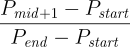
– the conditional probability of landing in the left half –
and recurses twice: the left half gets g pushed onto its
prefix, the right half gets NOT g. At a leaf
( ), the
 mulinput gate is
rewritten into the AND of the accumulated prefix, so its truth
value becomes the conjunction of the fresh-variable decisions
that lead to it. If the block’s probabilities do not sum to 1,
the outer call wraps the whole construction in one more fresh
input of probability  to carry the “none of them”
residual.
to carry the “none of them”
residual.
After rewriting, the block’s mulinput gates have been turned
into ordinary AND gates over fresh independent Boolean
inputs, and the circuit is ready for any TID-based probability
method. The dispatcher in
probability_evaluate_internal calls
BooleanCircuit::rewriteMultivaluedGates lazily: the
"independent" method handles mulinput gates natively and
runs on the raw circuit; every other method falls through to the
rewrite first. This is the pivot point referenced in
Step-by-Step: Adding a New Probability Evaluation Method below.
Note
The routes that do not go through the rewrite – the ones
that evaluate a block natively – are underwritten by
Provenance.CategoricalBlock
in the ProvSQL Lean 4 library, an independent re-proof of
weighted model counting over categorical block variables
(free Boolean variables being the two-outcome instance).
CatCircuit.dD_eventProb_eq_probDD
proves the direct-summation evaluator correct on decomposable +
deterministic categorical circuits, and
CatAssignment.singleBlock_detOR_sound
is what licenses treating a plus over the mulinput gates
of one block as a deterministic OR – the certificate mark the
certified-island sweep
(BooleanCircuit::evaluateCertifiedIsland) consumes –
together with the none-branch of a block
whose probabilities do not sum to 1.
Shapley and Banzhaf Values
ProvSQL also exposes expected Shapley values and expected
Banzhaf values, which quantify the individual contribution of
each input tuple to the truth of a provenance circuit. The
user-facing interface is described in Shapley and Banzhaf Values;
this section covers the implementation in shapley.cpp
and dDNNF.cpp.
Expected Shapley values are #P-hard in general but become polynomial-time computable when the provenance is represented as a decomposable and deterministic (d-D) Boolean circuit – essentially a d-DNNF. The algorithm ProvSQL uses is Algorithm 1 of Karmakar, Monet, Senellart, and Bressan (PODS 2024, [Karmakar et al., 2024]), specialised to the two coefficient functions that define the Shapley and Banzhaf scores. Both scores are computed in expectation: the random subset of variables is drawn according to the per-variable probabilities of the circuit, and when no probabilities have been set, each defaults to 1 and the computation collapses to the standard deterministic Shapley / Banzhaf value.
Entry Point
shapley / banzhaf (and their set-returning
variants shapley_all_vars /
banzhaf_all_vars) are thin wrappers that unpack their
arguments and call shapley_internal in
shapley.cpp. That helper performs the following
sequence:
Build a
BooleanCircuitfrom the persistent store viagetBooleanCircuit.Build a
dDNNF: the default (empty method,defaultorauto) cost-selects the construction route viaprovsql::makeDDAuto(see the makeDDautosection above); a named method goes throughBooleanCircuit::makeDDwith the usualmethod/argsconventions.dDNNF::makeSmooth– ensure that every OR gate’s children mention the same variable set. The paper’s algorithm assumes a smooth d-DNNF.For Shapley (but not Banzhaf):
dDNNF::makeGatesBinaryon AND – binarise AND gates so each has at most two children. Together, the previous two steps turn the d-DNNF into a tight d-D circuit in the paper’s sense.Call
dDNNF::shapleyordDNNF::banzhafon the target variable’s gate.
The Shapley Recurrence
The paper’s algorithm conditions the circuit on the target
variable being fixed to true (call the result  )
and to
)
and to false (call it  ), computes a pair of
per-gate arrays on each conditioned circuit, and combines them
into the final score. ProvSQL’s
), computes a pair of
per-gate arrays on each conditioned circuit, and combines them
into the final score. ProvSQL’s dDNNF::shapley
mirrors that structure:
double dDNNF::shapley(gate_t var) const {
  auto cond_pos = condition(var, true);   // C_1
  auto cond_neg = condition(var, false);  // C_0

  auto alpha_pos = cond_pos.shapley_alpha();
  auto alpha_neg = cond_neg.shapley_alpha();

  double result = 0.;
  for (size_t k = ...; k < alpha_pos.size(); ++k)
    for (size_t l = 0; l <= k; ++l) {
      double pos = alpha_pos[k][l];
      double neg = alpha_neg[k][l];
      result += (pos - neg) / comb(k, l) / (k + 1);
    }
  result *= getProb(var);
  return result;
}
dDNNF::condition returns a copy of the circuit in which
the target input gate has been replaced by an AND /
OR-with-no-children acting as the constant true /
false respectively. The private helper
dDNNF::shapley_alpha then performs a single bottom-up pass
computing a two-dimensional array
 (called
 result[g] in the code) at
every gate  , where is the number of variables
under in the current cofactor and
, where is the number of variables
under in the current cofactor and  is the
number of them that are positively assigned. The recurrences
follow the
is the
number of them that are positively assigned. The recurrences
follow the IN / NOT / OR / AND cases of
Algorithm 1 of the paper:
At a leaf, the array encodes the Bernoulli distribution of that single variable.
At an OR gate, the arrays of the children are summed coordinatewise (valid because the d-DNNF is smooth, so all children have the same variable set).
At a binary AND gate, the arrays are convolved via a double sum over
 pairs – the decomposability of
AND makes this the Cauchy product of two independent
distributions. This convolution is the reason AND gates have
to be binarised before the algorithm runs.
pairs – the decomposability of
AND makes this the Cauchy product of two independent
distributions. This convolution is the reason AND gates have
to be binarised before the algorithm runs.A standalone bottom-up pass (
dDNNF::shapley_delta) precomputes the polynomials, which the algorithm uses at
 NOTgates to turn negation into a coefficient flip.
The final score is
 ,
where
,
where  comes from and
 from , and
 is the Shapley coefficient –
i.e.exactly the formula implemented above. The overall
complexity is
is the Shapley coefficient –
i.e.exactly the formula implemented above. The overall
complexity is 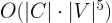 arithmetic operations,
dominated by the double-sum convolution at AND gates over the
arithmetic operations,
dominated by the double-sum convolution at AND gates over the
 -sized arrays.
The if (isProbabilistic()) guards inside
dDNNF::shapley_alpha and dDNNF::shapley_delta
short-circuit the polynomials to a single
top-level coefficient when all input probabilities are 1, so that
the same code path computes classical (deterministic) Shapley
values without paying the expected-score overhead.
Banzhaf
The expected Banzhaf value admits a much simpler formula [Karmakar et al., 2024]:

where  can be computed in a single
linear pass over a smooth d-D circuit without binarising AND
gates.
can be computed in a single
linear pass over a smooth d-D circuit without binarising AND
gates. dDNNF::banzhaf runs
dDNNF::banzhaf_internal on
the two conditioned circuits and and
returns the difference times  ; the overall
complexity is
; the overall
complexity is 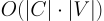 , one factor of
  less than Shapley. This is why
 shapley_internal skips
the dDNNF::makeGatesBinary call in the Banzhaf branch.
Hybrid Evaluation for Continuous Distributions
When the circuit being evaluated contains continuous gates
(gate_rv, gate_arith, gate_mixture, gate_case),
a hybrid evaluator runs before the Boolean dispatch above. Its
job is to fold every sub-circuit that has a closed-form analytical
answer into a Bernoulli leaf so the resulting circuit is a normal
Boolean circuit ready for any of the Boolean methods.
The hybrid evaluator has three passes:
Peephole pruning (
runRangeCheck): support intervals propagate throughgate_arith, everygate_cmpis tested against the propagated interval, and every comparator decidable from the support alone collapses to a Bernoulligate_inputwith probability0or1.Family-closure simplifier (
runHybridSimplifier): registry-driven family folds – linear combinations of independent normals into a single normal, same-rate Exponential / Erlang / Gamma sums, lognormal products,exp/lntransform images (exp(Normal) → Lognormal) – plus identity / single-child arith gates and semiring-identity collapses.Island decomposition (
runHybridDecomposer): the remaining cmps are partitioned by base-RV footprints into islands; single-cmp islands marginalise viarunAnalyticEvaluator’s closed-form CDF; multi-cmp islands with shared base RVs go through the joint table. The monotone-shared-scalar arm of the joint table is analytical (CDF intervals) for a baregate_rvscalar, so it runs even atprovsql.rv_mc_samples = 0– keeping a correlated conjunction / conditioning likeprobability((x ≥ 2000) | (x ≥ 1000))exact instead of collapsing to the product of the marginals; a correlated island that genuinely needs MC raises at0rather than falling back to that product.
See Continuous Distributions for the full simplifier rule set and the island-decomposition algorithm.
Conditional Evaluation
expected / variance / moment /
central_moment / support / rv_sample /
rv_histogram all accept an optional prov uuid argument
that conditions the moment, sample, or histogram on the provenance
event prov. When prov resolves to anything other than
gate_one, evaluation routes through the joint-circuit
loader getJointCircuit (MMappedCircuit.cpp),
which performs a multi-rooted BFS over the union of the reachable
gates from both input and prov so shared gate_rv
leaves between the two are loaded into a single
GenericCircuit and consequently couple correctly in the
Monte Carlo sampler’s rv_cache_. Closed-form truncated moments
(Distribution::truncatedRawMoment) are implemented by the
Normal (Mills ratio), Uniform (intersected support), Exponential
(memorylessness), Log-normal, Weibull, Pareto, and Beta families;
Erlang / Gamma and composite shapes fall back to MC rejection
sampling at provsql.rv_mc_samples budget. See
Continuous Distributions for depth.
The Inversion-Free UCQ(OBDD) Path
The 'inversion-free' method (and the default-chain rung that follows
independent) evaluates the inversion-free class of Jha and
Suciu [Jha and Suciu, 2011]: hierarchical, tuple-independent
UCQs – including self-joins and set-semantics UNIONs (the union of
conjunctive queries the class is named for) – whose lineage admits a
polynomial-size OBDD. On these the generic 'tree-decomposition' / compilation
fallbacks can blow up (the lineage is not low-treewidth), yet a
structured d-DNNF built over a query-derived variable order stays
linear in the lineage.
This path is a sibling of the Safe-Query Rewriter, and the two are complementary:
The safe-query rewriter (provenance class
'boolean') restructures the query so the planner emits a read-once circuit, whichindependentthen evaluates almost for free. It applies only to the read-once (safe) class and changes the produced circuit.The inversion-free path leaves the lineage intact and evaluates the naive circuit – which, even for a safe query, is generally not read-once (e.g.
q(x) :- B(x), A(x,y)yields⋁_y (B(x) ∧ A(x,y)), repeatingB(x)), soindependentrejects it. It also covers the strictly larger inversion-free-but-not-read-once self-join class. It is decoupled fromboolean_provenanceand gated on its own GUC,provsql.inversion_free(on by default).
The pipeline has four stages.
- Detection (
src/safe_query.c) detect_inversion_freechecks the four preconditions (hierarchical, strictly tuple-independent atoms, positional consistency, acyclic precedence) and, on success, builds aSafeCertrecipe describing the query-derived (Prop. 4.5) variable order. It reuses the candidate gate and union-find machinery of the safe-query rewriter but is not gated onboolean_provenance:process_queryruns it on the lineage query wheneverprovsql.inversion_freeis on, after (and only when) the read-once rewrite did not already fire.A non-tracked base relation (no
provsqlcolumn and no metadata entry) is deterministic: it contributes only probability-1 tuples and anchors no provenance variable, so the detector erases it from the root, positional, precedence and marker passes while keeping its join equalities (it still filters the cross product). This mirrors the read-once path’s dissociation transparency, with the same soundness guards (a plain table, not a matview / foreign table / partitioned parent / inheritance child), and only enlarges the certified class.- Flattening pre-pass (
src/provsql.c) build_inversion_free_ctxruns the detector on a flattened copy of the lineage query so that SPJ subqueries and views are recognised.flatten_spj_subqueriesinlines every non-lateral SPJ subquery slot (no aggregation, grouping,DISTINCT, set operation, sublink, CTE orLIMIT; flatRangeTblRefFROMover base relations; target list all plain baseVars) into its base atoms – substituting the parent’s column references, pulling the subqueryWHEREup and rebuilding a flatFROM– and recurses, so a view-over-view or nested derived table collapses to base atoms first. A view referenced k times inlines to k copies of its base atoms: a structured self-join the inversion-free path handles natively. On PostgreSQL 18 the syntheticRTE_GROUPof aGROUP BYquery is stripped from the copy first. The original query is left intact; only transparent markers and a root certificate are added.- Set-semantics
UNION– joint UCQ analysis (src/provsql.c) Inversion-freeness of a
UNIONis a joint property of the whole UCQ (a relation shared between two branches can introduce a cross-branch inversion), so a per-arm analysis does not suffice. A deduplicatingUNIONis lowered (byrewrite_non_all_into_external_group_by) to an outerGROUP BYover an innerUNION ALLwhose per-group root is theprovenance_plusOR of the branch tokens;build_inversion_free_union_ctxcertifies it by building a synthetic merged SPJ query of every arm’s base atoms – arm variables offset into one range table, the arms’ head columns equated, each arm’sWHEREpulled up – and runninginversion_free_analyzeon it. A relation shared between arms thereby becomes one relation symbol, so positional consistency and the precedence graph span the whole union – exactly Theorem 4.2’s joint condition – making overlapping UCQs such asq(x) :- R(x),S(x) ∪ R(x),T(x)(lineageR(x) ∧ (S(x) ∨ T(x))) tractable where a per-arm analysis, blind to the sharedR, could not. The per-atom markers map back to each arm (base relations keep positions1..nᵢ; PG 18’s group RTE is appended last and stripped) and the recipe lands on the plus root; no multi-branch certificate is needed because the order comes from the per-input keys. It fires only on a pure deduplicating-group root over already-loweredUNION ALLarms that are flat base-relation SPJs;HAVING/ aggregate unions, a nested not-yet-lowered non-ALLUNION, non-Varhead columns, and non-inversion-free unions all decline to the generic / joint-width / Möbius chain. A top-levelUNION ALLis instead certified arm by arm (each output row carries a single branch CQ): its arms inherittop_levelso each certifies its own root.- Certificate and per-input markers (
src/safe_query_cert.{h,c}) The recipe and the order are carried into the circuit on transparent
gate_annotationgates (see Architecture Overview). Transparent means every consumer sees through them: evaluators treat them as identity, and consumers keyed to gate identity –set_prob,create_provenance_mapping, the reachability edge classifier – peel them first (strip_annotationsis the peeling helper, the dual ofannotate):the serialised
SafeCertis stamped on the per-row root as aC-prefixedextrapayload;each certified atom’s input is wrapped (via
annotate) in an annotation carrying aK-prefixed order key(root, sec, factor)(SafeCertKey), emitted by the planner (build_inversion_free_markerinsrc/provsql.c) via theinversion_free_keySQL function. An atom binding only the head class is root-only (no secondary column); a relation whose occurrences span two or more secondary classes is the shared self-join guard (factor = SAFE_CERT_GUARD_FACTOR).The
rootandsecclass values are carried as length-prefixed value text (the column type’s I/O output), so the key works for any scalar key column –text(including spaces / colons),uuid,date,numeric… – not just integers. The builder uses them only for grouping (equal text ⇒ same block / tile) and a consistent total order, both of which any injective type rendering satisfies.
For a view inlined by the flattening pre-pass the markers wrap the base inputs inside the subquery, threaded down through the recursive rewrite by a per-query
InvFreeMarkerCtxcontext tree (the certificate stays on the parent’s per-row root).Both markers are inert at evaluation: the annotation gate is identity for every evaluator, so a query carrying them evaluates identically whether or not the analysis ran.
Neither is built for a query whose rows are products of distinct inputs – nothing merges or subtracts rows at any level, and no relation occurs twice (
rows_are_products_of_distinct_inputs):'independent', which precedes'inversion-free'in the default chain, always applies to such rows, and the markers cost one gate and one key per input per output row at query time.- Structured d-DNNF builder (
src/StructuredDNNF.{h,cpp}) StructuredDNNFBuildercompiles the monotone lineage top-down into a ProvSQLdDNNF: it expands the circuit to a canonical DNF and recurses with decomposable AND at independence points (variable-disjoint factors) and deterministic OR at Shannon decisions on the supplied variable order, threading a false-sink through OR-chains and sharing equal sub-d-DNNFs through a component cache. The order affects only the d-DNNF size, never correctness, so the builder is sound on any monotone lineage; the Prop. 4.5 order is what keeps it polynomial on the certified class. Multivalued (BID) andNOTgates are out of scope and rejected with aCircuitException.- Dispatch (
src/probability_evaluate.cpp) collect_inversion_free_keyswalks the circuit for theK-marker annotations and maps each wrapped input to itsInputKey;inversion_free_rankflattens those keys into a total rank (root value, then secondary value, then guard-before-payload, then factor) for the order-only builder. The explicit'inversion-free'method requires the certificate and errors without it; the default chain takes this rung only when a certificate is present andprovsql.inversion_freeis on, afterindependentand before tree-decomposition, catchingCircuitExceptionto fall through.
Shapes the analysis does not model cause detection to decline (no
certificate): a BID/gate_mulinput atom, a subquery the flattening
pre-pass cannot inline (an aggregating view, a correlated or LATERAL
subquery, or a UNION outside the certifiable group-over-UNION ALL
shape), or a flattened conjunction that is genuinely non-hierarchical (the
H-query R(x),S(x,y),T(y)). A malformed C-prefixed payload fails to
parse and is treated as an inert annotation. In every case evaluation falls
back to the normal chain and stays correct. These declines – and the
positive cases (self-joins, non-integer key columns, deterministic-relation
filters, single- and multi-relation SPJ views, views-over-views, and
set-semantics UNIONs including overlapping ones) – are covered by
test/sql/safe_query_inversion_free.sql.
The Safe-UCQ Möbius Compiler
mobius_evaluate.cpp compiles a UCQ plus its gathered TID facts
into a circuit whose root is a gate_mobius – a signed linear
combination over certified-independent Boolean islands – which the
mobius method above evaluates in one linear sweep. The compiler is
the extensional lattice walk of Dalvi, Schnaitter & Suciu (PODS 2010);
this section describes its pipeline, and in particular what licenses
each independence claim, since a wrong accept would silently return a
wrong probability.
- Normalization (ranking and shattering)
normalizeShardsruns the two rewrites the dichotomy proof puts before its lifted recursion, as a single shard split. A relation is split when any of its atoms carries a non-trivial pattern – a constant (left by a per-answer head pin) or a repeated variable – into one shard symbol per signature of its tuples: the equality pattern of the positions (ranking, Def. 4.1, at mostBell(k)classes for arityk) plus the query constant each block is pinned to (shattering, Prop. 2.10). Every atom is expanded into the disjunction of the shards it can match, applying the variable unifications and constant bindings each shard forces; a disjunct therefore becomes the product of its atoms’ compatible shards, and dead combinations (a shard’s free block bound to a constant, two distinct blocks collapsed onto one term) are dropped. Because the expansion can leave a constant on an atom of a relation that was not split, the pass iterates to a fixpoint. What comes out is in reduced form – pinned and duplicated positions are projected away, so every shard atom has distinct variables and no constants – and the shards of a relation partition its tuples, which is what makes disjoint symbols mean disjoint tuples again. The pass is an identity on a sentence whose atoms are all distinct-variable (every query the array decoder builds), so the common path pays only the scan that decides so.- Independence certificates
Three rules build independent gates, each with its own certificate:
independent union and independent product: the sub-sentences are combined only when their fact footprints are disjoint. A footprint records, per atom, its relation and its position → constant pins; two are disjoint when every pair of patterns over one relation pins a common position to two different constants (or the relations differ). Sound, deliberately not complete.
independent project (the separator step): a covering unification class is accepted only when it holds exactly one variable per disjunct – the disjunct then sits under a single existential and
Q ≡ ⋁_a Q[x:=a]; two class variables in one disjunct would substitute the same constant for both, a strictly stronger query – and occupies exactly one position per relation, so the piece for constantareads only tuples carryingathere and the pieces are pairwise disjoint.
At the leaves, a ground disjunct is the AND of its tuple tokens, deduplicated first: a self-join can send two atoms onto one tuple, where
x ∧ x = xis meant rather than an independent product. Distinct tuples are independent by the TID restrictions enforced at gather time (one token per element tuple, no token shared by two fact slots).- Self-joins that survive
Two components over one shard symbol are genuinely correlated. The compiler neither multiplies them nor declines: it falls through to the Möbius step, whose CNF for a single conjunction is the unit clauses of its components, so the signed enumeration computes
P(c1) + P(c2) − P(c1 ∨ c2)– the disjunctive detour of Example 3.1, and the reason UCQ rather than CQ is the natural class here. A sentence whose CNF collapses to one clause is recompiled as that clause when it is strictly simpler, and declines otherwise. Shapes carrying an inversion (S(x,y),S(y,x),R(x,y),R(y,z)) fail every rule and decline.- Caps
provsql.mobius_max_gatesbounds the data cost (gates built),provsql.mobius_max_cnfthe query cost (CNF conjuncts, hence the2^Mlattice); the transversal enumeration and the shard expansion have their own internal bounds. Every cap raisesMobiusDecline, caught at the SQL boundary, so the query falls back to the ordinary provenance.
Whatever the top rule was, compileTop roots the result in a
gate_mobius – a thin coefficient-1 selector when the top did not
end in a Möbius step – carrying the literal lineage as a transparent
child. That root is both what routes the token to the Möbius evaluator
(the only one that reads nested signed combinations) and what
mobius_or_null tests to tell a success from a decline.
test/sql/mobius_safe.sql covers the reduced-form class (q9 and
the lattice statistics); test/sql/mobius_selfjoin.sql covers the
self-join class (q_J, shattering, ranking, the must-declines),
cross-checking every probability against possible-worlds on the
literal lineage of the same query rather than pinning constants.
Step-by-Step: Adding a New Probability Evaluation Method
The work is almost entirely in two files. Pick a short, descriptive
method string – it is the value the user passes to
probability_evaluate.
Declare the method on
BooleanCircuit.h:double myMethod(gate_t g, const std::string &args) const;
Implement it in
BooleanCircuit.cpp. The method receives the root gate and the user-suppliedargsstring (may be empty) and must return a probability in![[0, 1]](../_images/math/3d075831ac3d404fd5808ee4d7b0b1091805368a.svg) . Check
. Check
provsql_interruptedperiodically if the computation is long so that the user can cancel withCtrl-C:double BooleanCircuit::myMethod(gate_t g, const std::string &args) const { // Parse args if needed. // Run the algorithm, respecting provsql_interrupted. // Return the probability. }
Register the method in the catalog: subclass
ProbabilityMethod(interface inProbabilityMethod.h) inprobability_evaluate.cppnext toMonteCarloMethodand friends, overridingname(),evaluate(),guaranteeKind()and the cost model, and add aregisterMethod(std::make_unique<MyMethod>())line to the one-time registration block. Three optional overrides matter:handlesMultivalued(): returntrueonly if the algorithm readsgate_mulinputblocks natively (likeindependent); otherwise the dispatcher rewrites multivalued gates to Boolean before calling you (see Block-Independent Databases and Multivalued Inputs).applicable(): structural preconditions (e.g.mobiusrequires agate_mobiusroot); keeps the method out of the chooser where it cannot run.producesDD()/buildDD(): implement these if the method constructs a d-DNNF, so the makeDDautoroute (Shapley / Banzhaf) can select it too.
(Optional) Join the default chain by overriding
inDefaultChain()andestimatedCost(): the chooser is a uniform-cost search over the registered methods’ estimates, so a well-calibrated cost model is what ranks the method – there is no hand-kept fallback order to edit.Add a regression test under
test/sql/and register it intest/schedule.common. Follow the skip-if-missing pattern from the other external-tool tests (see Testing) if the new method depends on an external binary.Update the user documentation in Probabilities and add a row for the new method to the “Currently supported methods” table above.