 |
ProvSQL C/C++ API
Adding support for provenance and uncertainty management to PostgreSQL databases
|
|
ProvSQL C/C++ API
Adding support for provenance and uncertainty management to PostgreSQL databases
|
Boolean circuit for provenance formula evaluation. More...
#include "BooleanCircuit.h"
Classes | |
| struct | CNFInputMapping |
| One row of the Tseytin variable mapping. More... | |
Public Member Functions | |
| bool | isDNNFCertified (gate_t g) const |
Is gate g certified by the d-DNNF per-gate marking? | |
| BooleanCircuit () | |
| Construct an empty Boolean circuit. | |
| virtual | ~BooleanCircuit () |
| gate_t | addGate () override |
| Allocate a new gate with a default-initialised type. | |
| gate_t | setGate (BooleanGate type) override |
Allocate a new gate with type type and no UUID. | |
| gate_t | setGate (const uuid &u, BooleanGate type) override |
Create or update the gate associated with UUID u. | |
| gate_t | setGate (BooleanGate t, double p) |
| Create a new gate with a probability annotation. | |
| gate_t | setGate (const uuid &u, BooleanGate t, double p) |
| Create (or update) a gate with a UUID and probability. | |
| const std::set< gate_t > & | getInputs () const |
| Return the set of input (IN) gate IDs. | |
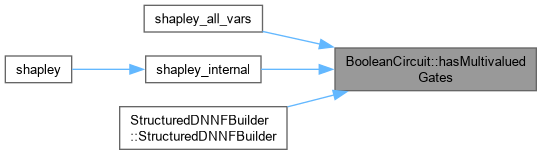
| bool | hasMultivaluedGates () const |
Return true if the circuit contains any MULIN gates. | |
| void | setProb (gate_t g, double p) |
Set the probability for gate g and mark the circuit as probabilistic. | |
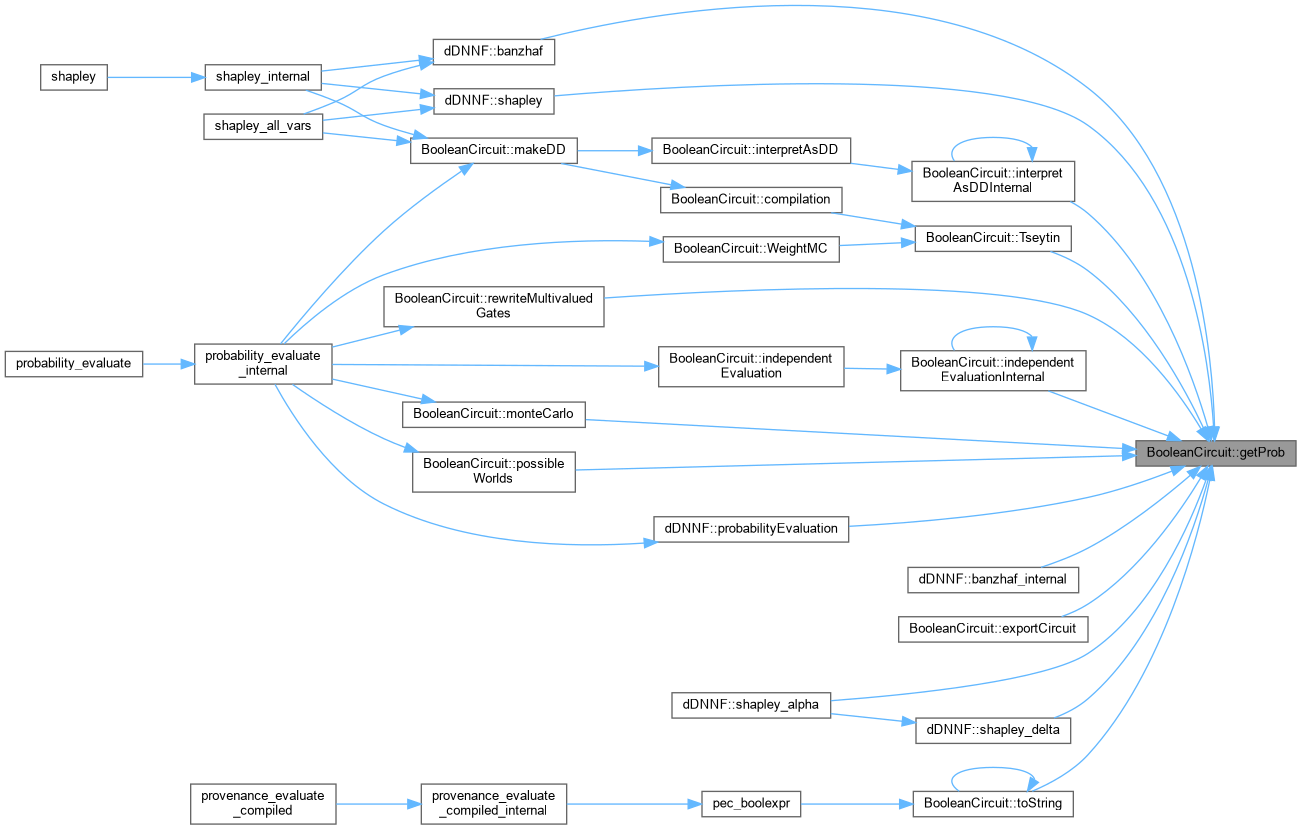
| double | getProb (gate_t g) const |
Return the probability stored for gate g. | |
| bool | isProbabilistic () const |
Return true if any gate has a non-trivial (< 1) probability. | |
| void | setInfo (gate_t g, unsigned info) |
Store an integer annotation on gate g. | |
| unsigned | getInfo (gate_t g) const |
Return the integer annotation for gate g. | |
| double | possibleWorlds (gate_t g) const |
| Compute the probability by exact enumeration of all possible worlds. | |
| dDNNF | compilation (gate_t g, std::string compiler, std::string *resolved=nullptr) const |
Compile the sub-circuit rooted at g to a dDNNF via an external tool. | |
| dDNNF | parseDDNNF (std::istream &in, const std::vector< gate_t > &inputOrder) const |
Parse a c2d/d4 NNF stream into a dDNNF over this circuit's input gates. | |
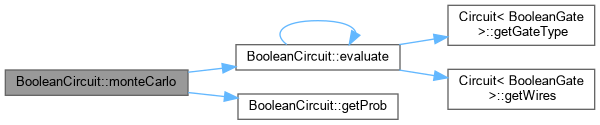
| double | monteCarlo (gate_t g, unsigned samples) const |
| Estimate the probability via Monte Carlo sampling. | |
| bool | dnfShape (gate_t g, std::vector< gate_t > &clauses, std::vector< std::set< gate_t > > &supports) const |
| Detect the DNF shape the Karp-Luby FPRAS requires. | |
| bool | dnfShapeInfo (gate_t g, std::size_t &num_clauses) const |
| Cheap shape test: is the circuit DNF-shaped, and how many clauses? | |
| double | karpLuby (const std::vector< gate_t > &clauses, const std::vector< std::set< gate_t > > &supports, unsigned long samples) const |
| Karp-Luby FPRAS estimate of a DNF-shaped circuit's probability (fixed sample budget, stratified). | |
| double | sieve (const std::vector< gate_t > &clauses, const std::vector< std::set< gate_t > > &supports) const |
| Exact probability of a monotone DNF by inclusion-exclusion (sieve). | |
| void | dnfBounds (const std::vector< std::set< gate_t > > &clauses, double &lower, double &upper) const |
Cheap certified probability interval | |
| double | karpLubyStopping (const std::vector< gate_t > &clauses, const std::vector< std::set< gate_t > > &supports, double eps, double delta, unsigned long max_samples, unsigned long &samples_used, bool &reached_target) const |
Karp-Luby FPRAS with the self-adjusting stopping rule (adaptive sample count for a relative | |
| double | wmcCount (gate_t g, const std::string &tool, const std::string &opt) const |
| Weighted model counting through a registered external counter. | |
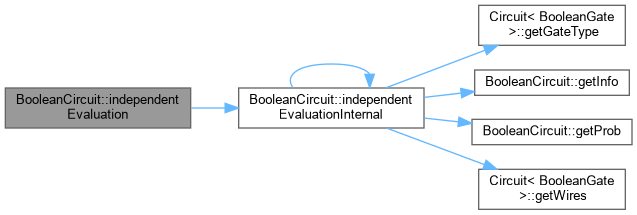
| double | independentEvaluation (gate_t g) const |
| Compute the probability exactly when inputs are independent. | |
| void | rewriteMultivaluedGates () |
| Rewrite all MULVAR/MULIN gate clusters into standard AND/OR/NOT circuits. | |
| dDNNF | interpretAsDD (gate_t g) const |
Build a dDNNF directly from the Boolean circuit's structure. | |
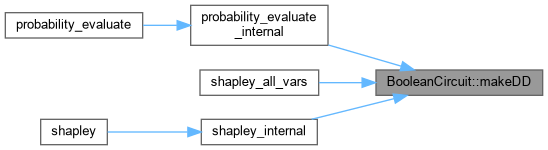
| dDNNF | makeDD (gate_t g, const std::string &method, const std::string &args) const |
| Dispatch to the appropriate d-DNNF construction method. | |
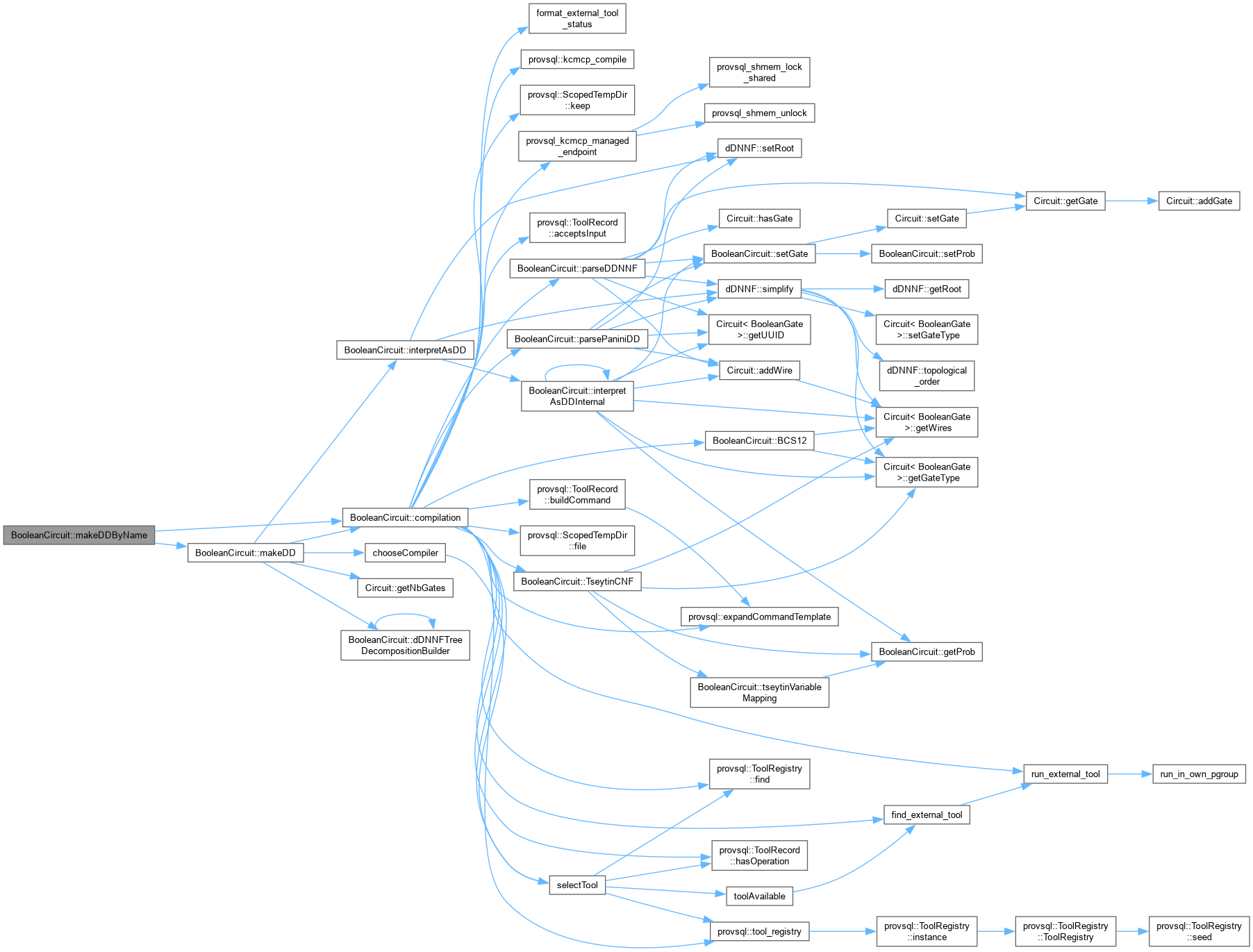
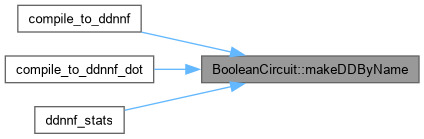
| dDNNF | makeDDByName (gate_t g, const std::string &name) const |
Build a dDNNF from a single compiler/route name. | |
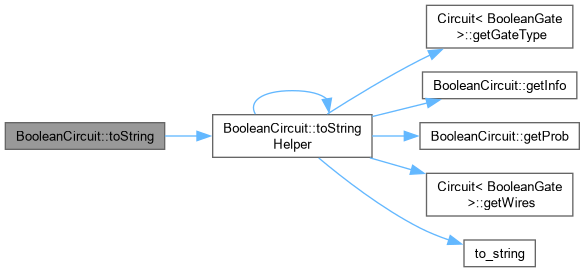
| virtual std::string | toString (gate_t g) const override |
Return a textual description of gate g for debugging. | |
| std::string | toString (gate_t g, const std::unordered_map< gate_t, std::string > &labels) const |
Render the sub-circuit at g, labelling input gates from a map. | |
| std::string | exportCircuit (gate_t g) const |
| Export the circuit in the textual format expected by external compilers. | |
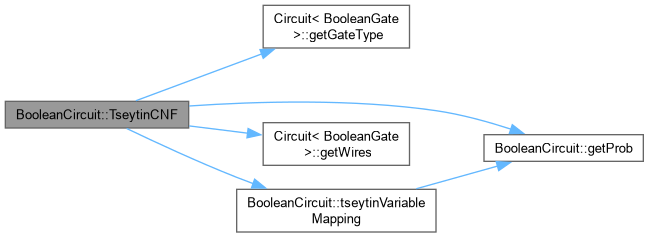
| std::string | TseytinCNF (gate_t g, bool display_prob, bool mapping=false) const |
Return the Tseytin transformation of the sub-circuit at g as a DIMACS string. | |
| std::vector< CNFInputMapping > | tseytinVariableMapping () const |
| Map each input gate to its DIMACS variable, UUID, probability. | |
| std::string | BCS12 (gate_t g, std::vector< gate_t > &inputOrder) const |
Serialise the sub-circuit at g in d4's BC-S1.2 circuit format. | |
| dDNNF | parsePaniniDD (const std::string &outfilename) const |
| Parse a Panini (KCBox) DD output file into a ProvSQL d-DNNF. | |
| template<class Archive> | |
| void | serialize (Archive &ar, const unsigned int version) |
| Boost serialisation support. | |
| Public Member Functions inherited from Circuit< BooleanGate > | |
| virtual | ~Circuit () |
| std::vector< gate_t >::size_type | getNbGates () const |
| Return the total number of gates in the circuit. | |
| gate_t | getGate (const uuid &u) |
Return (or create) the gate associated with UUID u. | |
| uuid | getUUID (gate_t g) const |
Return the UUID string associated with gate g. | |
| BooleanGate | getGateType (gate_t g) const |
Return the type of gate g. | |
| std::vector< gate_t > & | getWires (gate_t g) |
Return a mutable reference to the child-wire list of gate g. | |
| virtual gate_t | setGate (const uuid &u, BooleanGate type) |
Create or update the gate associated with UUID u. | |
| bool | hasGate (const uuid &u) const |
Test whether a gate with UUID u exists. | |
| void | addWire (gate_t f, gate_t t) |
Add a directed wire from gate f (parent) to gate t (child). | |
Protected Attributes | |
| std::set< gate_t > | inputs |
| Set of IN (input) gate IDs. | |
| std::set< gate_t > | mulinputs |
| Set of MULVAR gate IDs. | |
| std::vector< double > | prob |
| Per-gate probability (for IN gates). | |
| std::map< gate_t, unsigned > | info |
| Per-gate integer info (for MULIN gates). | |
| bool | probabilistic =false |
true if any gate has a non-unit probability | |
| Protected Attributes inherited from Circuit< BooleanGate > | |
| std::unordered_map< uuid, gate_t > | uuid2id |
| UUID string → gate index. | |
| std::unordered_map< gate_t, uuid > | id2uuid |
| Gate index → UUID string. | |
| std::vector< BooleanGate > | gates |
| Gate type for each gate. | |
| std::vector< std::vector< gate_t > > | wires |
| Child wire lists for each gate. | |
Private Member Functions | |
| bool | evaluate (gate_t g, const std::unordered_set< gate_t > &sampled) const |
Evaluate the sub-circuit at g on one sampled world. | |
| gate_t | interpretAsDDInternal (gate_t g, std::set< gate_t > &seen, dDNNF &dd) const |
Recursive helper for interpretAsDD(). | |
| gate_t | interpretCertifiedIsland (gate_t root, std::set< gate_t > &seen, dDNNF &dd) const |
Iteratively copy a certified island into dd. | |
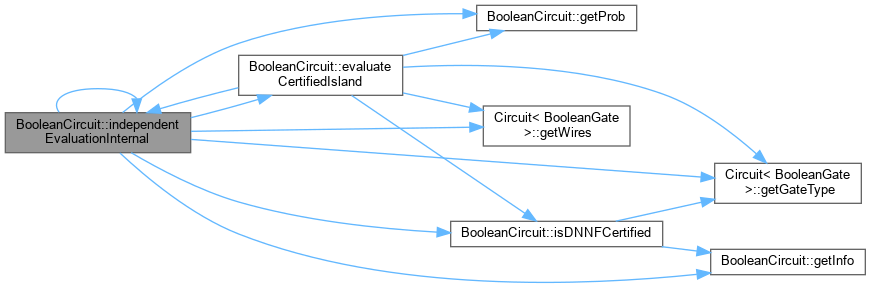
| double | independentEvaluationInternal (gate_t g, std::set< gate_t > &seen, std::unordered_map< gate_t, double > &memo) const |
Recursive helper for independentEvaluation(). | |
| double | evaluateCertifiedIsland (gate_t root, std::set< gate_t > &seen, std::unordered_map< gate_t, double > &memo) const |
| Iteratively evaluate a certified d-DNNF island. | |
| void | rewriteMultivaluedGatesRec (const std::vector< gate_t > &muls, const std::vector< double > &cumulated_probs, unsigned start, unsigned end, std::vector< gate_t > &prefix) |
Recursive helper for rewriteMultivaluedGates(). | |
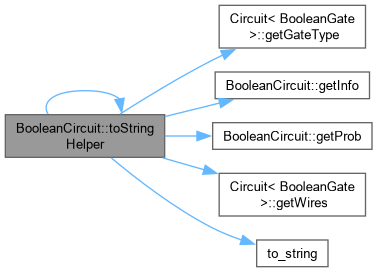
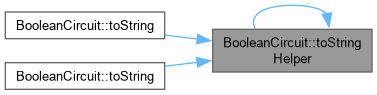
| std::string | toStringHelper (gate_t g, BooleanGate parent, const std::unordered_map< gate_t, std::string > *labels) const |
Internal recursive helper for the two toString() variants. | |
Friends | |
| class | dDNNFTreeDecompositionBuilder |
| class | boost::serialization::access |
Additional Inherited Members | |
| Public Types inherited from Circuit< BooleanGate > | |
| using | uuid |
UUID type used in this circuit (always std::string). | |
| Protected Member Functions inherited from Circuit< BooleanGate > | |
| void | setGateType (gate_t g, BooleanGate t) |
| Update the type of an existing gate. | |
Boolean circuit for provenance formula evaluation.
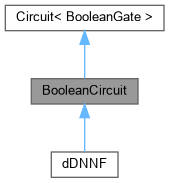
Inherits the gate/wire infrastructure from Circuit<BooleanGate> and adds probability annotation, info integers (for multivalued inputs), and a rich set of evaluation algorithms.
Definition at line 91 of file BooleanCircuit.h.
|
inline |
Construct an empty Boolean circuit.
Definition at line 225 of file BooleanCircuit.h.
|
inlinevirtual |
Definition at line 227 of file BooleanCircuit.h.
|
overridevirtual |
Allocate a new gate with a default-initialised type.
Derived classes override this to perform additional initialisation (e.g. resizing auxiliary vectors).
gate_t identifier of the newly created gate. Reimplemented from Circuit< BooleanGate >.
Definition at line 175 of file BooleanCircuit.cpp.

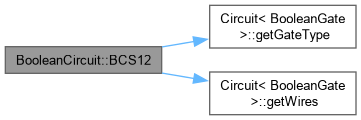
Serialise the sub-circuit at g in d4's BC-S1.2 circuit format.
Emits the Boolean circuit directly (inputs as "I" declarations, AND/OR gates as "G name := A|O …" definitions, the root as "T"), inlining NOT gates as literal sign flips. This is the input consumed by d4v2's --input-type circuit mode, letting us skip the Tseytin transform.
Inputs are emitted first, so d4 (which numbers literals from 1 in first-seen order) assigns them variables 1..k in declaration order; every variable above k is an internal-gate variable. inputOrder is filled so that d4 variable v (1-based) corresponds to input gate inputOrder[v-1], which the d-DNNF parse-back uses to map decision literals to the right IN gate.
Throws CircuitException on a gate shape BC-S1.2 cannot express (a nullary AND/OR, or a non-AND/OR/NOT/IN gate); the caller falls back to the Tseytin CNF path.
| g | Root gate of the sub-circuit. |
| inputOrder | Output: input gate for each d4 variable (1-based). |
Definition at line 975 of file BooleanCircuit.cpp.
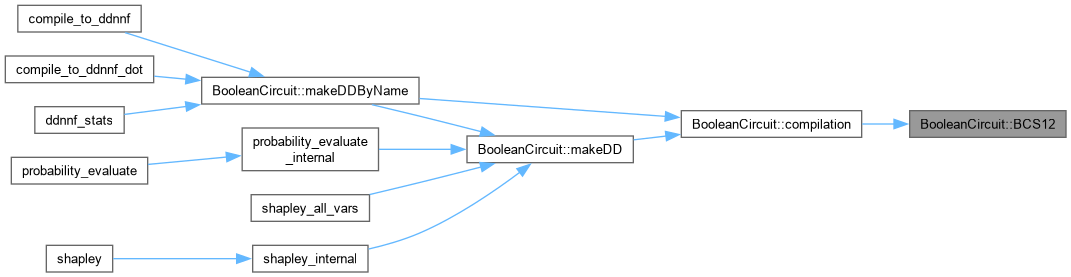
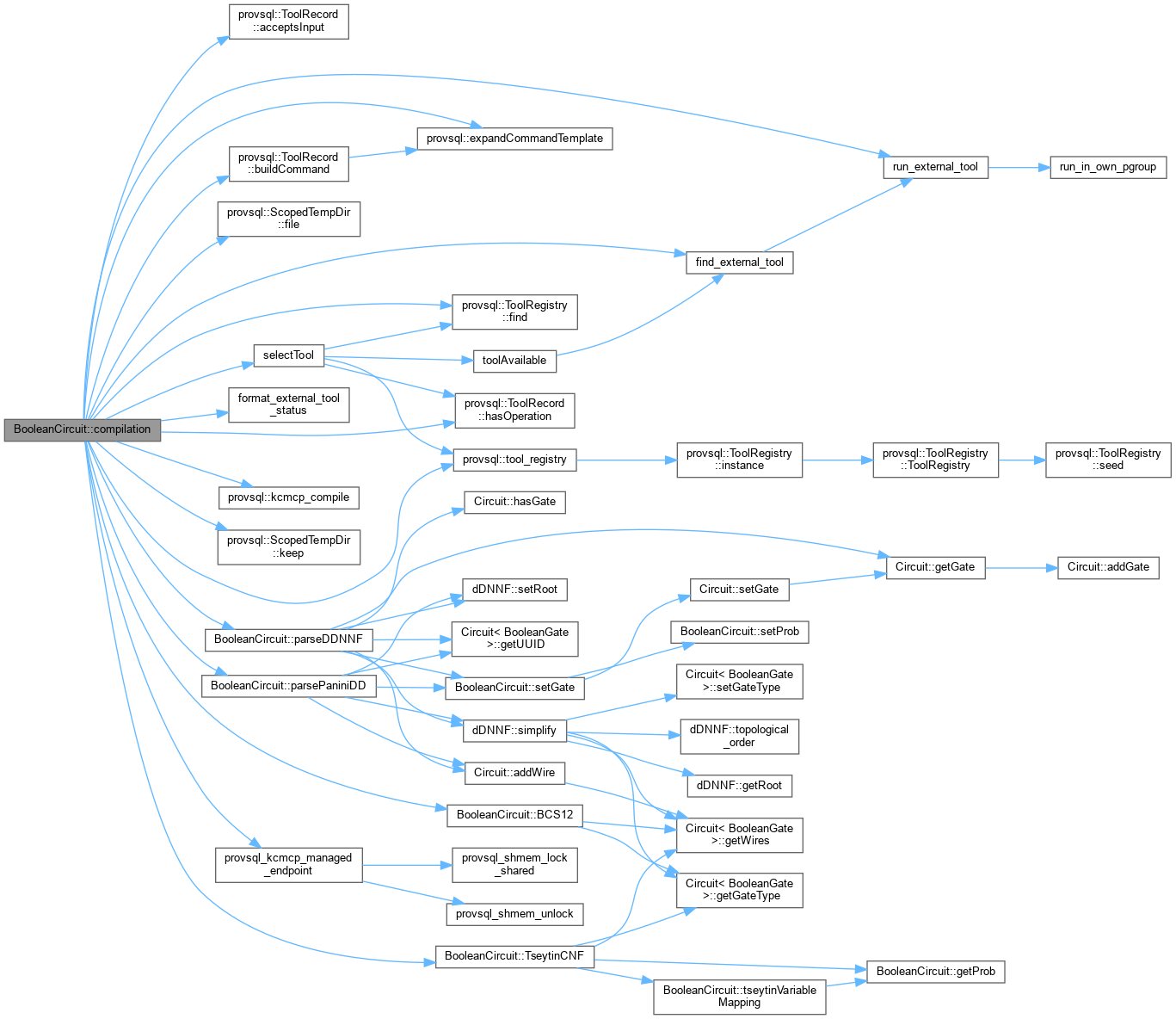
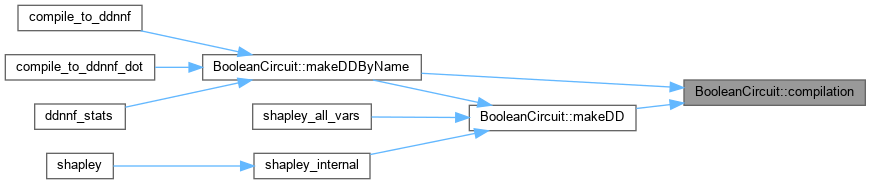
| dDNNF BooleanCircuit::compilation | ( | gate_t | g, |
| std::string | compiler, | ||
| std::string * | resolved = nullptr ) const |
Compile the sub-circuit rooted at g to a dDNNF via an external tool.
Writes the circuit in DIMACS/DNNF format, invokes compiler as a subprocess, and parses the resulting d-DNNF.
| g | Root gate. |
| compiler | Command to invoke (e.g. "d4", "c2d", "minic2d"). Empty auto-selects the highest-preference available tool. |
| resolved | If non-null, set to the tool actually used (after the empty -> auto-select resolution), so callers can report WHICH compiler ran rather than just "compilation". |
dDNNF. Definition at line 1242 of file BooleanCircuit.cpp.
| void BooleanCircuit::dnfBounds | ( | const std::vector< std::set< gate_t > > & | clauses, |
| double & | lower, | ||
| double & | upper ) const |
Cheap certified probability interval [lower,upper] of a monotone DNF, without compiling it (Olteanu-Huang-Koch d-tree leaf bound).
Implements the Independent heuristic of Olteanu, Huang & Koch, "Approximate Confidence Computation in Probabilistic Databases" (ICDE 2010, Fig. 3). The clauses are greedily partitioned into buckets of pairwise independent clauses (disjoint supports), clauses taken in descending marginal-probability order so the most probable clauses anchor the buckets. Each bucket's clauses are mutually independent, so its probability is the independent-or 1-∏(1-P(d)) with P(d)=∏_{leaf∈supports[d]} getProb(leaf). Then, since Φ is the disjunction of all buckets:
lower = max_i P(B_i): a sub-disjunction is a lower bound;upper = min(1, Σ_i P(B_i)): the union bound.Both bounds are sound for any partition (the greedy one only affects tightness), so lower ≤ Pr[Φ] ≤ upper always holds. When the clauses are mutually independent (disjoint supports) they all land in a single bucket and lower=upper=Pr[Φ], i.e. the interval collapses to the exact value. O(m^2) in the clause count m.
A monotone DNF is fully determined (for probability) by its per-clause input supports, so this takes only the supports (the set per clause returned by dnfShape, or a cofactor's residual clause set in the DTree engine); the clause root gates are not needed.
| clauses | Per-clause input-leaf supports (a monotone DNF as a set of clauses, each a set of IN leaves). |
| lower | [out] Certified lower bound on Pr[Φ]. |
| upper | [out] Certified upper bound on Pr[Φ]. |
Definition at line 754 of file BooleanCircuit.cpp.


| bool BooleanCircuit::dnfShape | ( | gate_t | g, |
| std::vector< gate_t > & | clauses, | ||
| std::vector< std::set< gate_t > > & | supports ) const |
Detect the DNF shape the Karp-Luby FPRAS requires.
Recognises the two tractable regimes: (a) a single AND-of-leaves clause, or (b) a top-level OR whose every child is an AND-only sub-circuit over IN leaves (no OR below the root, no NOT, no multivalued input). Cross-clause leaf sharing is allowed and is the normal Karp-Luby setting.
On success, clauses receives one root per top-level disjunct (or the singleton root g in regime (a)) and supports[i] the set of IN leaves reachable from clauses[i] through its AND-only stratum – the support determines Pr[C_i] (the product of leaf marginals) and the conditional sampler.
| g | Root gate. |
| clauses | Output: the top-level clause roots. |
| supports | Output: per-clause set of reachable IN leaves. |
true iff the circuit is DNF-shaped (regime (a)/(b)). Definition at line 394 of file BooleanCircuit.cpp.

| bool BooleanCircuit::dnfShapeInfo | ( | gate_t | g, |
| std::size_t & | num_clauses ) const |
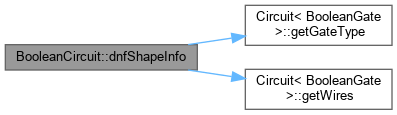
Cheap shape test: is the circuit DNF-shaped, and how many clauses?
The O(circuit) half of dnfShape – validates the OR-of-ANDs-of-leaves shape with a single global visited-set (no per-clause re-walk) and returns the clause count, WITHOUT materialising the per-clause supports (whose total size can be O(m*N)). Used by the chooser to rank sieve; the supports are built only if sieve / karp-luby actually runs (via dnfShape).
| g | Root gate. |
| num_clauses | Output: number of top-level clauses. |
true iff DNF-shaped. Definition at line 446 of file BooleanCircuit.cpp.
|
private |
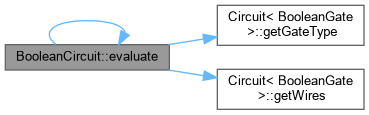
Evaluate the sub-circuit at g on one sampled world.
Each gate in sampled is treated as true; all other IN gates are false.
| g | Root gate to evaluate. |
| sampled | Set of input gates that are true in this world. |
g. Definition at line 322 of file BooleanCircuit.cpp.

|
private |
Iteratively evaluate a certified d-DNNF island.
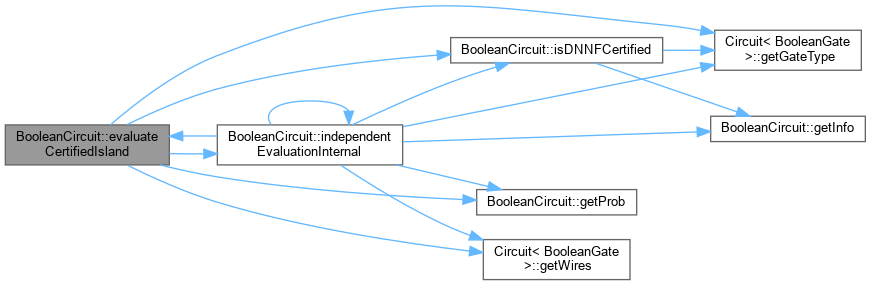
Walks the maximal region of certified AND/OR gates (plus the NOT and input gates they reach) under root with an explicit post-order stack – certified circuits can be as deep as the data (e.g. the decomposition-aligned reachability circuits of path-like graphs), so recursion would overflow the stack. Within the island every gate is computed once (sharing is licensed by the certificate): certified OR = sum (determinism), certified AND = product (decomposability), and each variable registers once in seen, so entanglement with the outside – or with another island – throws like a read-once violation. An uncertified AND/OR inside the island falls back to independentEvaluationInternal() (standard read-once rules).
| root | Certified gate the island is rooted at. |
| seen | Global variable registration shared with the uncertified region. |
| memo | Constant-only global memo (used by the uncertified fallback). |
root. Definition at line 1820 of file BooleanCircuit.cpp.

| std::string BooleanCircuit::exportCircuit | ( | gate_t | g | ) | const |
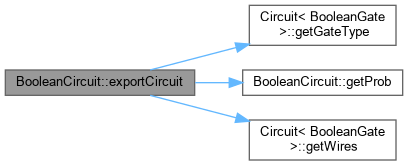
Export the circuit in the textual format expected by external compilers.
Produces a multi-line string encoding all gates reachable from the circuit in the format used by the standalone tdkc tool and external model counters.
| g | Root gate. |
Definition at line 263 of file BooleanCircuit.cpp.
| unsigned BooleanCircuit::getInfo | ( | gate_t | g | ) | const |
Return the integer annotation for gate g.
| g | Gate identifier. |
Definition at line 1923 of file BooleanCircuit.cpp.

|
inline |
Return the set of input (IN) gate IDs.
Definition at line 258 of file BooleanCircuit.h.

|
inline |
Return the probability stored for gate g.
| g | Gate identifier. |
Definition at line 292 of file BooleanCircuit.h.
|
inline |
Return true if the circuit contains any MULIN gates.
Multivalued inputs are normally rewritten into AND/OR/NOT/IN gates by rewriteMultivaluedGates() before the circuit is consumed by an evaluation method. Algorithms that cannot handle multivalued inputs directly can use this as a precondition check.
true iff at least one MULIN gate is present. Definition at line 272 of file BooleanCircuit.h.
| double BooleanCircuit::independentEvaluation | ( | gate_t | g | ) | const |
Compute the probability exactly when inputs are independent.
Applicable when the circuit has no shared input gate (i.e., each input appears at most once).
| g | Root gate. |
Definition at line 1911 of file BooleanCircuit.cpp.
|
private |
Recursive helper for independentEvaluation().
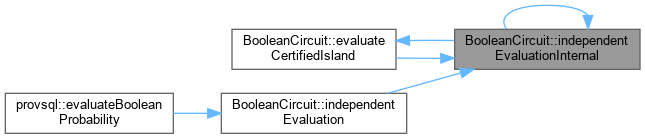
A certified (d-DNNF-marked) gate is handed to evaluateCertifiedIsland(); the recursion only walks the uncertified region.
| g | Current gate to evaluate. |
| seen | Set of variable gates (IN / MULVAR) already consumed; a second occurrence means the circuit is not read-once. |
| memo | Memoised probability of variable-free (constant-only) gates, so a shared constant subgraph is evaluated once – this is what keeps the whole evaluation O(circuit) rather than re-traversing shared subgraphs. Variable-bearing gates are never memoised (a re-visit must reach seen and throw). |
g. Definition at line 1703 of file BooleanCircuit.cpp.
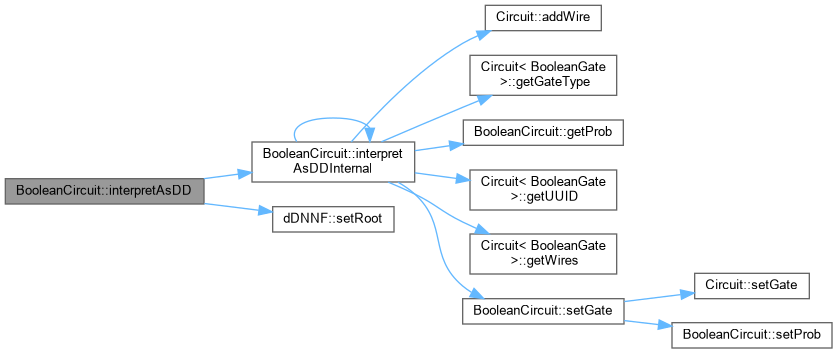
Build a dDNNF directly from the Boolean circuit's structure.
Used as a fallback when no external compiler is available and the circuit is already in a form that can be interpreted as a d-DNNF.
| g | Root gate. |
dDNNF wrapping the same structure. Definition at line 2138 of file BooleanCircuit.cpp.

|
private |
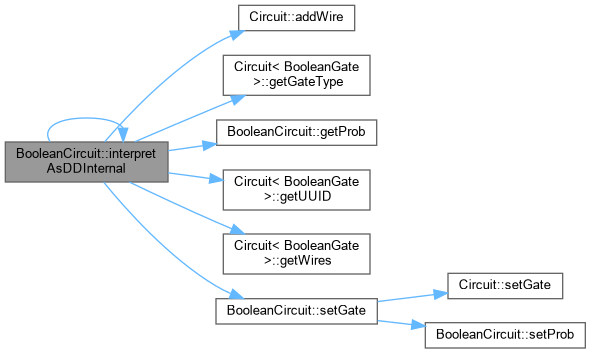
Recursive helper for interpretAsDD().
A certified (d-DNNF-marked) gate is handed to interpretCertifiedIsland(); the recursion only walks the uncertified region.
| g | Current gate to process. |
| seen | Set of variable gates already consumed (read-once check in the uncertified region; per-island registration inside certified islands). |
| dd | The d-DNNF being constructed. |
dd corresponding to g. Definition at line 2011 of file BooleanCircuit.cpp.

|
private |
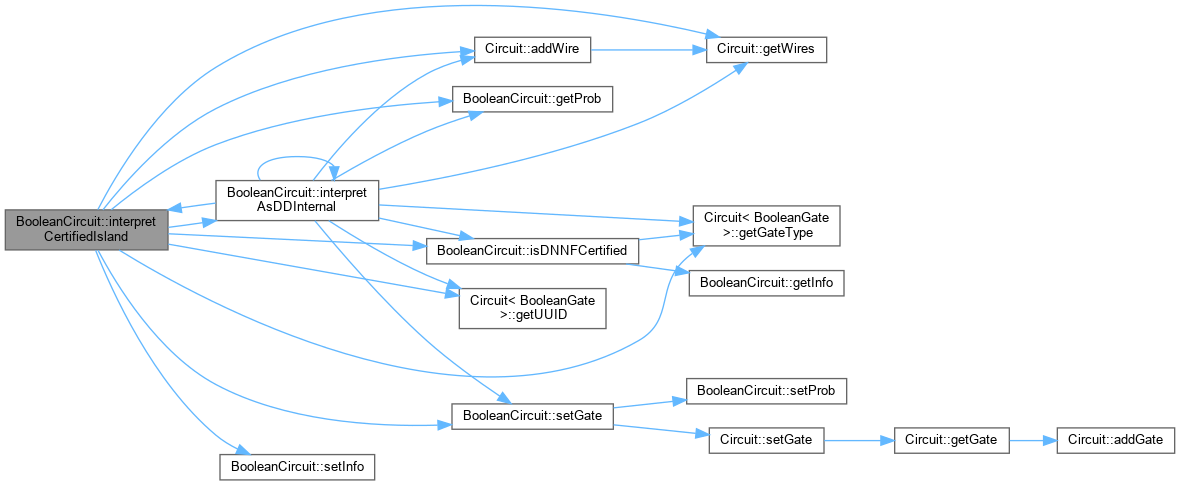
Iteratively copy a certified island into dd.
Island twin of evaluateCertifiedIsland() (same discipline, same iterative post-order): certified ORs are copied as native deterministic ORs (no De Morgan rewriting), certified ANDs as-is, shared sub-DAGs map to shared dd gates. An uncertified AND/OR inside the island falls back to interpretAsDDInternal().
| root | Certified gate the island is rooted at. |
| seen | Global variable registration (see evaluateCertifiedIsland()). |
| dd | The d-DNNF being constructed. |
dd corresponding to root. Definition at line 2074 of file BooleanCircuit.cpp.

|
inline |
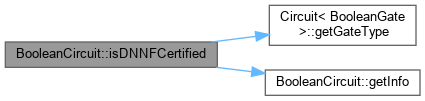
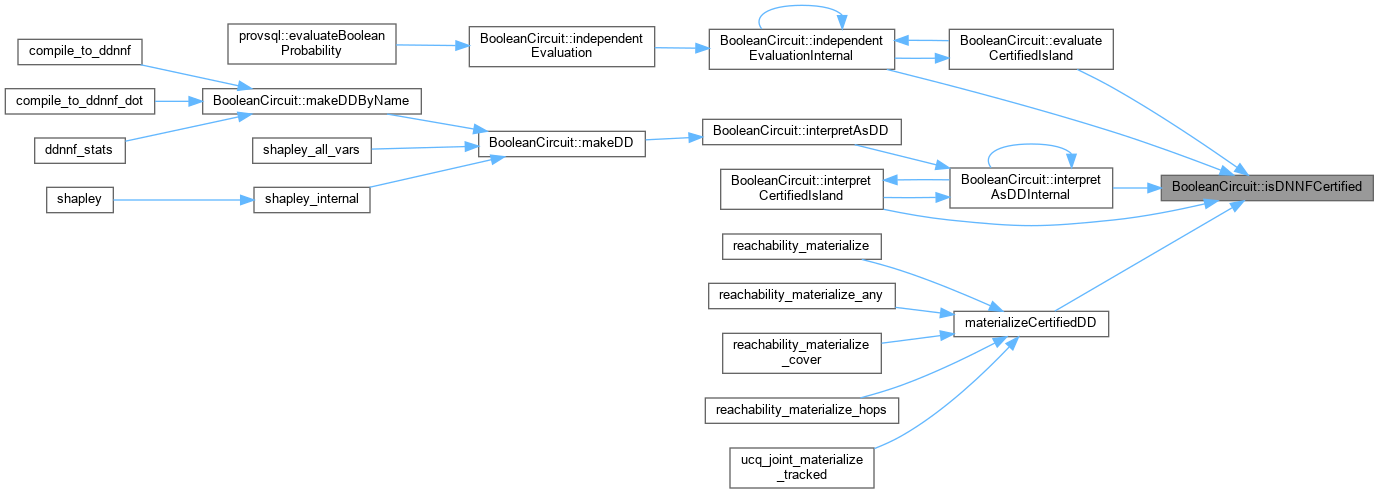
Is gate g certified by the d-DNNF per-gate marking?
true iff g is an OR marked deterministic or an AND marked decomposable (info = DNNF_CERT_INFO); see DNNF_CERT_INFO for the semantics and trust model.
| g | Gate to test. |
Definition at line 194 of file BooleanCircuit.h.
|
inline |
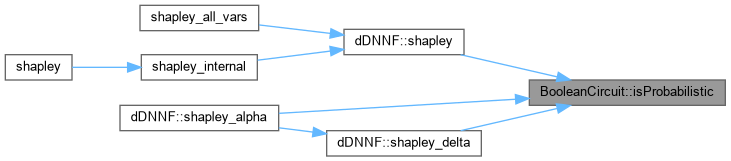
Return true if any gate has a non-trivial (< 1) probability.
true iff at least one gate has a probability strictly less than 1. Definition at line 300 of file BooleanCircuit.h.
| double BooleanCircuit::karpLuby | ( | const std::vector< gate_t > & | clauses, |
| const std::vector< std::set< gate_t > > & | supports, | ||
| unsigned long | samples ) const |
Karp-Luby FPRAS estimate of a DNF-shaped circuit's probability (fixed sample budget, stratified).
Implements the Karp-Luby coverage estimator for the DNF-counting problem (#DNF) under tuple-independent inputs: with p_i the product of the marginals of supports[i] and S the sum of the p_i (so S in [Pr[F], m*Pr[F]]), the estimator over clause i samples a satisfying assignment of C_i (its support forced true, every other leaf drawn from its marginal), finds the smallest clause index j the assignment satisfies, and accepts iff j == i; Pr[F] is then sum_i p_i times the per-clause acceptance rate. The acceptance probability is Pr[F]/S in [1/m, 1], so the sample count for an (eps,delta) guarantee is independent of Pr[F], unlike naive Monte Carlo.
The samples rounds are spread across clauses by stratified allocation (n_i proportional to p_i/S, every clause sampled at least once), estimating each clause's acceptance rate separately and combining sum_i p_i * acceptRate_i. This removes the variance of the categorical clause draw used by the textbook estimator (between-strata variance), tightening the estimate at the same budget by up to a factor m. When samples < m there are too few rounds for one per clause, so the method falls back to the unstratified categorical-draw estimator (still unbiased for any budget).
The clauses / supports are those returned by dnfShape. The mt19937_64 is seeded from provsql.monte_carlo_seed exactly as monteCarlo, so the estimate is reproducible under a pinned seed.
| clauses | Top-level clause roots (from dnfShape). |
| supports | Per-clause reachable IN leaves (from dnfShape). |
| samples | Resolved number of sampling rounds. |
Definition at line 585 of file BooleanCircuit.cpp.
| double BooleanCircuit::karpLubyStopping | ( | const std::vector< gate_t > & | clauses, |
| const std::vector< std::set< gate_t > > & | supports, | ||
| double | eps, | ||
| double | delta, | ||
| unsigned long | max_samples, | ||
| unsigned long & | samples_used, | ||
| bool & | reached_target ) const |
Karp-Luby FPRAS with the self-adjusting stopping rule (adaptive sample count for a relative (eps,delta) guarantee).
The Dagum-Karp-Luby-Ross stopping rule (SICOMP 2000, the optimal form of the Karp-Luby-Madras 1989 self-adjusting rule): rather than fixing the number of rounds from the worst-case acceptance probability 1/m, draw coverage trials (clause i with probability p_i/S, then the smallest-index coverage test of karpLuby) until the accept count reaches the deterministic threshold Y1 = 1 + (1+eps) * 4*(e-2)*ln(2/delta)/eps^2, then return S * Y1 / N over the N rounds actually run. That estimate is a relative (eps,delta) approximation of Pr[F], and N adapts to the true acceptance probability Pr[F]/S (expected N is Y1*S/Pr[F], i.e. up to m times fewer rounds than the fixed bound when the clauses barely overlap).
Sampling stops early at max_samples rounds; reached_target is then false and the return is the plain unbiased S*accepts/N estimate over the spent budget (the (eps,delta) target was not met – the caller reports the weaker guarantee actually achieved).
| clauses | Top-level clause roots (from dnfShape). |
| supports | Per-clause reachable IN leaves (from dnfShape). |
| eps | Target relative error (in |
| delta | Target failure probability (in |
| max_samples | Hard cap on the number of rounds. |
| samples_used | Output: rounds actually run. |
| reached_target | Output: whether the stopping threshold was reached before max_samples (i.e. the guarantee holds). |
Definition at line 661 of file BooleanCircuit.cpp.
| dDNNF BooleanCircuit::makeDD | ( | gate_t | g, |
| const std::string & | method, | ||
| const std::string & | args ) const |
Dispatch to the appropriate d-DNNF construction method.
| g | Root gate. |
| method | Compilation method name (e.g. "tree-decomposition", "d4", "c2d"…). |
| args | Additional arguments forwarded to the chosen method. |
dDNNF. Definition at line 2157 of file BooleanCircuit.cpp.
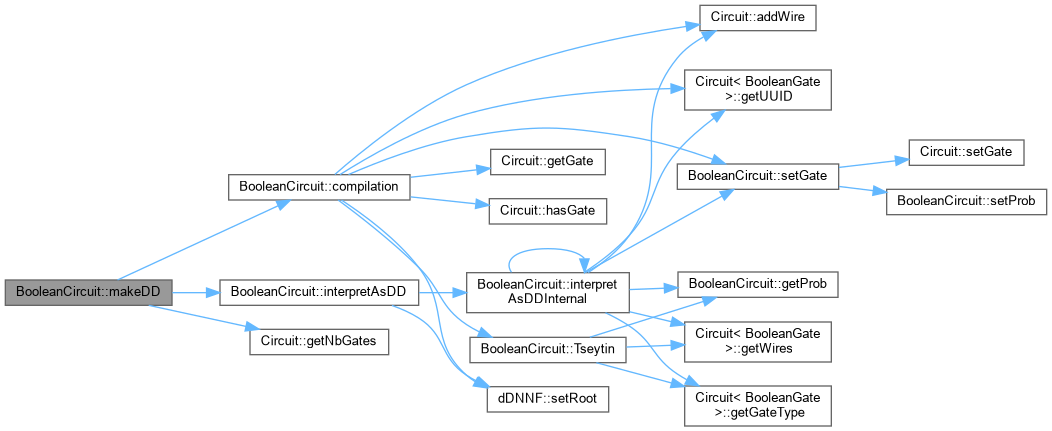
Build a dDNNF from a single compiler/route name.
Resolves the name the way a user (or Studio) thinks of it, with no separate method / args split:
"tree-decomposition", "interpret-as-dd", "default" (and the empty string) go through makeDD;"d4", "d4v2", "c2d", "minic2d", "dsharp", "panini-*") and is passed straight to compilation.This is the single dispatch point shared by compile_to_ddnnf_dot, compile_to_ddnnf (NNF) and ddnnf_stats, so they cannot drift on which names they accept.
| g | Root gate. |
| name | Compiler or meta-route name. |
dDNNF. Definition at line 2200 of file BooleanCircuit.cpp.
| double BooleanCircuit::monteCarlo | ( | gate_t | g, |
| unsigned | samples ) const |
Estimate the probability via Monte Carlo sampling.
| g | Root gate. |
| samples | Number of independent worlds to sample. |
Definition at line 359 of file BooleanCircuit.cpp.
| dDNNF BooleanCircuit::parseDDNNF | ( | std::istream & | in, |
| const std::vector< gate_t > & | inputOrder ) const |
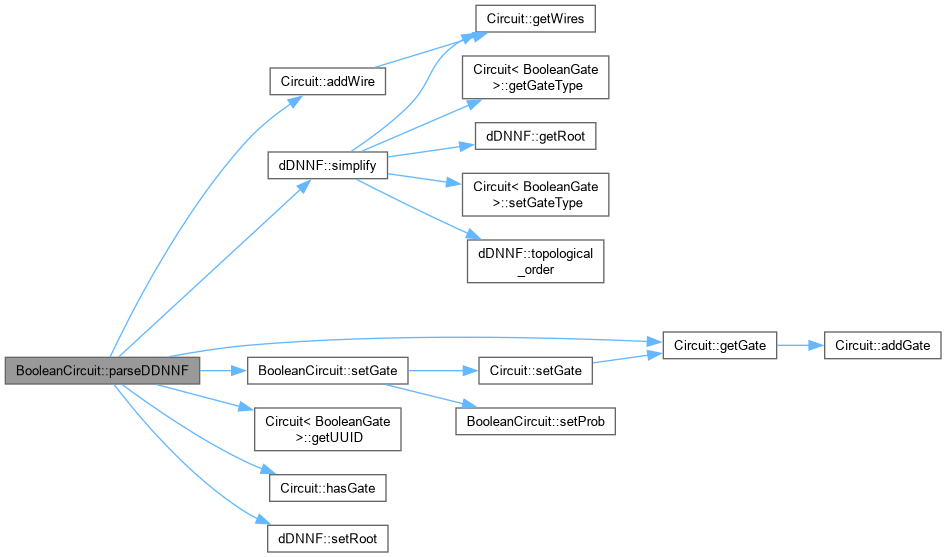
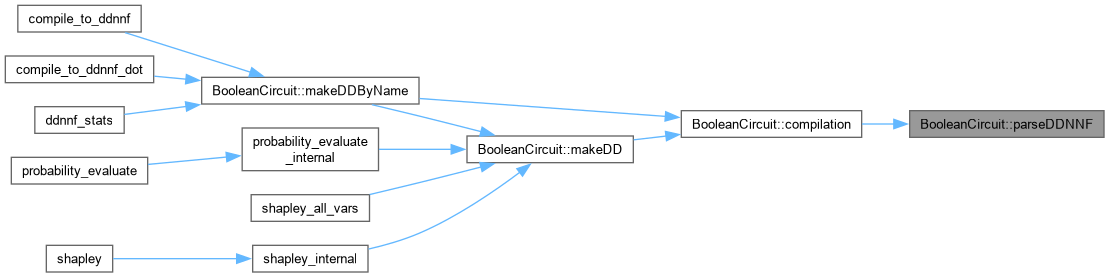
Parse a c2d/d4 NNF stream into a dDNNF over this circuit's input gates.
Shared by the CLI compilation() path and the KCMCP client: both obtain the same NNF text (from a temp file or a socket RESULT) and parse it identically. inputOrder maps d4 circuit-mode variables (1..k) to IN gates; an empty vector means CNF mode, where d-DNNF variable v stands for gate id v-1 (real only for IN gates, every other being a Tseytin auxiliary that is projected out).
| in | NNF text stream. |
| inputOrder | Circuit-mode input-variable to IN-gate map (empty = CNF). |
dDNNF (empty if the formula is unsat). Definition at line 1406 of file BooleanCircuit.cpp.
| dDNNF BooleanCircuit::parsePaniniDD | ( | const std::string & | outfilename | ) | const |
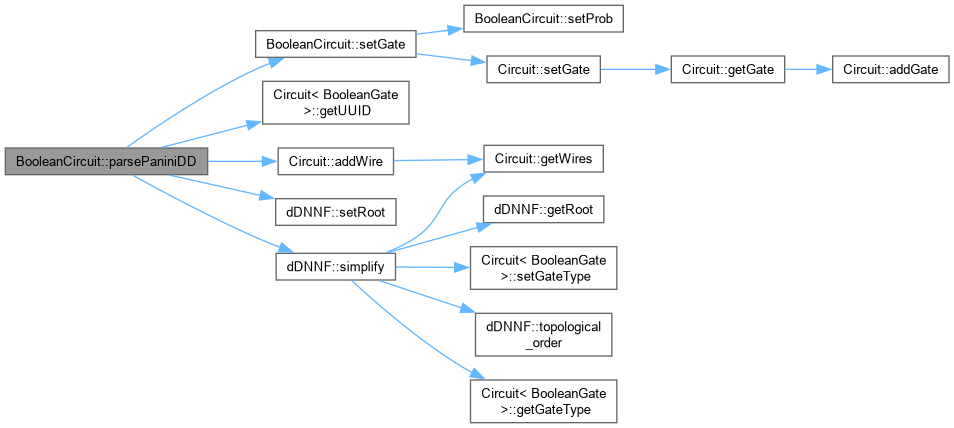
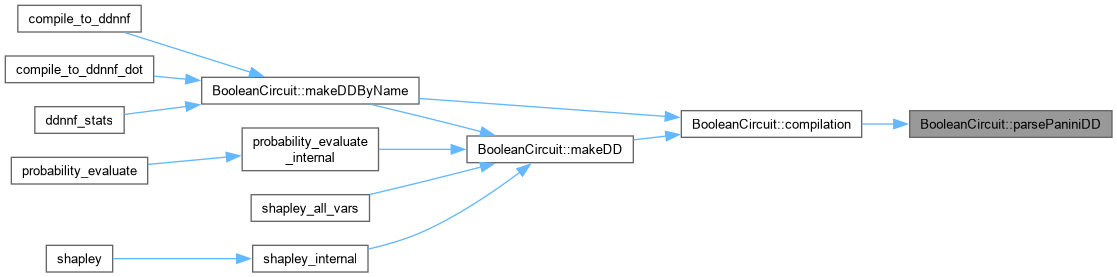
Parse a Panini (KCBox) DD output file into a ProvSQL d-DNNF.
The panini-dd output parser, selected by compilation() for the panini-* records. Those records run the generic compile path (a Tseytin CNF written to the input, the record's argtpl run, the --lang carried in the template); they differ from the nnf compilers only in this parse-back. Panini's DD output is over the variables of our Tseytin CNF: decisions on input variables are translated to the corresponding IN gates; decisions on Tseytin auxiliaries are dropped (their branches are mutually exclusive over input assignments by Tseytin determinism, so the input-projection is still a sound d-DNNF). "R2-D2" / "CCDD" emit K (kernelize) nodes that break decomposability, so those variants are not registered and a K node here is an error.
| outfilename | Path to Panini's DD output file. |
Definition at line 1067 of file BooleanCircuit.cpp.
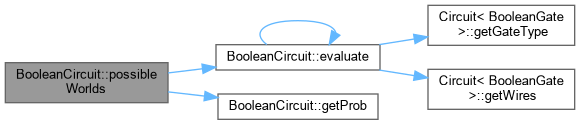
| double BooleanCircuit::possibleWorlds | ( | gate_t | g | ) | const |
Compute the probability by exact enumeration of all possible worlds.
Only tractable for circuits with a small number of input gates.
| g | Root gate. |
Definition at line 829 of file BooleanCircuit.cpp.
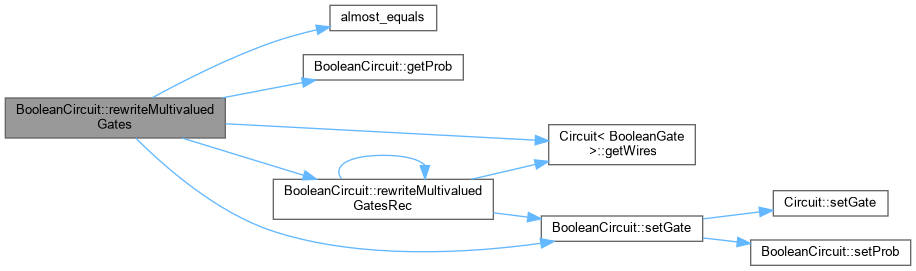
| void BooleanCircuit::rewriteMultivaluedGates | ( | ) |
Rewrite all MULVAR/MULIN gate clusters into standard AND/OR/NOT circuits.
Must be called before any evaluation method when the circuit contains multivalued input gates.
Definition at line 1981 of file BooleanCircuit.cpp.

|
private |
Recursive helper for rewriteMultivaluedGates().
| muls | Gates in the MULVAR group being rewritten. |
| cumulated_probs | Cumulative probability thresholds for each MULIN. |
| start | First index in muls to process. |
| end | One past the last index in muls to process. |
| prefix | Current AND-chain prefix being built. |
Definition at line 1933 of file BooleanCircuit.cpp.


|
inline |
Boost serialisation support.
| ar | Boost archive (input or output). |
| version | Archive version (unused). |
Definition at line 781 of file BooleanCircuit.h.
| gate_t BooleanCircuit::setGate | ( | BooleanGate | t, |
| double | p ) |
Create a new gate with a probability annotation.
| t | Gate type (typically BooleanGate::IN). |
| p | Probability of this gate being true. |
Definition at line 166 of file BooleanCircuit.cpp.

|
override |
Allocate a new gate with type type and no UUID.
| type | Gate type. |
Definition at line 133 of file BooleanCircuit.cpp.
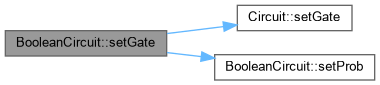
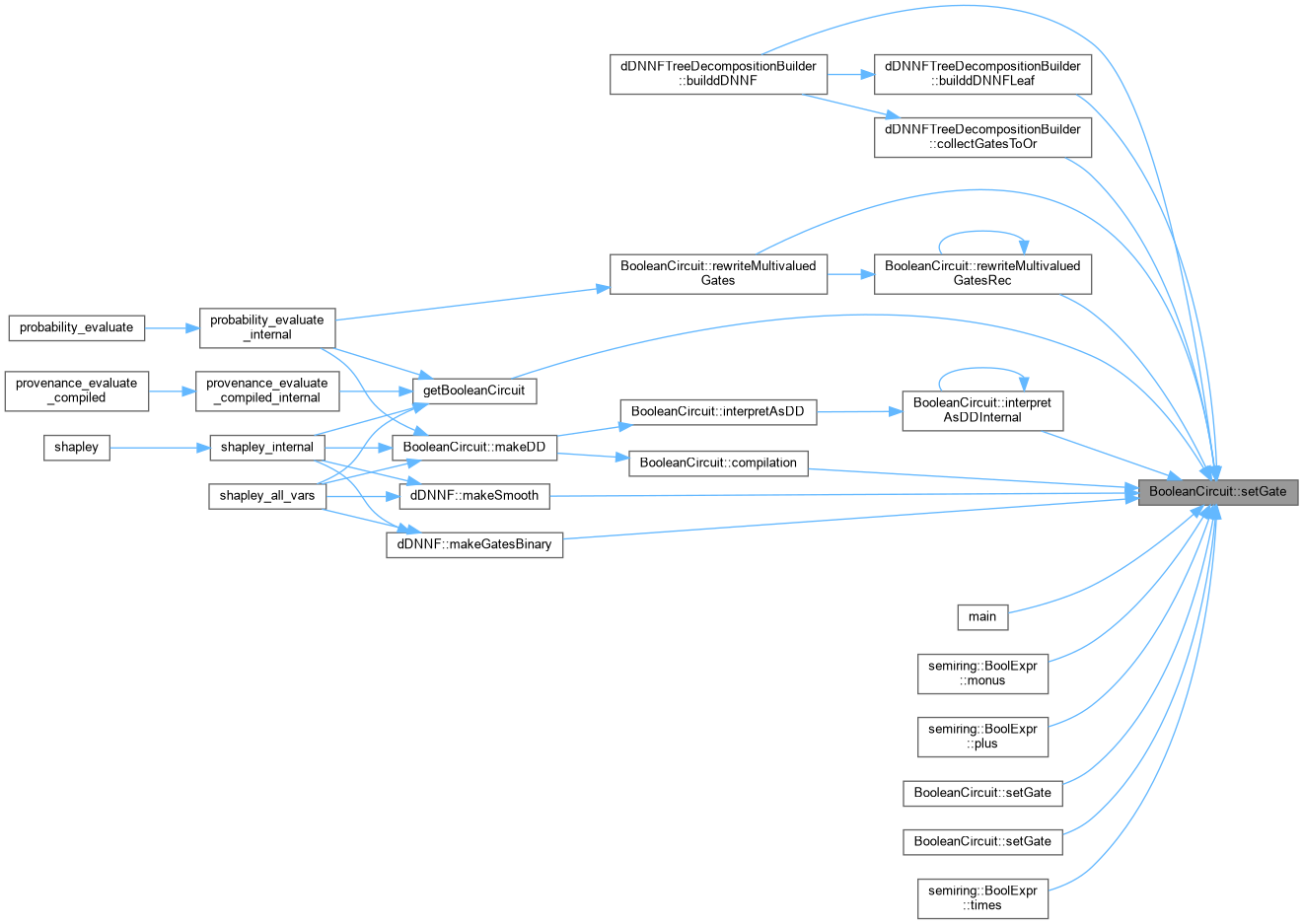
| gate_t BooleanCircuit::setGate | ( | const uuid & | u, |
| BooleanGate | t, | ||
| double | p ) |
Create (or update) a gate with a UUID and probability.
| u | UUID string. |
| t | Gate type. |
| p | Probability of this gate being true. |
Definition at line 157 of file BooleanCircuit.cpp.

|
override |
Create or update the gate associated with UUID u.
If the UUID is already mapped the existing gate's type is updated. Otherwise a new gate is allocated.
| u | UUID string to associate with the gate. |
| type | Gate type. |
Definition at line 145 of file BooleanCircuit.cpp.
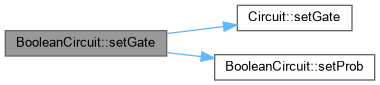
| void BooleanCircuit::setInfo | ( | gate_t | g, |
| unsigned | info ) |
Store an integer annotation on gate g.
Used to record the index of a MULIN gate within its MULVAR group.
| g | Gate identifier. |
| info | Integer to store. |
Definition at line 1918 of file BooleanCircuit.cpp.
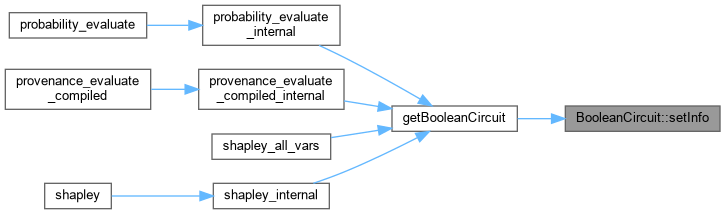
|
inline |
Set the probability for gate g and mark the circuit as probabilistic.
| g | Gate identifier. |
| p | Probability value in [0, 1]. |
Definition at line 281 of file BooleanCircuit.h.
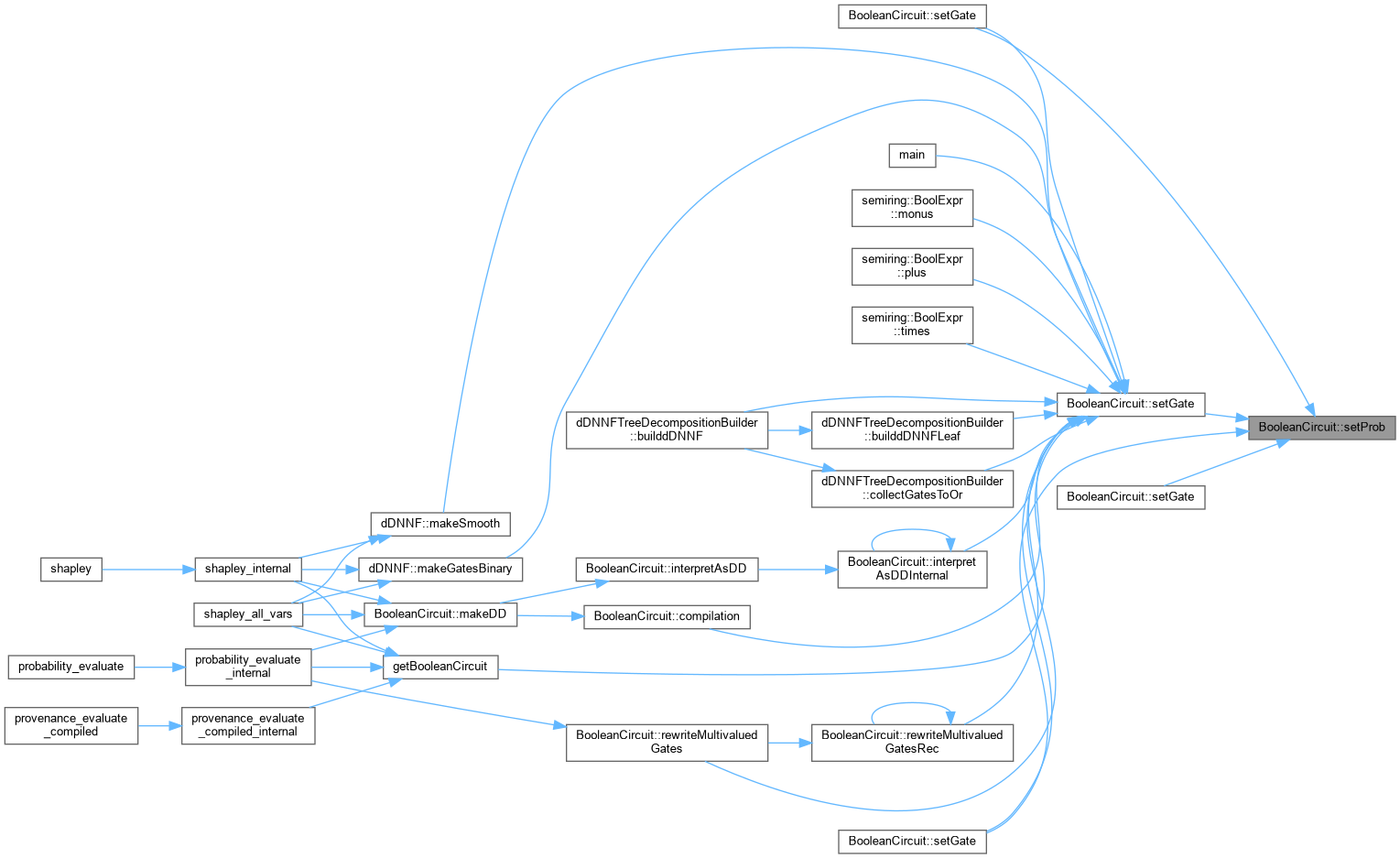
| double BooleanCircuit::sieve | ( | const std::vector< gate_t > & | clauses, |
| const std::vector< std::set< gate_t > > & | supports ) const |
Exact probability of a monotone DNF by inclusion-exclusion (sieve).
Pr[∨_i c_i] = Σ_{∅≠S⊆clauses} (-1)^{|S|+1} Pr[∧_{i∈S} c_i]. Each clause is a conjunction of positive input leaves, so the conjunction of a set S of clauses is the AND of the union of their supports, and over independent inputs Pr[∧_{i∈S} c_i] = ∏_{leaf ∈ ∪supports(S)} getProb(leaf). Exact, and O(2^m) in the clause count m – the portfolio member to pick when m is small (a handful of clauses), where it beats the general compilers.
clauses / supports are those returned by dnfShape (monotone DNF over input leaves). Throws when m exceeds kSieveMaxClauses (the 2^m enumeration would be impractical) so the caller can pick another method.
| clauses | Top-level clause roots (from dnfShape). |
| supports | Per-clause reachable IN leaves (from dnfShape). |
Definition at line 718 of file BooleanCircuit.cpp.

|
overridevirtual |
Return a textual description of gate g for debugging.
Pure virtual; each concrete circuit class provides its own formatting.
| g | Gate to describe. |
Implements Circuit< BooleanGate >.
Definition at line 182 of file BooleanCircuit.cpp.
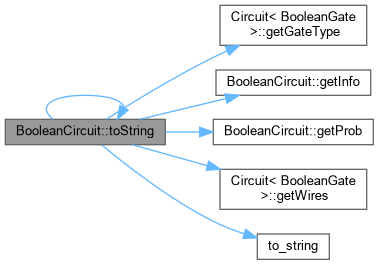
| std::string BooleanCircuit::toString | ( | gate_t | g, |
| const std::unordered_map< gate_t, std::string > & | labels ) const |
Render the sub-circuit at g, labelling input gates from a map.
Same as toString(gate_t), but IN and MULIN gates whose gate identifier is present in labels are rendered using the mapped string instead of the default x<id> placeholder. Gates not found in labels fall back to the default rendering.
| g | Gate to render. |
| labels | Optional mapping from input/mulinput gate IDs to user-supplied labels. |
Definition at line 187 of file BooleanCircuit.cpp.
|
private |
Internal recursive helper for the two toString() variants.
The parent parameter carries the gate type of the immediate caller. It drives parenthesis elision in two cases: at the root (parent set to UNDETERMINED) the outer wrap is omitted, and when parent matches the current gate type (associative AND/OR) the wrap is omitted to flatten same-op nesting. A 1-wire AND/OR also bypasses the wrap and delegates to its child since such single-element joins carry no information.
| g | Gate to render. |
| parent | Gate type of the caller, or UNDETERMINED at the root. |
| labels | Pointer to a label map, or nullptr for the unlabelled rendering. |
Definition at line 194 of file BooleanCircuit.cpp.
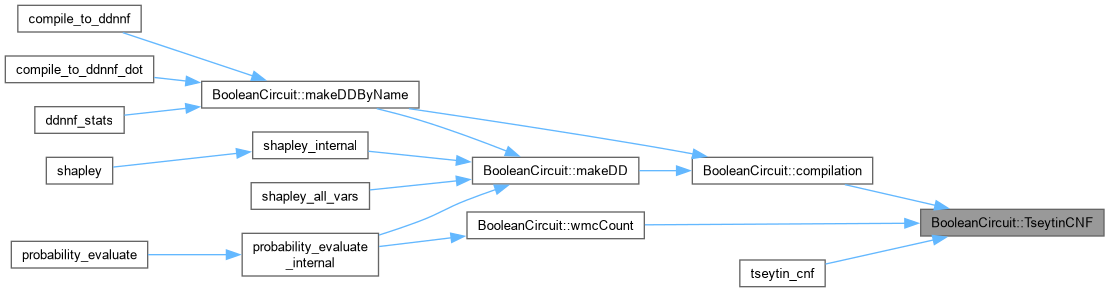
| std::string BooleanCircuit::TseytinCNF | ( | gate_t | g, |
| bool | display_prob, | ||
| bool | mapping = false ) const |
Return the Tseytin transformation of the sub-circuit at g as a DIMACS string.
Same encoding as the private Tseytin file-emitting overload, but returned in memory without any file I/O. Useful for surfacing the CNF to a user or to a knowledge-compilation tool over stdin.
| g | Root gate. |
| display_prob | Include w lines listing each input's probability (and its complement). |
| mapping | Prepend "c input <var> <uuid> <prob>" comment lines, one per input gate, so the emitted DIMACS is self-documenting (the comments are ignored by every model counter / compiler). |
Definition at line 882 of file BooleanCircuit.cpp.
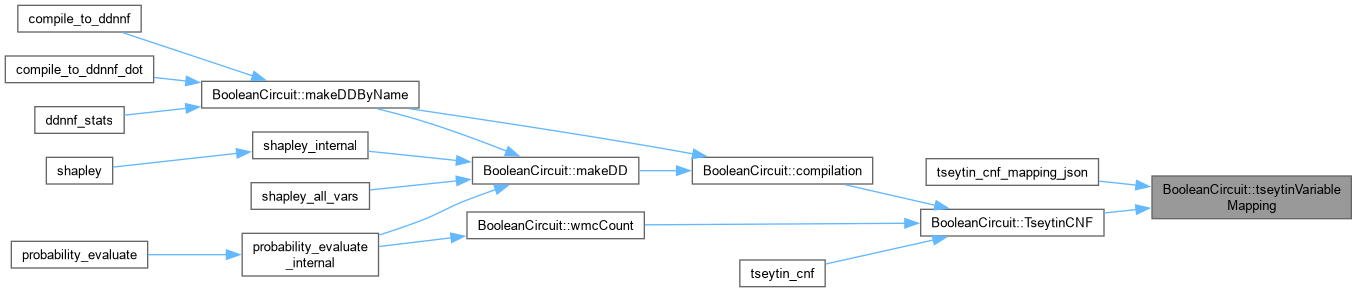
| std::vector< BooleanCircuit::CNFInputMapping > BooleanCircuit::tseytinVariableMapping | ( | ) | const |
Map each input gate to its DIMACS variable, UUID, probability.
The variable numbering matches TseytinCNF (and dDNNF::toNNF): variable = gate id + 1. Inputs are listed in gate-id order so the mapping is deterministic.
CNFInputMapping per input gate. Definition at line 960 of file BooleanCircuit.cpp.

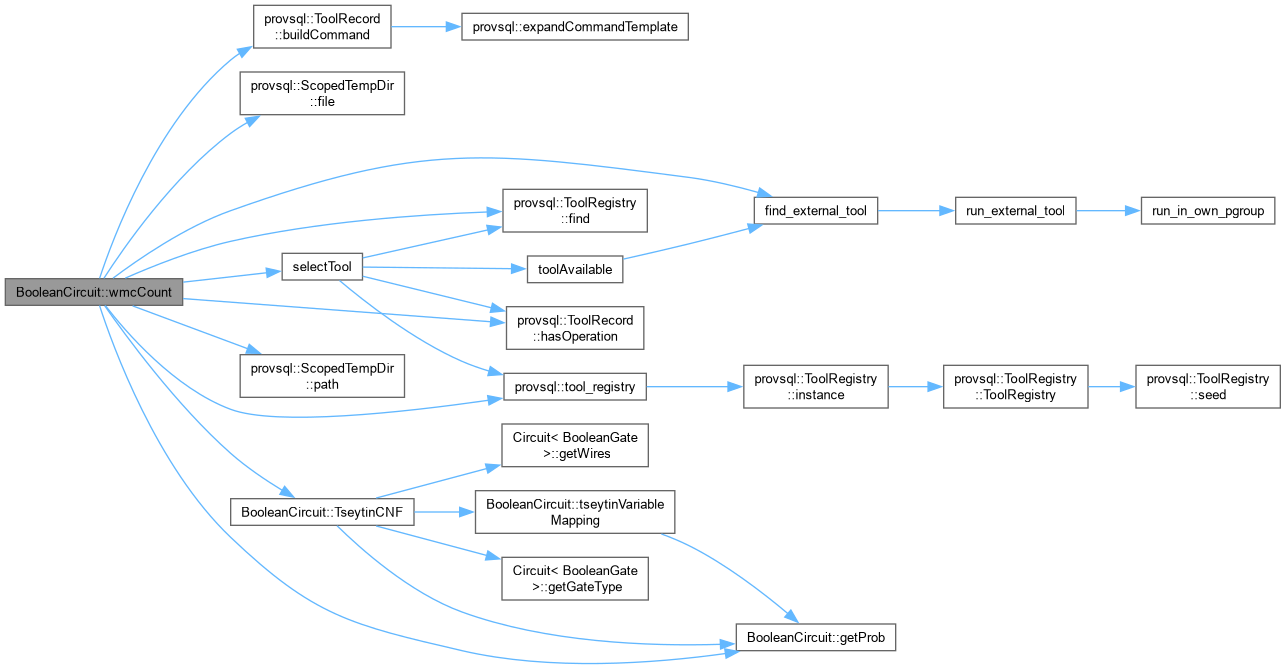
| double BooleanCircuit::wmcCount | ( | gate_t | g, |
| const std::string & | tool, | ||
| const std::string & | opt ) const |
Weighted model counting through a registered external counter.
Generic over the counter: tool names a registry record with the "wmc" operation (today weightmc, ganak, sharpsat-td, dpmc, or any tool an administrator registers). The record's binary, dependencies, argtpl and parser drive the whole call – which weighted-CNF dialect to write, the command to run, and how to read the count back – so there is no per-counter code path. Two output/input conventions are understood, by parser: "wmc-line" (MCC-2024 weighted DIMACS in, a "c s exact" / "s wmc" count line out) and "weightmc" (weightmc's own dialect in, a "mantissa x 2^exp" line out).
| g | Root gate of the sub-circuit. |
| tool | Logical name of the wmc tool to use. |
| opt | Tool options; for the approximate counters of the form "delta;epsilon" (drives the {pivotAC} placeholder). |
Definition at line 1586 of file BooleanCircuit.cpp.
|
friend |
Definition at line 795 of file BooleanCircuit.h.
|
friend |
Definition at line 794 of file BooleanCircuit.h.
|
protected |
Per-gate integer info (for MULIN gates).
Definition at line 220 of file BooleanCircuit.h.
|
protected |
Set of IN (input) gate IDs.
Definition at line 217 of file BooleanCircuit.h.
|
protected |
Set of MULVAR gate IDs.
Definition at line 218 of file BooleanCircuit.h.
|
protected |
Per-gate probability (for IN gates).
Definition at line 219 of file BooleanCircuit.h.
|
protected |
true if any gate has a non-unit probability
Definition at line 221 of file BooleanCircuit.h.