 |
ProvSQL C/C++ API
Adding support for provenance and uncertainty management to PostgreSQL databases
|
|
ProvSQL C/C++ API
Adding support for provenance and uncertainty management to PostgreSQL databases
|
Hierarchical-CQ rewriter for the 'boolean' provenance class (provsql.provenance GUC).
More...
#include "postgres.h"#include "fmgr.h"#include "pg_config.h"#include "access/htup_details.h"#include "catalog/pg_class.h"#include "catalog/pg_inherits.h"#include "catalog/pg_type.h"#include "nodes/bitmapset.h"#include "nodes/makefuncs.h"#include "nodes/nodeFuncs.h"#include "nodes/parsenodes.h"#include "nodes/pg_list.h"#include "optimizer/clauses.h"#include "optimizer/var.h"#include "parser/parse_oper.h"#include "tcop/tcopprot.h"#include "utils/builtins.h"#include "utils/datum.h"#include "utils/lsyscache.h"#include "utils/syscache.h"#include "compatibility.h"#include "provsql_mmap.h"#include "provsql_utils.h"#include "qual_classify.h"#include "safe_query.h"#include "safe_query_cert.h"
Go to the source code of this file.
Classes | |
| struct | safe_proj_slot |
| One projected column of an atom's wrapping subquery. More... | |
| struct | safe_rewrite_atom |
| Per-atom rewrite metadata discovered by the hierarchy detector. More... | |
| struct | safe_inner_group |
| Descriptor for an inner sub-Query introduced when one or more shared classes have partial coverage. More... | |
| struct | safe_pushed_remap_ctx |
Mutator context for safe_pushed_remap_mutator. More... | |
| struct | safe_remap_ctx |
Mutator context for safe_remap_vars_mutator. More... | |
| struct | safe_inner_varno_remap_ctx |
Mutator context for safe_inner_varno_remap_mutator. More... | |
| struct | safe_outer_te_remap_ctx |
Mutator context for safe_outer_te_remap_mutator. More... | |
| struct | safe_unify_remap_ctx |
Mutator context for safe_unify_remap_mutator. More... | |
| struct | safe_inline_shift_ctx |
Walker context for safe_inline_shift_mutator. More... | |
| struct | safe_inline_subst_ctx |
Walker context for safe_inline_subst_mutator. More... | |
| struct | safe_inline_compact_ctx |
Walker context for safe_inline_compact_mutator. More... | |
Macros | |
| #define | ANCHOR(c, atom_idx) |
| #define | DETERMINED(c, atom_idx) |
| #define | CCLASS(varidx) |
Functions | |
| static bool | is_safe_query_candidate (const constants_t *constants, Query *q, Bitmapset *approved_self_join_relids, bool for_skeleton) |
| Walk a Query and reject anything outside the safe-query scope. | |
| static void | safe_partition_residual (Node *residual, List *atoms, List *groups, Node **outer_residual_out) |
| Partition the cross-atom residual into per-group conjuncts and a new outer residual. | |
| static Node * | safe_pushed_remap_mutator (Node *node, safe_pushed_remap_ctx *ctx) |
Rewrite Var.varno from the outer atom rtindex to 1, the sole RTE of the inner wrap subquery. | |
| static List * | find_hierarchical_root_atoms (const constants_t *constants, Query *q, Node *quals, List **groups_out) |
Run the hierarchy detector on q, returning per-atom rewrite info. | |
| static Node * | safe_remap_vars_mutator (Node *node, safe_remap_ctx *ctx) |
| Rewrite Var nodes in the outer query after each base RTE has been wrapped as a DISTINCT subquery projecting one or more slot columns. | |
| static Query * | safe_build_inner_wrap (Query *outer_src, RangeTblEntry *base_rte, List *proj_slots, Index outer_rtindex, List *pushed_quals) |
Build the inner Query that projects every slot in proj_slots of base_rte under SELECT DISTINCT. | |
| static Node * | safe_inner_varno_remap_mutator (Node *node, safe_inner_varno_remap_ctx *ctx) |
Rewrite base-level Var.varno from the outer atom rtindex to the corresponding inner-sub-Query rtindex. | |
| static Query * | safe_build_group_subquery (Query *outer_src, safe_inner_group *gr, List *atoms) |
| Build the inner sub-Query that aggregates a group of partial-coverage atoms over their non-root shared variables. | |
| static Query * | rewrite_hierarchical_cq (const constants_t *constants, Query *q, List *atoms, List *groups, Node *residual) |
| Apply the (multi-level when needed) hierarchical-CQ rewrite. | |
| static int | compute_atom_components (Query *q, Node *quals, int *atom_to_comp) |
| Compute atom-level connected components. | |
| static Node * | safe_outer_te_remap_mutator (Node *node, safe_outer_te_remap_ctx *ctx) |
| Rewrite Vars in the outer targetList for the multi-component rewrite. | |
| static Query * | rewrite_multi_component (const constants_t *constants, Query *q, Node *residual, List **per_atom_quals, int *atom_to_comp, int ncomp) |
| Apply the multi-component rewrite. | |
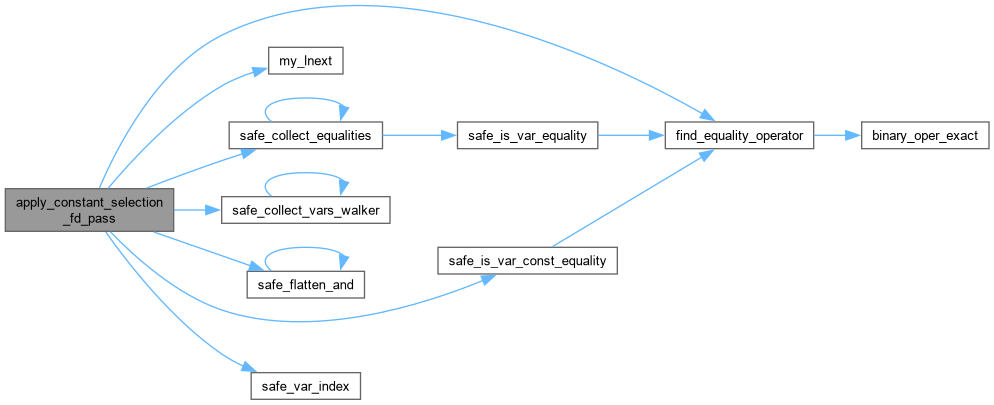
| static void | apply_constant_selection_fd_pass (Query *q, List **per_atom_quals, Node **residual_in_out) |
| Constant-selection elimination pre-pass. | |
| static Node * | safe_unify_remap_mutator (Node *node, safe_unify_remap_ctx *ctx) |
Tree mutator that renumbers Var.varno and RangeTblRef.rtindex through the PK-unifiable self-join map. | |
| static Query * | try_pk_self_join_unification (Query *q) |
| PK-unifiable self-join detection and unification. | |
| static Bitmapset * | try_disjoint_constant_self_join_split (Query *q) |
| Disjoint-constant self-join certification. | |
| static Node * | safe_inline_shift_mutator (Node *node, safe_inline_shift_ctx *ctx) |
Add offset to the varno of every base-level (varlevelsup == 0) Var and the rtindex of every RangeTblRef in node. | |
| static Node * | safe_inline_subst_mutator (Node *node, safe_inline_subst_ctx *ctx) |
Replace every outer-scope Var pointing at the inlined subquery RTE with a shifted copy of the matching target-list entry's expression. | |
| static bool | is_inlineable_subquery (Query *sub) |
Decide whether sub may be inlined. | |
| static void | inline_one_subquery (Query *q, int target_rti) |
Inline the subquery RTE at target_rti into q in place. | |
| static Node * | safe_inline_compact_mutator (Node *node, safe_inline_compact_ctx *ctx) |
Renumber Vars / RangeTblRefs via old_to_new. | |
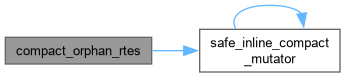
| static void | compact_orphan_rtes (Query *q, Bitmapset *orphans) |
Drop orphan RTEs (the inlined subquery slots) from q->rtable and renumber every surviving Var / RangeTblRef. | |
| static Query * | try_inline_simple_subqueries (Query *q) |
| Subquery-inlining pre-pass. | |
| static char * | safe_cert_describe (const SafeCert *cert) |
| Top-level entry point for the safe-query rewrite. | |
| static SafeCert * | detect_inversion_free (const constants_t *constants, Query *q) |
| Recognise an inversion-free UCQ(OBDD) over tuple-independent inputs. | |
| static bool | compute_inversion_free_markers (const SafeCert *cert, InvFreeMarker *m) |
| Derive per-atom marker specs from a SafeCert recipe. | |
| bool | inversion_free_analyze (const constants_t *constants, Query *q, char **cert_out, InvFreeMarker **markers_out, int *natoms_out) |
Inversion-free analysis of the lineage query q. | |
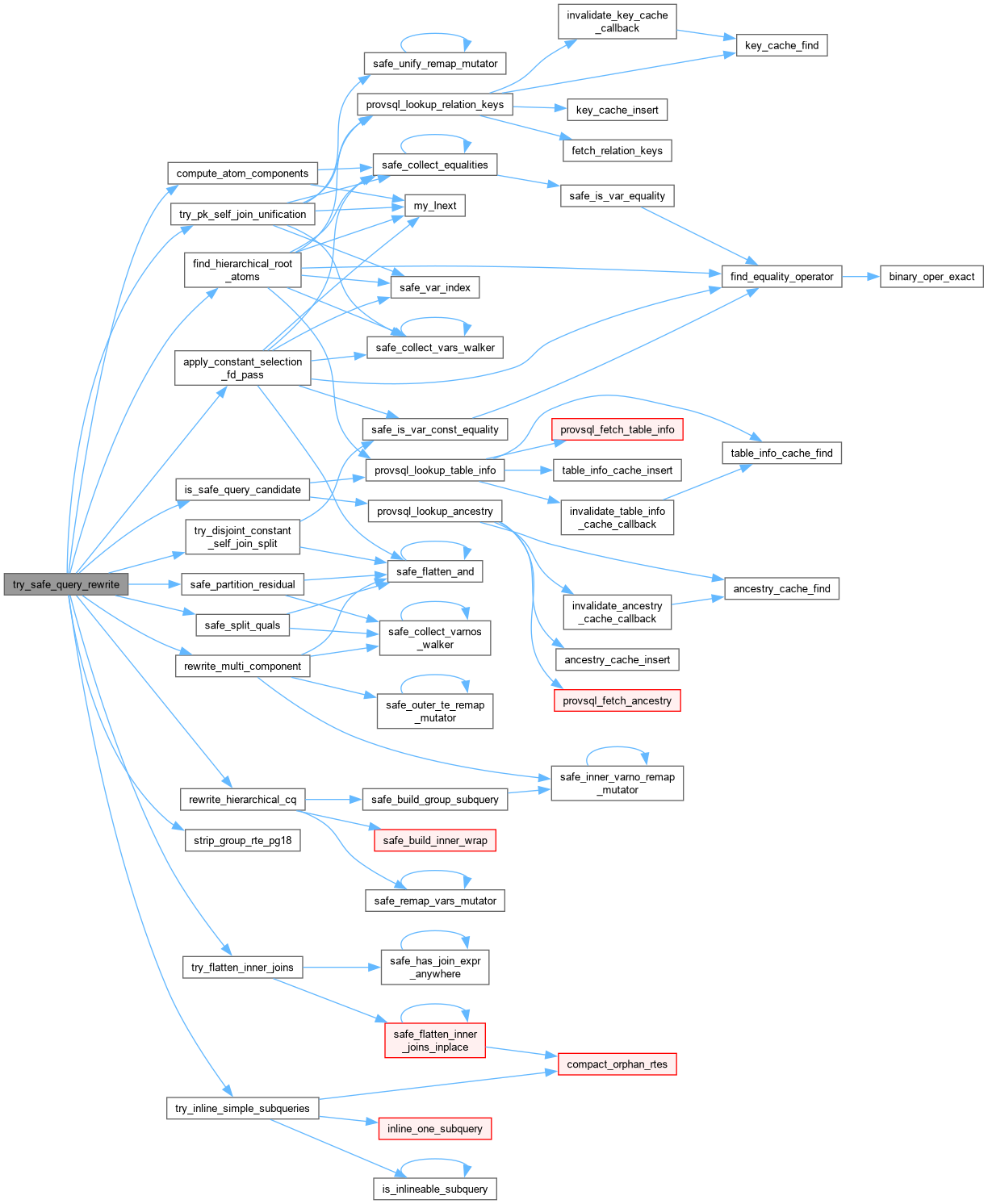
| Query * | try_safe_query_rewrite (const constants_t *constants, Query *q) |
| Top-level entry point for the hierarchical-CQ rewriter. | |
Variables | |
| int | provsql_verbose |
Verbosity level; controlled by the provsql.verbose_level GUC. | |
Hierarchical-CQ rewriter for the 'boolean' provenance class (provsql.provenance GUC).
Opt-in pre-pass invoked by process_query in provsql.c. Rewrites SELECT-FROM-WHERE conjunctive queries with a hierarchical structure (every shared variable's atom-set is either fully covered or fits into a multi-level inner-group decomposition) into a form whose provenance circuit is read-once. The result lets the linear-time BooleanCircuit::independentEvaluation method handle queries that would otherwise fall through to the dDNNF / tree-decomposition / external-knowledge-compiler pipeline.
The hierarchical-CQ class and its read-once decomposability are the "safe queries" of Dalvi and Suciu, "The Dichotomy of Probabilistic Inference for Unions of Conjunctive Queries", J. ACM 59(6), 2012 (doi:10.1145/2395116.2395119) ; the dichotomy theorem in that paper is the theoretical foundation for the rewrite this file implements.
Entry point: try_safe_query_rewrite (see safe_query.h).
The bulk of the file is detector + rewriter helpers. All non-API symbols are static.
Definition in file safe_query.c.
| #define ANCHOR | ( | c, | |
| atom_idx ) |
| #define CCLASS | ( | varidx | ) |
| #define DETERMINED | ( | c, | |
| atom_idx ) |
|
static |
Constant-selection elimination pre-pass.
Implements Dalvi & Suciu 2007 §5.1's induced-FD construction (∅ → R.a from a R.a = c conjunct), specialised to the safe-query rewriter's representation:
*residual_in_out. Every pair of Vars that share an equijoin (transitively, through the closure) lands in the same equivalence class.per_atom_quals[i] (atom-local conjuncts) and *residual_in_out (cross-atom conjuncts) for Var = Const matches. Mark the matched Var's class repr as constant- pinned, recording one of the literals for propagation.Var = const conjunct on the Var's atom's per_atom_quals list (when not already present, dedup'd by AND conjuncts of *residual_in_out whose every base-level Var is in a constant-pinned class. These are the equijoin conjuncts that brought constant atoms together (e.g. R.x = S.x under S.x = 42); after propagation each side carries its own Var = const filter, so the original equijoin is redundant and would only prevent the rewriter from resolving columns the constant-pinned atoms' wraps no longer project.Effect on the rest of try_safe_query_rewrite: with cross-atom equijoin links to constant-pinned atoms removed, those atoms become their own connected components, and the existing multi-component path in try_safe_query_rewrite handles them by emitting a separate inner sub-Query per component. The recursive process_query re-entry then collapses each constant-pinned atom to a single aggregated gate_plus token, while the remaining atoms keep the standard single-component hierarchical shape. This is the read-once factoring constant-pinning prescribes – the pinned atom's contribution factors out as an independent gate_times child of the result.
Definition at line 3032 of file safe_query.c.

|
static |
Drop orphan RTEs (the inlined subquery slots) from q->rtable and renumber every surviving Var / RangeTblRef.
Definition at line 4178 of file safe_query.c.

|
static |
Compute atom-level connected components.
Two atoms belong to the same component iff there is a chain of equality conjuncts in quals that connects one of their Vars to one of the other's Vars. Uses a quick atom-level union-find driven by the equality pairs already extracted by qc_collect_equalities, then compacts representatives into 0-based component ids written into atom_to_comp.
Definition at line 2499 of file safe_query.c.


|
static |
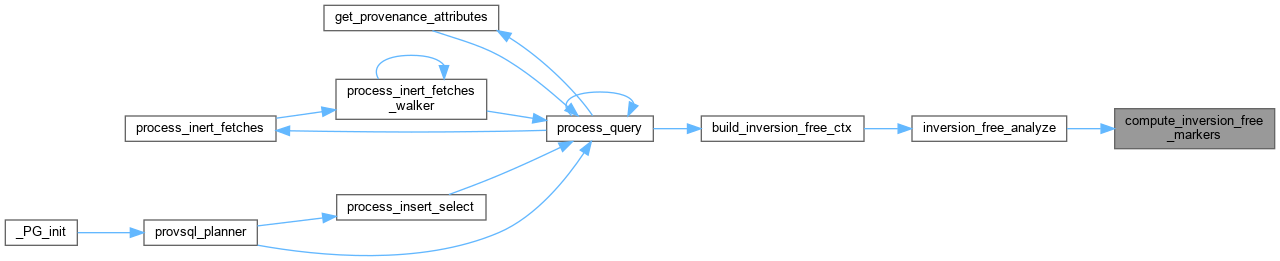
Derive per-atom marker specs from a SafeCert recipe.
Each atom binds the root class at one column and at most one secondary class at another. Its factor is the secondary class, except that a relation whose occurrences span two or more distinct secondary classes (the consistent-unification self-join) is the shared guard, whose atoms take SAFE_CERT_GUARD_FACTOR. An atom binding only the root class is root-only: it has no secondary column (sec_col 0) and its factor is its relation rank, so the relations of one block stay distinguished. This covers the self-join witness (guard S spanning y and z, payloads A on y and B on z), the self-join-free hierarchical case grouped by secondary class, and the pure conjunction q(x):-A(x),B(x) (all atoms root-only). Returns false when an atom lacks a root column or binds two or more secondary classes (outside this shape); the caller then attaches no markers and the inversion-free path declines at evaluation.
The specs give the structured builder a Prop. 4.5 order (root value, then secondary value, then guard-before-payload, then factor). Order affects only the d-DNNF size, never correctness, so a builder fed these specs is sound on any lineage; the order is what keeps it polynomial on the certified class.
Definition at line 4678 of file safe_query.c.
|
static |
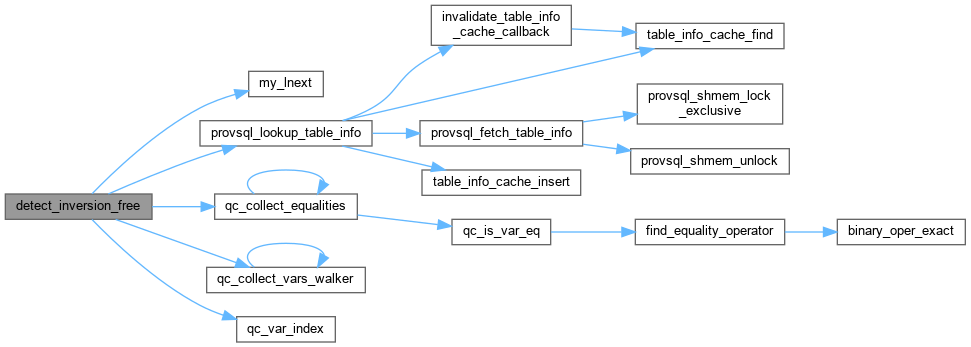
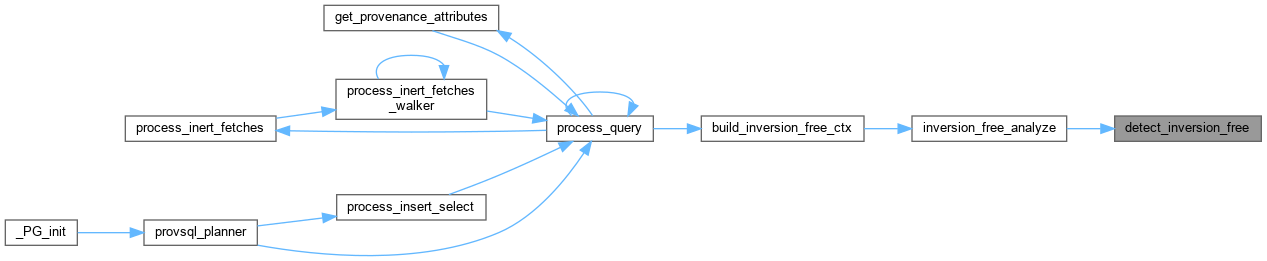
Recognise an inversion-free UCQ(OBDD) over tuple-independent inputs.
Sound under-approximation (documented as such): requires the four preconditions of the plan – hierarchical, per-relation positional consistency, precedence-graph (G_prec) acyclicity, and all-atoms-TID. Returns a palloc'd SafeCert recipe on success, NULL otherwise. Reasons for rejection are logged at provsql_verbose >= 5 once the query is past the cheap shape/metadata gate and a self-join is present.
Definition at line 4372 of file safe_query.c.
|
static |
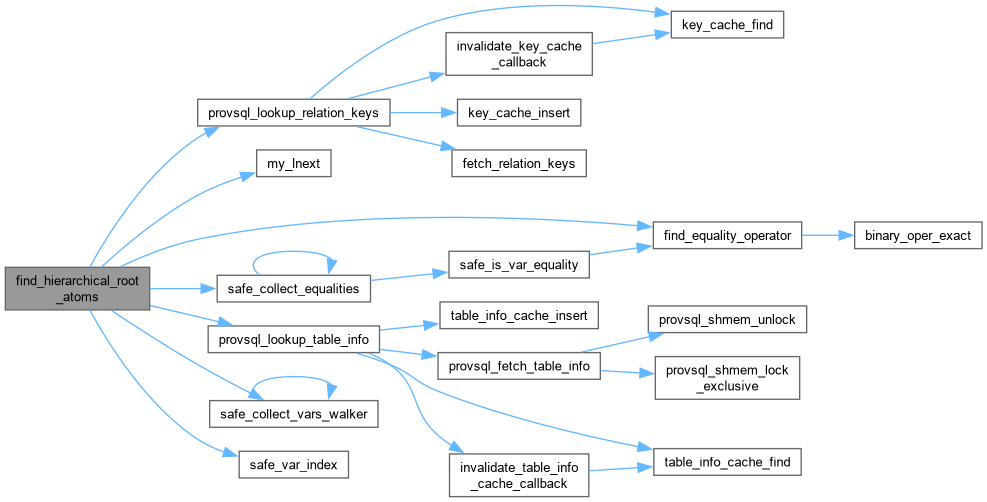
Run the hierarchy detector on q, returning per-atom rewrite info.
Builds the variable equivalence relation induced by WHERE-clause Var = Var equalities, identifies a "root variable" (a class whose member Vars touch every base RTE), and decides how each remaining shared class is materialised. Fully-covered non-root classes become extra projection slots in the per-atom inner wrap. Partial-coverage shared classes – those touching at least two but not all atoms – trigger the multi-level path: the affected atoms are bundled into an inner sub-Query whose GROUP BY folds the partial-coverage variables before the outer join with the remaining atoms. Returns a list of safe_rewrite_atom * (one per q->rtable entry, in rtable order) plus, via groups_out, the list of safe_inner_group * the rewriter must build.
Returns NIL when the query is not in the currently-supported shape:
try_safe_query_rewrite via rewrite_multi_component, so this bail covers only the "connected but no variable touches
every atom" case ;A(x,x) when x is the root) into the inner subquery ; the current rewriter does not synthesise such an equality and bails ;quals or q->targetList that does not fit any of the slot kinds the rewriter knows how to expose : the fully-covered class (extra outer slot), a partial-coverage class whose atom landed in an inner group (inner-group slot), or a single-atom head Var on an atom whose wrap can carry an extra projection slot. Body-only Vars on a single-atom class and partial-coverage classes that the multi-group / bridge merger cannot route to any group fall outside this set and trigger the bail.The shape gate in is_safe_query_candidate has already enforced self-join-free, no aggs / windows / sublinks etc.; this function only adds the hierarchy-specific checks.
| constants | Cached extension OIDs (unused here; reserved for future class/type lookups). |
| q | Input Query; the detector only reads it. |
| quals | Residual WHERE quals (post-split): the cross-atom conjunction that the union-find must reason about. Single-atom conjuncts have been extracted upstream and stored separately per atom. |
| groups_out | Out: list of safe_inner_group * produced when the partial-coverage path fires; NIL when the rewriter only needs single-level outer wraps. |
Definition at line 509 of file safe_query.c.

|
static |
Inline the subquery RTE at target_rti into q in place.
Caller is responsible for compaction (the orphan RTE is left in q->rtable so other still-pending rtindex references don't shift mid-pass).
Definition at line 4039 of file safe_query.c.


| bool inversion_free_analyze | ( | const constants_t * | constants, |
| Query * | q, | ||
| char ** | cert_out, | ||
| InvFreeMarker ** | markers_out, | ||
| int * | natoms_out ) |
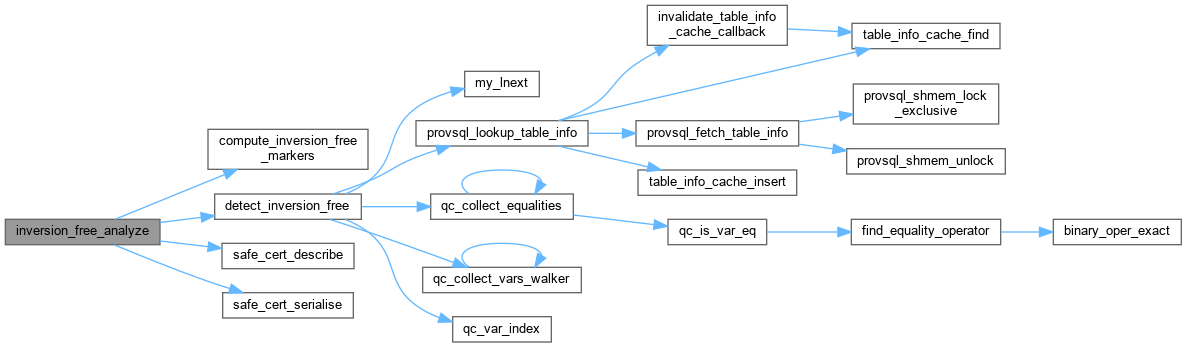
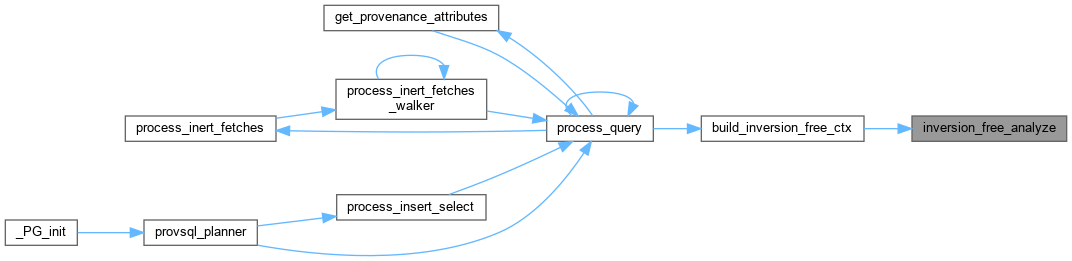
Inversion-free analysis of the lineage query q.
Runs the detector on q itself (the query whose provenance lineage is being built), so the certificate and the per-atom marker specs align with the lineage by construction, independent of any read-once pre-pass. On success sets cert_out to a palloc'd C-prefixed serialised SafeCert recipe (for the per-row root) and, when the marker model applies, markers_out to a palloc'd array of *natoms_out InvFreeMarker (one per atom); otherwise leaves them NULL.
true if q is certified inversion-free (cert produced). Definition at line 4738 of file safe_query.c.
|
static |
Decide whether sub may be inlined.
See the chapter comment above for the predicate; the recursion through nested RTE_SUBQUERY entries is bounded by the input query's syntactic nesting depth.
Definition at line 3966 of file safe_query.c.

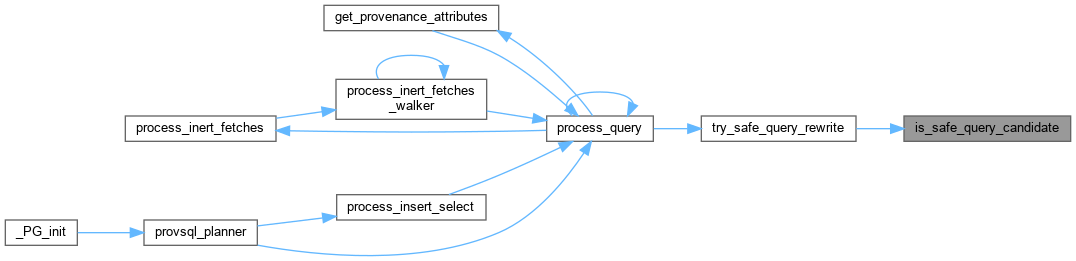
|
static |
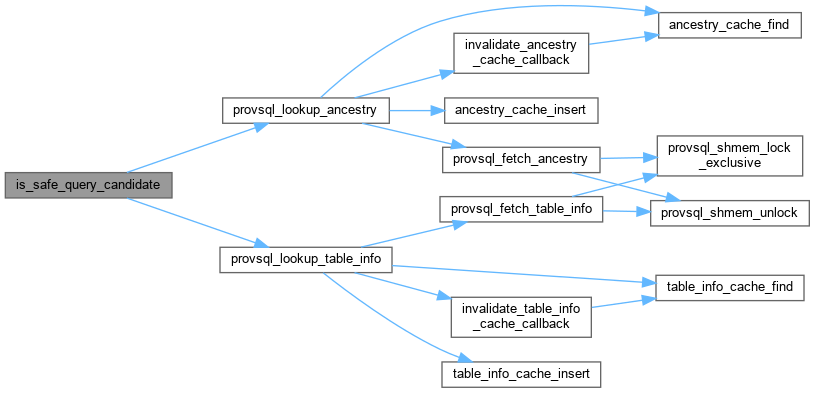
Walk a Query and reject anything outside the safe-query scope.
Accepts only:
process_query, so each branch reaches this gate on its own and the outer set-operation node bails here.GROUP BY or top-level DISTINCT. Without one, the per-atom SELECT DISTINCT wraps would shrink the user- visible row count, so the rewrite would change the result set.true iff q is a candidate for the safe-query rewrite. Definition at line 95 of file safe_query.c.
|
static |
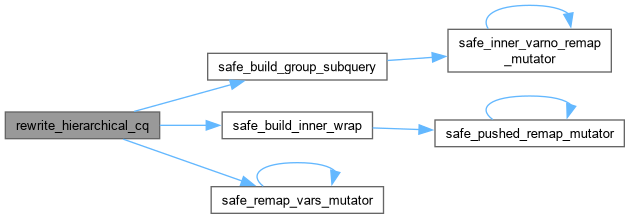
Apply the (multi-level when needed) hierarchical-CQ rewrite.
Walks the outer rtable in original order. Each atom is replaced by an RTE_SUBQUERY. Atoms with group_id == -1 get a direct outer wrap (SELECT DISTINCT on their projection slots). The first atom of each inner group emits the group's sub-Query (safe_build_group_subquery), and subsequent group members are skipped from the outer rtable – they live inside the inner sub-Query. The outer rtable therefore has one entry per outer-wrap atom plus one entry per inner group, generally fewer than the original.
The remap pass then rewrites every base Var in the outer targetList and residual WHERE. Both outer-wrap and grouped Vars resolve by scanning the atom's proj_slots for the matching base_attno: the new varno is the atom's (or its group's) outer_rtindex, and the new varattno is the slot's 1-based position in proj_slots (which matches the output column of the outer wrap or of the inner sub-Query's targetList).
Definition at line 2272 of file safe_query.c.

|
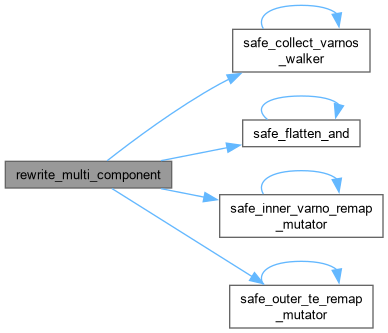
static |
Apply the multi-component rewrite.
Assumes atom_to_comp partitions the q->rtable atoms into ncomp connected components (ncomp >= 2) and that every TargetEntry in q->targetList has all its Vars in a single component. Builds one inner Query per component, each carrying:
RTE_RELATION clones,q->targetList referencing this component's atoms (fresh ressortgroupref) plus matching groupClause, and assembles an outer Query whose rtable is the list of inner sub-Queries. Each output row's provenance is the gate_times of the per-component provsqls; Choice A re-entry lets the single-component rewriter handle each component independently.Returns NULL to fall through when any component has no Var- carrying TargetEntry to anchor its inner sub-Query (the all- constant case, e.g. SELECT DISTINCT 1 FROM A,B, is deferred).
Definition at line 2631 of file safe_query.c.

|
static |
Build the inner sub-Query that aggregates a group of partial-coverage atoms over their non-root shared variables.
The sub-Query's rtable contains a clone of each member atom's RangeTblEntry, in original-rtindex order. Its WHERE is the AND of gr->inner_quals (cross-atom conjuncts within the group) and every member atom's pushed_quals; each conjunct's Var.varno is remapped from the outer atom rtindex to the inner rtindex via safe_inner_varno_remap_mutator. The targetList exposes a single column carrying the root-class binding of the first member; the groupClause aggregates the per-group provenance over the inner shared variables. When process_query re-enters on this sub-Query, the hierarchical-CQ rewriter fires again and wraps each member atom with its own SELECT DISTINCT.
Definition at line 2070 of file safe_query.c.


|
static |
Build the inner Query that projects every slot in proj_slots of base_rte under SELECT DISTINCT.
One TargetEntry and one SortGroupClause are emitted per slot, in proj_slots order; the root-class slot is conventionally first, so it always ends up at output attno 1. The recursive process_query call on this Query will discover the provsql column on base_rte and append it to the inner target list, so the wrapping outer query gets the slot columns at attno 1..N and the provsql column at attno N+1.
Definition at line 1901 of file safe_query.c.


|
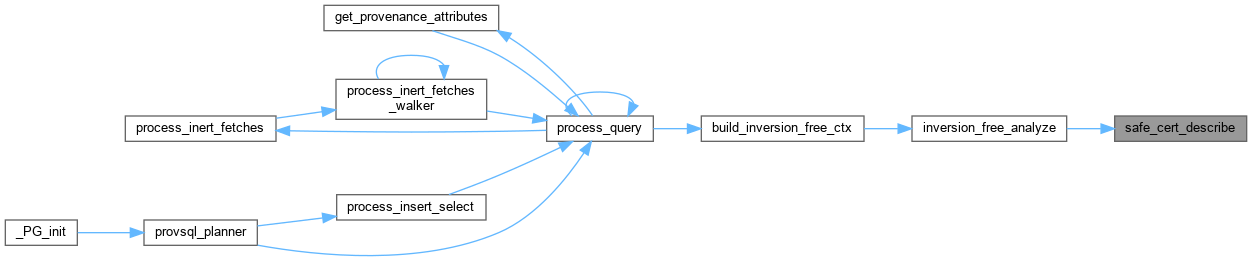
static |
Top-level entry point for the safe-query rewrite.
Runs the shape gate then the hierarchy detector. If both accept, applies the single-level rewrite and returns the rewritten Query; the caller (process_query) feeds it back from the top so that inner subqueries are themselves re-considered (multi-level recursion via Choice A). Returns NULL to fall through to the existing pipeline.
Human-readable one-line summary of a SafeCert, for the NOTICE.
Definition at line 4350 of file safe_query.c.
|
static |
Renumber Vars / RangeTblRefs via old_to_new.
Slots mapped to 0 (the inlined-orphan rtindexes) would signal a live reference into a dropped RTE – defensively, the node passes through unchanged so the downstream candidate gate notices and refuses the query.
Definition at line 4136 of file safe_query.c.

|
static |
Add offset to the varno of every base-level (varlevelsup == 0) Var and the rtindex of every RangeTblRef in node.
Used when relocating a subquery's rtable entries into the tail of the outer query's rtable.
Outer Vars (varlevelsup > 0) and outer RangeTblRefs cannot legitimately appear in an inlineable subquery – the inlineable predicate refuses LATERAL RTEs and sublinks – but we leave them alone defensively.
Definition at line 3891 of file safe_query.c.

|
static |
Replace every outer-scope Var pointing at the inlined subquery RTE with a shifted copy of the matching target-list entry's expression.
The substituted expression is copyObject'd before its base-level Vars / RangeTblRefs are renumbered by outer_offset, so the inlined subquery's targetList is left intact for any other outer-scope Var still referencing it.
Definition at line 3935 of file safe_query.c.


|
static |
Rewrite base-level Var.varno from the outer atom rtindex to the corresponding inner-sub-Query rtindex.
Applied to each conjunct that the partition pass routed into an inner group (and to every pushed-down atom-local qual of every grouped atom) before injection into the inner sub-Query's jointree->quals. varattno is unchanged – the inner sub-Query's RTEs are fresh clones of the same base relations, so the base attribute numbers carry over.
Definition at line 2029 of file safe_query.c.

|
static |
Rewrite Vars in the outer targetList for the multi-component rewrite.
Each base-level Var(varno=v, varattno=a) in the user's targetList is looked up in atom_to_inner_attno[v-1] to find which output column of the matching component's inner sub-Query carries the Var, then rewritten to point at that component's RTE_SUBQUERY in the outer rtable. A Var whose atom_to_inner_attno entry is 0 (i.e. the detector did not pick this column for its inner sub-Query) indicates a bug or a query the caller should have refused; we provsql_error to surface it.
Definition at line 2573 of file safe_query.c.

|
static |
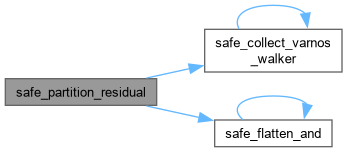
Partition the cross-atom residual into per-group conjuncts and a new outer residual.
For every top-level AND conjunct of residual:
Var it references points at an atom in some inner group's member set, the conjunct moves into that group's inner_quals (in original-varno space; the rewriter remaps to inner varnos when it builds the sub-Query);Volatile conjuncts always stay in the outer residual: collapsing the row count inside a sub-Query with an aggregating GROUP BY would change how many times the volatile function runs.
Definition at line 347 of file safe_query.c.

|
static |
Rewrite Var.varno from the outer atom rtindex to 1, the sole RTE of the inner wrap subquery.
Applied to each pushed conjunct before it is AND-injected into the inner Query's jointree->quals. varattno is preserved (the inner subquery's RTE is a fresh clone of the same base relation).
Definition at line 425 of file safe_query.c.

|
static |
Rewrite Var nodes in the outer query after each base RTE has been wrapped as a DISTINCT subquery projecting one or more slot columns.
For each base-level Var (varno, varattno), the matching atom is atoms[varno-1]. We scan its proj_slots in order, looking for a slot with base_attno == varattno, and remap the Var to the 1-based output position of that slot. A Var with no matching slot indicates the detector accepted a query it shouldn't have; we provsql_error to surface the bug rather than silently emit a broken plan.
Definition at line 1828 of file safe_query.c.

|
static |
Tree mutator that renumbers Var.varno and RangeTblRef.rtindex through the PK-unifiable self-join map.
Applied to every node of the unified Query : the targetList, the jointree (which itself contains RangeTblRef leaves referring to surviving RTEs as well as expression subtrees in the quals), the havingQual when present, etc. Vars with varlevelsup > 0 are outer references and left alone – the candidate gate has already rejected sublinks, so they cannot legitimately appear, but the guard keeps the mutator local.
varnosyn / varattnosyn (PG 13+ "syntactic" parallel of the semantic rtindex used by ruleutils.c's deparser) are kept in sync; without that, pg_get_querydef on the unified query stack-overflows because the syntactic dereference and the semantic one disagree.
Definition at line 3264 of file safe_query.c.

|
static |
Disjoint-constant self-join certification.
When two (or more) RTEs over the same relation each carry a Var = Const conjunct on the same column with provably-different literals, their tuple-sets are disjoint: a single base-relation row can satisfy at most one of the constant predicates, so the provsql tokens never overlap across the RTEs. The shared-relid bail in is_safe_query_candidate then becomes too conservative – the standard per-atom SELECT DISTINCT wrap on each RTE (with its constant predicate pushed in) factors the relation into disjoint virtual partitions, each acting as an independent atom.
This pre-pass runs after try_pk_self_join_unification and before is_safe_query_candidate. For each same-relid group of >1 RTE remaining in q->rtable, it checks pairwise whether every pair has Var = Const conjuncts on the same varattno with provably distinct literal values. When the entire group satisfies the check, the relid is added to the returned Bitmapset; the candidate gate consults that set and skips the shared-relid bail for those relids.
"Provably distinct" uses datumIsEqual on the Const values after matching consttype: two literals of the same type with different constvalue are guaranteed different at executor time. Conservative: when types disagree or when datumIsEqual cannot decide (TOAST'ed varlena where the stored representation differs from the logical value), the pair is treated as NOT provably-disjoint – the certification simply doesn't fire on that group, and the candidate gate's existing shared-relid bail refuses the query as before.
Soundness traps:
varattno match). A pair like r1.kind = 'A' AND r2.color = 'B' is NOT disjoint – an R-tuple with kind = 'A' and color = 'B' satisfies both.r.kind <> 'A') do not pin a column to a single value and do not contribute to provable disjointness. qc_is_var_const_eq enforces this through the operator-OID check.kind → category, with r1.category = 'X' / r2.category = 'Y') is deferred to the general FD closure follow-up. Definition at line 3676 of file safe_query.c.


|
static |
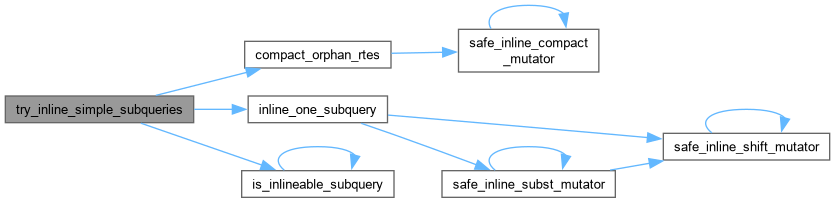
Subquery-inlining pre-pass.
See the chapter comment. Returns NULL when nothing inlined (caller keeps the original q); else a fresh Query with the inlining and compaction baked in.
Definition at line 4227 of file safe_query.c.

|
static |
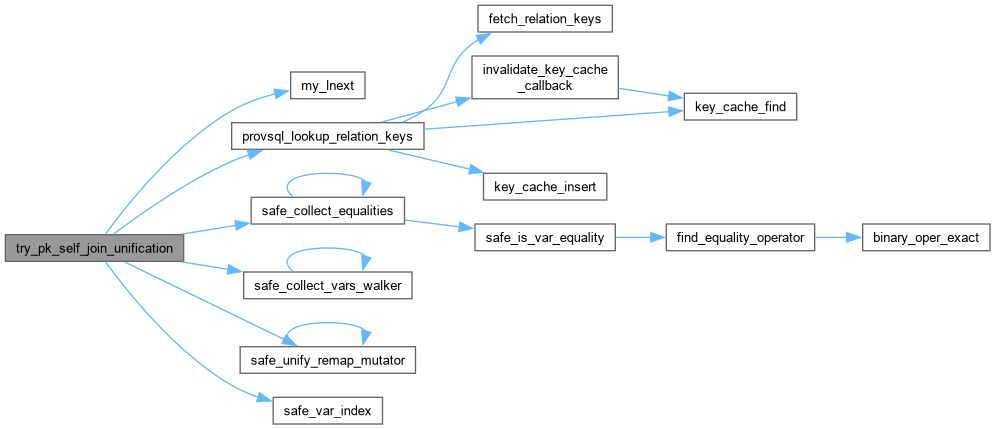
PK-unifiable self-join detection and unification.
A query of shape R r1, R r2 WHERE r1.x = r2.x with PRIMARY KEY (x) on R forces r1 and r2 to refer to the same tuple. The two RTEs collapse to one single-atom CQ; the safe-query candidate gate's "no two RTEs may
share a relid" bail becomes a missed-opportunity bail when the PK proves the shared-relid pair is non-self-joining at the tuple level.
This pre-pass runs before is_safe_query_candidate. It returns NULL when no unification fires; otherwise it returns a fresh Query in which:
rtable.jointree->fromlist's RangeTblRef entries are renumbered or dropped to match. Multiple original entries pointing at the same survivor are deduplicated.Var.varno (and parallel varnosyn) in targetList and jointree->quals is rewritten to point at the survivor's new (compacted) rtindex.Soundness traps:
r1.x = r3.x AND r2.x = r3.x) suffice.Definition at line 3338 of file safe_query.c.

| Query * try_safe_query_rewrite | ( | const constants_t * | constants, |
| Query * | q ) |
Top-level entry point for the hierarchical-CQ rewriter.
Runs the shape gate, then the hierarchy detector. When both accept, applies the rewrite and returns the rewritten Query (the caller is expected to re-enter process_query on the result). Returns NULL when q is outside the safe-query scope.
| constants | Cached extension OIDs (from get_constants). |
| q | Input Query, modified in place by side-effect-free helpers but not consumed; the rewriter copyObject's it before mutating. |
Query, or NULL to fall through. Definition at line 4775 of file safe_query.c.