Aggregation Provenance
Aggregation is the most subtle feature of ProvSQL’s query rewriter: unlike selection or join, an aggregate function fundamentally combines values rather than just propagating them, so the provenance of an aggregate result cannot be a plain semiring value of the same type as a tuple’s provenance. This chapter explains the data model ProvSQL uses to represent aggregate provenance, the gate types involved, and how the rewriter glues everything together. The final section is a step-by-step guide for adding a new aggregate function in C++.
For the user-facing semantics see Aggregation and Grouping; for the formal semantics over the extended relational algebra see the ICDE 2026 paper [Sen et al., 2026].
The Semimodule Picture
The semiring framework for positive relational algebra (selection,
projection, join, union) annotates tuples: each row of a
K-relation carries a single element of a commutative semiring K.
Aggregation does not fit that picture, because the result of
SUM(salary) is a value, not a tuple, and the question “where
does this value come from?” has to track both the contributing
rows and the payload each row contributed. Amsterdamer, Deutch,
and Tannen ([Amsterdamer et al., 2011]) resolved this
by annotating tuples and values simultaneously using a
K-semimodule.
A K-semimodule is a commutative monoid  together
with a scalar multiplication
together
with a scalar multiplication  that
distributes over the semiring operations on K and over the monoid
addition on M. The intuition is that elements of M are
“aggregate values” and elements of K are “provenance
annotations”; scaling
that
distributes over the semiring operations on K and over the monoid
addition on M. The intuition is that elements of M are
“aggregate values” and elements of K are “provenance
annotations”; scaling m by k produces an M-element
“tagged” with the provenance k.
The specific K-semimodule the paper builds for aggregate
provenance is the tensor product  , whose
elements are finite formal sums
, whose
elements are finite formal sums
 of pairs (“simple tensors”)
  , modulo the
equivalences that make
, modulo the
equivalences that make  bilinear
(
bilinear
( , etc.).
Note how this mixes three different operations:
, etc.).
Note how this mixes three different operations:  is the ⊕ of the semiring K,
  is the monoid addition of
the semimodule , and is the
tensor product that glues a K-element to an M-element. A simple
tensor should be read as “the tuple with
provenance
is the monoid addition of
the semimodule , and is the
tensor product that glues a K-element to an M-element. A simple
tensor should be read as “the tuple with
provenance k contributed the value m”. The whole
is itself a K-semimodule, with scalar
multiplication  .
.
Concretely, for a query like
SELECT city, SUM(salary) FROM personnel GROUP BY city;
the provenance of the aggregate value in one group is

where k_i is the semiring annotation of the i-th input tuple
in the group and m_i is its salary payload (lifted into M).
The sum is not collapsed into a single number – it carries,
for every contributing tuple, both its provenance and the value
it contributed, and concrete semirings (Counting, Formula, …)
are free to specialise the aggregation over
into a meaningful scalar only at evaluation time.
Strictly speaking, the Amsterdamer et al. construction requires
to be a commutative monoid, which rules out
aggregate operators that are non-associative or non-commutative
(ARRAY_AGG with a user-supplied order, for instance).
ProvSQL therefore reuses the semimodule framework – the
tensor product , the semimod / agg /
value gate types, the circuit shape – but does not bake
the monoid axioms into it. An agg gate is treated as an
abstract formal sum of simple tensors, and it is up to each
concrete accumulator to decide what “combining” those tensors
means. Aggregates whose operator genuinely is a commutative
monoid (SUM, COUNT, MIN, MAX, AND, OR,
…) open the door to optimisations – reordering, partial
folding during traversal, and so on – that accumulators for
order-sensitive or non-associative aggregates cannot use. The
distinction is a property of the accumulator, not of the gate
representation.
ProvSQL realises this construction directly as a circuit built
from three gate types in gate_type:
value– a leaf carrying a constant payload (stored as a string in the persistent representation; the
C++ accumulator parses it into the appropriate native type).
(stored as a string in the persistent representation; the
C++ accumulator parses it into the appropriate native type).semimod– a binary gate representing one simple tensor. Its two children are the tuple’s
provenance (a sub-circuit evaluating to  ) and a
valuegate carrying.agg– the aggregate root, the formal sum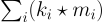 taken over all tuples in
the group. Its annotations (
taken over all tuples in
the group. Its annotations (info1/info2fromget_infos) record the PostgreSQL OID of the aggregate function and the OID of its result type, so the evaluator can later instantiate the right C++ accumulator. The high bit ofinfo2(PROVSQL_AGG_SCALAR_FLAG, inprovsql_utils.h) flags a scalar (noGROUP BY) aggregation; consumers ANDinfo2withPROVSQL_AGG_TYPE_MASKto recover the result-type OID before using it. Soinfo2of acountreads20(int8), of a text aggregate25, of afloat8one701, each with the high bit set where there is noGROUP BY. This is the only place the type of a value is recorded: an evaluator that instead infers it from how the value’s text looks will read a text column of numerals as numbers, and order it numerically where PostgreSQL orders it lexicographically.
Row-level provenance and the δ operator
An agg gate gives the provenance of the aggregate value in
one column of one output row, but the row itself also has a
provenance – “this row exists in the result” – that the
downstream evaluators need. That row-level provenance is the ⊕
of the per-tuple tokens of the group, just like for a plain
GROUP BY without aggregates. However, summing raw tuple
annotations can over-count existence: a row that exists in
multiplicity  in the input would naively have a
row-level provenance of
in the input would naively have a
row-level provenance of
 (n times),
whereas what we want is a single “it exists”.
(n times),
whereas what we want is a single “it exists”.
The δ operator (Amsterdamer, Deutch, Tannen
[Amsterdamer et al., 2011]) solves this. A
δ-semiring is a semiring together with a unary operation δ
satisfying  and
and
 regardless of the number of
  s. Intuitively, δ collapses “any positive number of
witnesses” to a single “exists”. The rewriter emits a
s. Intuitively, δ collapses “any positive number of
witnesses” to a single “exists”. The rewriter emits a delta
gate wrapping the row-level ⊕ for grouped aggregation whose
HAVING clause (if any) is not lifted into the provenance
circuit (see make_provenance_expression). Scalar
aggregation (no GROUP BY) gets gate_one instead: the
single result row always exists, even over an empty input. A
HAVING predicate left for native PostgreSQL evaluation still
gets the δ; a lifted HAVING – one referencing aggregate
provenance – instead supersedes it with provenance_cmp: such
a predicate constrains existence in a way that depends on the
aggregate value, so the row-level token has to carry more
information than a flat “exists”, and the rewriter routes the
result through cmp gates that having_semantics.hpp
evaluates ahead of the main traversal (see
Optional Methods). The cmp gate subsumes the
δ rather than multiplying with it: its possible-world enumeration
ranges over the non-empty worlds of the same per-row tokens, so it
already entails the group’s existence, and conjoining both would
count that factor twice in a non-idempotent semiring.
For MIN / MAX against a constant in an absorptive semiring
(Semiring::absorptive() true; see
Optional Methods), the enumeration is replaced by a
single-scan closed form. With  the -sums of the contributors whose value is
 the constant,
 MIN < C is  ,
,
MIN <= C is  ,
, MIN >= C is
 ,
, MIN > C is
 ,
, MIN = C is
 and
and MIN <> C is
 ;
; MAX is the
mirror image with  and
and  exchanged. The two
monus-free forms are the existential comparisons:
exchanged. The two
monus-free forms are the existential comparisons: MIN < C
holds in exactly the worlds containing some contributor below
 , a family closed under supersets whose minimal elements are
the singletons, and on such a family the monus cancels from the
possible-world sum, so absorptivity alone makes the sum of the
witnesses exact (Lean
, a family closed under supersets whose minimal elements are
the singletons, and on such a family the monus cancels from the
possible-world sum, so absorptivity alone makes the sum of the
witnesses exact (Lean Having.sum_ann_meet and the
*_site_rewrite theorems of Provenance/HavingMonotone.lean).
The four other forms are proved only when  also
distributes over
also
distributes over  (
(Semiring::mul_sub_left_distributive()
true; Lean Having.minScan_correct / Having.maxScan_correct
in Provenance/HavingMinMax.lean), so in the security (min-max)
semiring, absorptive but not distributive, only the existential
comparisons take the scan and the others keep the enumeration.
Whether distributivity is necessary for them is not settled: the
five-element chain of Provenance/Semirings/ChainFive.lean
refutes the COUNT = 1 and COUNT <= 1 identities without it,
but is not a counterexample to the MIN / MAX forms. The same existential collapse serves
bool_or = true and bool_and = false, whose valid worlds are
those meeting the trigger class. Short of absorptivity, idempotence
(Semiring::idempotent(), true of why- and which-provenance)
already cancels the monus from the possible-world sum over any
family closed under supersets (Lean Having.witness_identity):
for those two conditions, and for MIN below and MAX above a
constant, COUNT above one and SUM above one over non-negative
values, an idempotent semiring keeps the exhaustive enumeration but
annotates each valid world by the product of its present
annotations alone. The empty world
never satisfies the comparison (MIN / MAX of an empty group
is NULL), so scalar aggregation needs no special case. The certifying
Boolean-circuit construction (BoolExpr over independent base
tuples) keeps the complete enumeration, whose mutually exclusive world
terms its d-DNNF certificate needs; the closed form is what it builds
when the contributors are derived sub-circuits (a join, a subquery).
What the cmp supersedes is the compared group’s δ, not the
whole row token it sits in. The distinction matters when the
comparison was written in an outer WHERE over a subquery’s
aggregate: migrate_probabilistic_quals routes such a qual
to that outer level’s havingQual, where the row token is the
product of every input at that level, and only the δ inside it is
superseded. Those tokens are opaque UUIDs at planning time, so
make_provenance_expression defers the decision to
provenance_cmp_times, which walks them at evaluation
time through cmp_surviving_factors:
a bare δ over the compared group disappears – the plain γ-then-σ shape, whose annotation is then the
cmpalone, the same gate the fusedHAVINGbuilds;a
timeskeeps its other factors, so a join partner’s annotation survives even when the aggregation and the join reach this level bundled inside one view or CTE token;anything else is kept whole and multiplied – in particular an earlier comparison’s
cmpon the same group, which a second comparison does not subsume, so σ∘σ yields the product of both comparisons rather than the later one alone.
A δ counts as the compared group’s when its ⊕ child’s operands are
exactly the provenance children of that aggregate’s semimod
wires, i.e. when it collapses the multiplicity of the very group
the comparison ranges over.
The supersede is licensed only when the predicate really does
entail that the group exists. An aggregate-free leaf does not: it
lowers to a deterministic regular_indicator, 𝟙 or 𝟘 by
the value of a grouping column, which says nothing about whether
any row is present. HAVING count(*) >= 4 OR g = 1 would
otherwise report certainty for a group that is empty half the
time, since 𝟘 ⊕ 𝟙 = 𝟙. having_entails_group_existence
decides this the way the semiring composes: under ⊗ one entailing
factor suffices, under ⊕ every disjunct must entail. Where it
does not hold the δ stays – wrapped around the group’s ⊕ in the
fused shape, left in place in the row tokens otherwise.
Note
This supersede discipline is machine-checked in the ProvSQL
Lean 4 library, on a query syntax whose columns are indexed by
the three kinds ProvSQL distinguishes by type – regular
values, aggregate tokens, provenance values (see
the formal-verification section of the rewriting chapter). Row annotations there
are factored
(GenAnn):
a grouping leaves its group-existence factor pending, an
aggregate comparison supersedes exactly the compared groups’
factors with the predicate provenance of the token, and a
projection cashes the factors of the token columns it drops.
Whether the guard is superseded or kept is decided by
GenPred.entailsExistence,
the counterpart of having_entails_group_existence: an
aggregate-only predicate always supersedes it
(GenPred.aggOnly_entailsExistence),
one with a regular atom reachable in an empty group does not –
that atom being an indicator gate
(TermG.chiGate),
the counterpart of regular_indicator. For the fused shape,
one aggregate comparison directly above a grouping, the
annotation is proved to be exactly the possible-world predicate
provenance of the group, one row per group key
(AggQuery.havingSite_evaluateAnnotated).
Groups that fail in every world
A lifted HAVING predicate becomes a gate whose value is only known
once the circuit is evaluated. Some groups can be told to be zero
without that: those where the predicate cannot hold whichever rows of
the group are present. What decides it is the range of values the
aggregate takes over the non-empty selections of the group’s rows, and
PostgreSQL computes the ends of that range as ordinary aggregates of
the same GROUP BY. having_possible builds, from the
predicate, an ordinary SQL condition that is true when the predicate
may hold in some world; make_provenance_expression leaves it
as the HAVING clause of the rewritten query, so PostgreSQL drops
the other groups before their gates are created. A row whose
provenance is zero being the same as an absent row, this changes no
result; it restores SQL’s row set on such groups and spares their
gates and evaluation, at a cost that does not show (a few ordinary
aggregates, next to one provenance_semimod call per row).
The ends used, for a comparison of the aggregate with an aggregate-free term (a constant, an expression over grouping keys):
count: at most the count itself;sum: at most the sum of the positive values (sum(x) FILTER (WHERE x > 0)), or 0 without any, and symmetrically below; the group must also have a non-NULLvalue at all;max,min,avg: between theminand themaxof the values, the sibling aggregate being looked up on the exact argument type.
>= needs the upper end to reach the term, <= the lower end,
= both; <>, a comparison of two aggregates, any other
aggregate, or an aggregate column coming from a subquery leave the
group alone. The Boolean structure follows the lift: NOT is
pushed to the atoms, a conjunction keeps what is known of its parts, a
disjunction is known only if every part is, and a regular atom is its
own condition. A NULL condition drops the group: the comparison is
then unknown in every world.
The check is a sufficient one – sum(x) = 5 over {2, 4} lies
inside the range and is kept, to be evaluated to zero; telling such
cases is NP-hard – and it rests on an invariant of the rewriting: the
rows PostgreSQL aggregates over are a superset of the rows present in
any world. A row that some world lacks is kept with a token that is
zero in that world (monus for differences, antijoins and null-padded
outer-join rows, comparison gates for lifted predicates), never
filtered on the current instance. The one construct that breaks it, a
LIMIT / OFFSET in a subquery, raises a warning of its own. The
same predicate written as a selection on the aggregate column of a
subquery is not checked (no HAVING clause can carry the condition
at that level); its zero rows stay visible, which is equivalent. An
evaluation-time counterpart exists in RangeCheck.cpp, which
resolves the comparisons that reach the evaluator.
The agg_token Type
PostgreSQL evaluates aggregates using its own machinery, which
expects them to return ordinary scalar types (an INT, a
FLOAT…). But the rewritten query needs the aggregate
result to carry both the scalar value and the provenance gate
that captures how it was computed – otherwise downstream
references to provenance would have nothing to return.
ProvSQL solves this by introducing agg_token, a
composite SQL type wrapping a UUID (the root agg gate) and a
string form of the aggregate value. The rewriter wraps every
Aggref in a call to provenance_aggregate whose
return type is agg_token. When the executor processes the
result, every aggregate column carries an agg_token and
both pieces of information flow downstream:
provenanceextracts the UUID for the user.Cast operators on
agg_token(defined inagg_token.c) extract the scalar value when the user treats the result as a number, e.g. for further arithmetic.
Arithmetic on aggregate results preserves provenance: once you
write SUM(x) * 2, the rewriter
(cast_agg_token_mutator / try_swap_agg_arith in
provsql.c) swaps the scalar operator for the + - * /
operators defined on agg_token (in
sql/provsql.common.sql), so the result is again an
agg_token whose UUID points at an arith gate over the
operand circuits. Provenance is lost only on a genuine cast out
of agg_token – e.g. storing the result into a numeric
column – and the cast functions in agg_token.c emit an
execution-time warning when that happens. Comparisons of
aggregate results are routed through cmp gates so that
HAVING predicates preserve provenance too – see
Semiring Evaluation for the gory details of how that
pre-evaluation works.
What the Rewriter Builds
The generic rewriting pipeline in Query Rewriting Pipeline covers
aggregation at the pipeline level: Step 4 calls
rewrite_agg_distinct to lift a single-argument
AGG(DISTINCT ...) into an inner GROUP BY, Step 8 calls
migrate_probabilistic_quals, then
replace_aggregations_by_provenance_aggregate (and
rewrite_agg_cases), then
insert_agg_token_casts, and Step 9 fuses the row-level
tokens with provenance_plus(array_agg(...)) and wraps the
result in provenance_delta. This section only documents the
aggregation-specific structures those passes produce – the
pieces that the generic pipeline description is too terse to spell
out.
The call that make_aggregation_expression synthesises to
replace an Aggref is a FuncExpr for
provenance_aggregate whose arguments are:
the OID of the aggregate function;
the OID of its result type;
the original
Aggrefitself, so PostgreSQL still computes the scalar value (this is what ends up inside theagg_token). When a row reaching the aggregate may be false in the database as it is (plain_row_token: its token has amonusor acmp, or comes from a relation of derived tokens), aFILTER (WHERE plain_truth(t))on the row tokentis added to it, so that the value is the one plain SQL computes on the same data.plain_truthissr_booleanwithout a mapping, walkingtimes/plus/monus/ … gates directly and evaluating a comparison over the Boolean semiring. TheHAVINGpruning bounds, which range over every world, read theAggrefwithout that filter (aggref_over_all_rows);an
array_aggof per-tupleprovenance_semimod(arg, t)calls – onesemimodgate per input the aggregate reads, glueing the row’s provenancetto the row’s contributed valuearg(see Which rows are children of the agg gate below for which rows those are);a boolean
is_scalar(DEFAULT false), set for scalar (noGROUP BY) aggregation; it flows into the high bit of theagggate’sinfo2.
That fourth argument is where the semimodule construction of
The Semimodule Picture is actually assembled: every
semimod gate is one simple tensor , and the
agg gate at the root of the provenance_aggregate call is
their formal sum .
Which rows are children of the agg gate
The invariant is that the children of an agg gate are exactly
the inputs the aggregate reads; the value-aware evaluators
(HAVING, moments, sampling) rely on it. Three cases, decided in
make_row_semimod, which builds the contribution of a row for
make_aggregation_expression:
NULL-skipping aggregates (
sum,min,max,avg,string_agg,choose, …).provenance_semimodreturnsNULLfor aNULLvalue andprovenance_aggregatedrops such entries, so a row with aNULLargument is no child. AFILTER (WHERE f)clause is folded into the argument, asCASE WHEN f THEN arg END, which makes a row failingfindistinguishable from a row with aNULLargument – including forHAVING agg IS [NOT] NULL, which splits the group on that per-row value.count.count(*)contributes the constant 1 andcount(e)the valueCASE WHEN e IS NOT NULL THEN 1 ELSE 0 END; with aFILTERthe condition becomesf(respectivelyf AND e IS NOT NULL). A row that does not count thus stays a child, of value 0: it still witnesses its group, and a liftedHAVING count(...) = 0replaces the group’s δ, so dropping the row would let the comparison hold in the world where the group is empty. The gate keeps theCOUNToperator, which is what tells evaluators that the empty input has value 0 and notNULL.NULL-keeping aggregates (
array_agg,json_agg,jsonb_agg,json_object_agg,jsonb_object_agg, and user-defined aggregates with a non-strict transition function; seeaggregate_keeps_nulls), whose result enumerates every input. They useprovenance_semimod_nullable, which maps aNULLvalue to asemimodgate over the constant value gategate_null; aFILTERis copied onto the tokenarray_agg, removing children exactly as it removes inputs. No existence issue arises here: over an empty input these aggregates areNULL, and a comparison withNULLnever holds.HAVING agg IS [NOT] NULLaccordingly splits the group on “passes the filter”, not on the value.
For built-in aggregates the catalog cannot tell the first and last
cases apart: a non-strict transition function says nothing
(sum(bigint) and string_agg have one and skip NULL), hence
the explicit list. For a user-defined aggregate the transition
function is all there is to go by: a strict one is never called on a
NULL input, so the aggregate is NULL-skipping; a non-strict one
does receive NULL inputs, and the aggregate is treated as
NULL-keeping, which loses nothing (a kept NULL input can still be
ignored by an evaluator, a dropped one cannot be recovered).
ProvSQL’s own choose, non-strict and NULL-skipping, is exempted.
No user-defined aggregate has an evaluator, so this choice shows in
the displayed circuit and in HAVING agg IS [NOT] NULL only.
gate_null is a constant in the manner of
gate_zero and gate_one, but of type value, with NULL as its display
text. The C++ side knows it by its UUID (GATE_NULL_UUID in
having_semantics.hpp), which is what distinguishes it from
the value gate of the string 'NULL': its seed, 'null', is not
of the form 'value' || text that every actual value has. The
array_agg comparison of having_semantics.hpp maps it, and
an unquoted NULL of the constant array, to one element that equals
only itself, which is how PostgreSQL compares arrays.
Aggregates over random_variable (next section but one) take a
different route, and handle FILTER differently: the aggregates
make_rv_aggregate_expression rebuilds simply carry the clause
over, since their result is a random_variable built from the rows
PostgreSQL feeds them.
Constant arithmetic on an aggregate (sum(x) * 2) is pushed into
the argument by try_push_into_aggref before all this, so it
composes with FILTER: the identities it uses hold over any multiset
of rows.
The row-level side of the rewrite is much simpler. It reuses the
ordinary get_provenance_attributes collection, combines the
per-row tokens with provenance_plus(array_agg(...)), and – for
grouped aggregation whose HAVING (if any) is not lifted –
wraps the result in provenance_delta (scalar aggregation gets
gate_one; a lifted HAVING replaces the token with
provenance_cmp). The row-level token therefore has no
semimodule content: it only records which input rows witness the
output row’s existence.
The end result is that each row of the aggregation output carries:
per-aggregate-column
agg_tokenvalues whose UUID points to anagggate combiningsemimodper-tuple contributions;a row-level
provsqltoken whose root is adeltagate over the ⊕ of the group’s row tokens.
These two pieces are independent: an evaluator that asks for the
provenance of a value in the result reaches an agg gate; an
evaluator that asks for the provenance of the row itself reaches
a delta gate.
Aggregates as window functions
An aggregate used as a window function, in a query without aggregation
of its own, is rewritten by replace_window_aggregations, which
calls make_window_aggregation_expression on each
WindowFunc of the target list:
provenance_aggregate(fn, type,
                     f(x) OVER w,
                     array_agg(provenance_semimod(x, k)) OVER w,
                     is_scalar)
Both window calls reference the same WindowClause (the same
winref), so the token array is collected over exactly the rows of
the frame, and make_row_semimod builds each row’s contribution
as for a group. The row-level token is left as it is: a window function
neither merges nor removes rows. For a whole-partition window, the gate
of each row is the gate of the GROUP BY on the partition attributes,
as the equivalence of a window aggregate with the join of each row to
the grouped query predicts (Equivalence (4) of Lindner, Naumann and
Lerner, Window Function Optimization: Co-Evaluation and Other
Techniques,
PVLDB 19(11), 2026).
The frame of a window is only known in each possible world if it
depends on the values of the rows, not on their positions: the previous
row of a world is its previous present row.
window_frame_by_values accepts a window without ORDER BY,
RANGE frames, GROUPS frames without offsets and ROWS frames
over the whole partition; any other window function is left as it is,
and process_query emits its warning. is_scalar is set when
the frame may exclude the current row
(window_frame_has_current_row): the frame may then be empty in
a world where the row exists, and has the value of an aggregation over
no row, for which provenance_aggregate builds an agg gate
without children rather than gate_zero. When the frame always
contains the current row, the grouped convention is kept, which is what
makes whole-partition gates those of the GROUP BY.
A sort key on a rewritten value is moved to a junk copy of the original
window call, so ORDER BY sorts on the displayed value.
The ranks are counts over a frame appended to the query
(make_rank_window): a copy of the window of the rank with the
frame RANGE BETWEEN UNBOUNDED PRECEDING AND CURRENT ROW EXCLUDE
GROUP, the rows strictly before the current one, which needs
PostgreSQL 11.
rank()is1 + count(*)over that frame (make_rank_expression). The frame excludes the current row, so the count does not read the token that multiplies the comparisons on it, and the comparison evaluators, which fold the+ 1into their threshold (see Probability Evaluation), see independent contributors.dense_rank()counts the distinct ordering values of that frame (make_dense_rank_expression). Window aggregates have noDISTINCT: twoarray_aggover the frame collect the ordering values, as a row value, and the row tokens, andwindow_distinct_tokensgroups them by value into onesemimod(1, ⊕ tokens)per value, the children of a scalarCOUNTgate whose value isdense_rank() - 1.row_number()is its rank wrapped inrow_number_as_rank, which returns the rank and warns, once per statement, when PostgreSQL’s row number differs from it.
Currently Supported Aggregates
The AggregationOperator enum in Aggregation.h
lists the operators recognised in C++: COUNT (whose per-row
values are 0 or 1, but which stays distinct from SUM because it is
0, not NULL, over an empty input), SUM, MIN, MAX,
AVG, AND, OR, CHOOSE, and ARRAY_AGG. Only the
aggregates the Monte-Carlo sampler and the subset enumerator
evaluate directly get an Aggregator accumulator (the
numeric ones – SUM / COUNT / MIN / MAX / AVG
– and CHOOSE); the boolean aggregates (bool_and /
bool_or / every) and array_agg exist only as enum
values for routing, because their HAVING comparisons are
resolved entirely by the m-semiring rewrite in
having_semantics.cpp (a first-present-occurrence
characterisation, a closed form in absorptive -over-
distributive semirings, a sum of witnesses for the
existential bool_or = true / bool_and = false in every
absorptive semiring, and an exact enumeration
elsewhere, and a possible-worlds enumeration respectively) and never
reach the deterministic sampler. Adding to the accumulator list is the
topic of the next section.
Random-Variable Aggregates
When the aggregated column has type random_variable
(see Continuous Distributions), the rewriter routes
through a separate path: instead of producing a
provenance_aggregate call that wraps the original
Aggref in an agg_token, it produces an aggregate
that returns a random_variable root. The aggregate’s
result is the lifted scalar  (or its product / average / extremum analogue),
realised as a single
(or its product / average / extremum analogue),
realised as a single gate_arith over per-row
gate_mixture children.
The dispatch in make_aggregation_expression keys on
aggtype (the aggregate’s result type OID): when
aggtype = OID_TYPE_RANDOM_VARIABLE, the per-row argument
X_i is wrapped in rv_aggregate_semimod
(a mixture over the row’s provenance gate and
the identity for the aggregate) before it reaches the SFUNC.
The identity is dispatched per aggregate — 0 for
sum, and through the three-argument
identity-parameterised form of rv_aggregate_semimod, 1
for product, -Infinity for max,
+Infinity for min — so a row absent in a world
contributes the fold’s identity rather than perturbing it.
avg is rewritten at the same site into the
“AVG = SUM / COUNT” identity (a numerator sum over the wrapped
rows divided by a sum of mixture(prov_i, 1, 0) indicators).
The aggregate’s SFUNC accumulates the wrapped per-row UUIDs; the
FFUNC is then a plain fold building the final gate_arith
root (PLUS / TIMES / MAX / MIN). The
RV-returning aggregates currently shipped – sum,
avg, product, max,
min – share an INITCOND = '{}' so the FFUNC runs
even on an empty group, and can therefore tell an empty group
apart from a group whose every input was NULL. Both report
SQL NULL.
This is the semimodule-of-mixtures shape: rather than minting a
new M-polymorphic gate_agg that would require parallel
evaluation paths in every analytical evaluator, the rewrite
composes through the existing gate_arith /
gate_mixture rules. See
Continuous Distributions for the FFUNC details.
Step-by-Step: Adding a New Aggregate
As a running example, assume we want to add bit_and – the
bitwise-AND of all non-null integer values in a group. The
mechanics are independent of which aggregate you are adding; the
only design point is the C++ accumulator that knows how to
combine the values incrementally.
Add an enum value. In
Aggregation.h, extendAggregationOperator:enum class AggregationOperator { COUNT, SUM, MIN, MAX, AVG, AND, OR, CHOOSE, ARRAY_AGG, BIT_AND, // new NONE, };
Map the PostgreSQL function name to the enum. In
Aggregation.cpp, extendgetAggregationOperatorwith a case matching the PostgreSQL function name returned byget_func_name():} else if(func_name == "bit_and") { op = AggregationOperator::BIT_AND;
Each PostgreSQL aggregate function with distinct semantics needs its own enum value and accumulator; aliases with identical semantics (e.g.
stddev/stddev_samp) can share one.Implement the accumulator. Add a templated
Aggregatorsubclass inAggregation.cppnext to the existing ones (SumAgg,MinAgg,AvgAgg, etc.). The interface is three virtual methods (resultType()defaults toinputType()):template <typename T> struct BitAndAgg : Aggregator { T acc = ~T{0}; // all-ones identity bool has = false; void add(const AggValue& x) override { if (x.getType() == ValueType::NONE) return; acc &= std::get<T>(x.v); has = true; } AggValue finalize() const override { return has ? AggValue{acc} : AggValue{}; } ValueType inputType() const override { return ValueType::INT; } };
An accumulator is only warranted for an aggregate the sampler / enumerator must evaluate on concrete values; an aggregate whose
HAVINGsemantics are resolved by the m-semiring rewrite (like the boolean aggregates andarray_agg) needs only the enum value and routing inhaving_semantics.cpp.Instantiate the accumulator. Extend
makeAggregatorinAggregation.cppwith a case that creates the right template instantiation for each supported input type:case AggregationOperator::BIT_AND: switch (t) { case ValueType::INT: return std::make_unique<BitAndAgg<long>>(); default: throw std::runtime_error("BIT_AND not supported for this type"); }
Add a regression test. Create
test/sql/agg_bit_and.sqland its expected output, following the pattern of the existing aggregation tests. Reference it fromtest/schedule.common(see Testing and Build System for the schedule conventions).Update the user guide. Mention the new aggregate in Aggregation and Grouping, and add it to the list of currently supported operators in the “Currently Supported Aggregates” section above.
Nothing else needs to change: the query rewriter, the
provenance_aggregate SQL function, and the agg_token
composite type all operate on OIDs and metadata, so they pick up new
aggregates automatically once steps 1–4 are in place.
CASE over aggregates
A searched CASE whose branches are aggregates lowers to a gate_case
carried by an agg_token – the aggregate-carrier counterpart of the
RV-carrier CASE (Continuous Distributions). The gate type is
carrier-agnostic (its branch types discriminate the carrier), so no new gate or
on-disk change is needed.
Planner lowering (provsql.c). Unlike the RV pass, which runs early,
the aggregate-CASE rewrite (rewrite_agg_cases) must run after
replace_aggregations_by_provenance_aggregate – only then are the branch
sum(y) / guard sum(x) > 3 lowered to agg_token and an agg comparison.
It runs before insert_agg_token_casts so the result stays an agg_token
(rather than being cast to numeric, which would drop the provenance).
build_agg_case mirrors build_rv_case but lowers each guard with
having_Expr_to_provenance_cmp (the same evaluator as a HAVING
comparison, which the RV path’s predicate_to_condition_gate cannot reach
post-lowering because it dispatches on the now-absent Aggref), and casts
each branch value agg_token -> uuid (a constant branch is lifted with
agg_value_gate, the agg-side as_random). It emits agg_case(uuid[]).
Degradation when the lowering does not apply. A CASE the rewrite
leaves alone – the simple form CASE <arg> WHEN ..., a shape
build_agg_case declines, or a schema whose upgrade path predates
agg_case (OID_FUNCTION_AGG_CASE invalid) – still carries
agg_token-typed branches under the original (e.g. numeric) CASE
type. cast_agg_token_mutator therefore has a CaseExpr arm that
casts such branches back to the CASE’s result type (their actual-world
values, with the provenance-loss warning). This is load-bearing: a bare
117-byte fixed-length agg_token datum left under a varlena-typed CASE
would be reinterpreted as a varlena whose “length” is UUID text bytes –
a server crash in tts_virtual_materialize or silent tuple corruption.
Exact evaluation (agg_raw_moment). A case gate is handled by
the conditional-on-defined possible-worlds identity
![E[\text{pick}^k \mid \text{defined}] =
\sum_i \Pr(R_i \wedge d_i)\,E[\text{value}_i^k \mid R_i \wedge d_i] /
\sum_i \Pr(R_i \wedge d_i)](../_images/math/2e0cb43bfcfc436d1f03fba8837e291fdcd71dc8.svg) over the
first-match regions
over the
first-match regions  (built with
 provenance_times /
provenance_not), each conjoined with the branch’s defined event
 (
(agg_defined_event: gate_one for sum / count /
constants, whose empty group is the real value 0; “some contributing row
present” – the OR of the semimod children’s row tokens – for min /
max / avg, which are NULL on an empty group; recursive for a
nested CASE). The moment therefore conditions on the CASE’s value
being defined, matching the bare MIN / MAX convention, and returns NULL
only when the defined mass is zero; when every branch is defined
everywhere the defined mass equals  and the
formula reduces to the plain region-weighted sum. Both factors reuse
existing exact machinery – the Boolean
and the
formula reduces to the plain region-weighted sum. Both factors reuse
existing exact machinery – the Boolean
probability of the region-and-defined event and a recursive conditional
agg_raw_moment of
the branch (whose MIN / MAX / CASE arms condition on their own definedness
within the region, so the two factors weigh the same worlds) – so no new
possible-worlds enumeration is written; the regions are
mutually exclusive, so the terms sum without inclusion–exclusion. Per branch:
a constant is a Dirac ( ), a single aggregate or nested
 CASE is
exact via agg_raw_moment, and an arithmetic / composite / avg branch
falls back to
the Monte-Carlo scalar path (rv_moment), which composes gate_case with
the aggregate leaves. The MC sampler already handles gate_case + gate_agg
with no change.
AVG moments (agg_raw_moment’s avg arm). AVG = SUM/COUNT is a
ratio of two correlated world-dependent quantities, so the SUM arm’s
k-tuple expansion does not apply. The exact arm
(agg_avg_moment_exact -> aggAvgRawMomentExact in
AggMarginalEvaluator.cpp) computes
![E[\text{AVG}^k \mid \text{COUNT} \ge 1] =
\sum_{(s,c),\,c\ge 1} (s/c)^k\,\text{pmf}(s,c) / \Pr(c \ge 1)](../_images/math/bcc99f019555c4d6c4d16670e9e7c5b0fbbb3ed4.svg) from the
joint
from the
joint  distribution – the
sumCountPMF machinery the HAVING comparison pre-pass already uses,
now templated on the weight type (the integral instantiation keeps the
HAVING path byte-identical; the double instantiation shares the
independent-fold and laminar-shared-root branches, so join-anchored
groups stay exact, and self-gates on the integer-only
additive-separation product branch). Any out-of-scope shape – an outer
conditioning event, shared leaves beyond the laminar class, compound
contributors – falls back to the Monte-Carlo scalar path, whose
NaN-skip on empty draws implements the same conditional-on-defined
convention.
Display. The token’s cell carries the actual-world CASE value, like any
aggregate’s cell: agg_case resolves it through the circuit with
agg_gate_value (agg / arith / value gates read their recorded
extra; a case walks its guards first-match via agg_guard_holds,
which evaluates each cmp gate on its operands’ deterministic values under
the operator recorded in info1, with Kleene AND/OR for times /
plus combinations). agg_token_value_text uses the same walker for
case / conditioned / semimod / value roots, so every
aggregate-carrying token renders as value (*) – both in psql cells and in
Studio result tables (which recover the display from the bare UUID).
Open: closed-form moments for arithmetic-combination branches (inherits the
bare sum(x) + sum(y) limitation).