 |
ProvSQL C/C++ API
Adding support for provenance and uncertainty management to PostgreSQL databases
|
|
ProvSQL C/C++ API
Adding support for provenance and uncertainty management to PostgreSQL databases
|
Aggregation operator and accumulator implementations. More...
#include "Aggregation.h"#include <string>#include <stdexcept>#include "utils/lsyscache.h"#include "utils/elog.h"#include "provsql_utils.h"#include "provsql_error.h"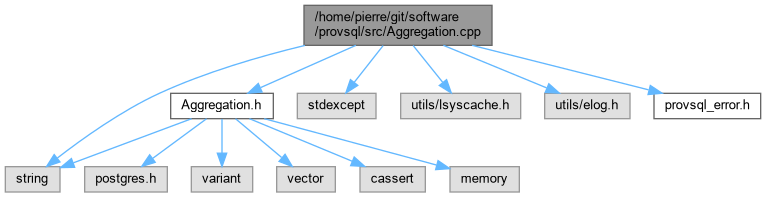
Go to the source code of this file.
Classes | |
| struct | False<... > |
| struct | StandardAgg< T > |
| Base aggregator template for scalar types (int, float, bool, string). More... | |
| struct | SumAgg< T > |
| Aggregator implementing SUM for integer or float types. More... | |
| struct | MinAgg< T > |
| Aggregator implementing MIN for integer or float types. More... | |
| struct | MaxAgg< T > |
| Aggregator implementing MAX for integer or float types. More... | |
| struct | ChooseAgg< T > |
| Aggregator implementing CHOOSE (returns the first non-NULL input). More... | |
| struct | AvgAgg< T > |
| Aggregator implementing AVG; always returns a float result. More... | |
Functions | |
| AggregationOperator | getAggregationOperator (Oid oid) |
Map a PostgreSQL aggregate function OID to an AggregationOperator. | |
| ComparisonOperator | cmpOpFromOid (Oid op_oid, bool &ok) |
Map a PostgreSQL comparison-operator OID to a ComparisonOperator. | |
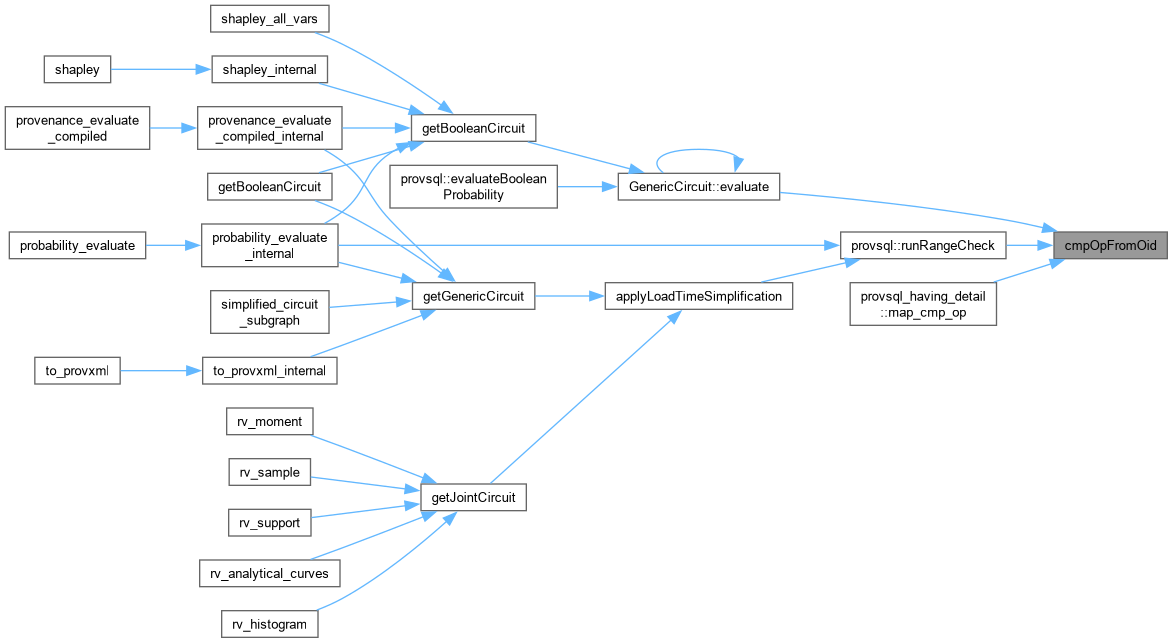
| ArithmeticOperator | arithOpFromTag (unsigned tag, bool &ok) |
Map a gate_arith operator tag to an ArithmeticOperator. | |
| std::unique_ptr< Aggregator > | makeAggregator (AggregationOperator op, ValueType t) |
Create a concrete Aggregator for the given operator and value type. | |
Aggregation operator and accumulator implementations.
Implements the two factory functions declared in Aggregation.h:
getAggregationOperator(): maps a PostgreSQL aggregate function OID (looked up by name via get_func_name()) to an AggregationOperator enum value.makeAggregator(): constructs a concrete Aggregator subclass for the given operator/type combination.Each built aggregation function × value-type combination has its own Aggregator subclass defined locally in this file (e.g. SumAgg<long>, MinAgg<double>, ChooseAgg<long>). Only the aggregates the Monte-Carlo sampler and the subset enumerator evaluate directly are built: the numeric ones (SUM / COUNT / MIN / MAX / AVG) and CHOOSE (the categorical analog, decided by the exhaustive subset enumerator). The boolean (bool_or / bool_and) and array_agg aggregates are resolved to a Boolean subcircuit by the m-semiring HAVING rewrite (having_semantics) and so never reach makeAggregator.
Definition in file Aggregation.cpp.
| ArithmeticOperator arithOpFromTag | ( | unsigned | tag, |
| bool & | ok ) |
Map a gate_arith operator tag to an ArithmeticOperator.
The tag is the provsql_arith_op value stored in gate_arith's info1 field.
| [in] | tag | The persisted operator tag. |
| [out] | ok | Set to true on a recognised tag, false when tag is outside the enumeration (a circuit written by a newer version of the extension). |
ArithmeticOperator on success; an unspecified value (currently PLUS) when ok is false. Definition at line 94 of file Aggregation.cpp.
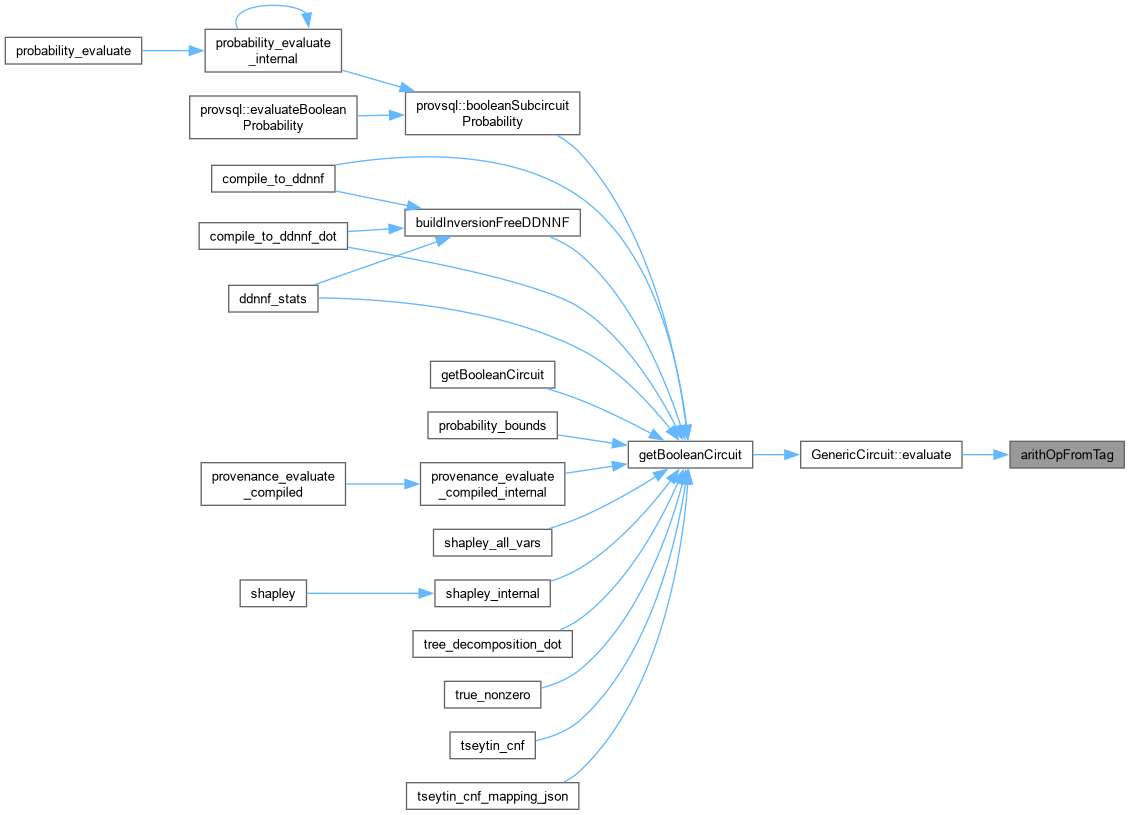
| ComparisonOperator cmpOpFromOid | ( | Oid | op_oid, |
| bool & | ok ) |
Map a PostgreSQL comparison-operator OID to a ComparisonOperator.
The OID is the one stored in gate_cmp's info1 field (the OID of one of the six standard comparators =, <>, <, <=, >, >=). The translation goes via get_opname() so it is operand-type agnostic.
| [in] | op_oid | Comparison-operator OID. |
| [out] | ok | Set to true on a recognised comparator, false when op_oid does not resolve in pg_operator or its name is not one of the six standard ones. |
ComparisonOperator on success; an unspecified value (currently EQ) when ok is false. Definition at line 72 of file Aggregation.cpp.
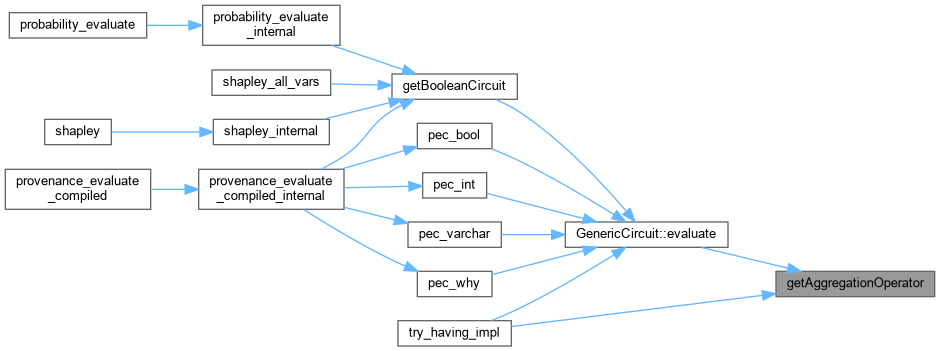
| AggregationOperator getAggregationOperator | ( | Oid | oid | ) |
Map a PostgreSQL aggregate function OID to an AggregationOperator.
| oid | OID of the aggregate function (e.g. F_COUNT_ANY, F_SUM_INT4). |
AggregationOperator. Definition at line 35 of file Aggregation.cpp.
| std::unique_ptr< Aggregator > makeAggregator | ( | AggregationOperator | op, |
| ValueType | t ) |
Create a concrete Aggregator for the given operator and value type.
| op | The aggregation function to implement. |
| t | The type of input values that will be accumulated. |
Aggregator, or nullptr if the combination is not supported. Definition at line 259 of file Aggregation.cpp.
