Aggregation and Grouping
ProvSQL supports provenance tracking for GROUP BY queries and aggregate
functions [Amsterdamer et al., 2011]. The semantics follow a
semimodule model: aggregation is treated as a scalar multiplication of
provenance values.
GROUP BY Queries
When a query includes a GROUP BY clause, each aggregate expression
receives an agg gate in the provenance circuit (surfaced as the
agg_token value of that cell). The children of this gate are
semimod gates, each pairing a contributing row’s value with that
row’s provenance token. The group row’s own provenance token
is a plus gate over the contributing tokens, wrapped in a delta
gate marking the aggregation boundary:
SELECT dept, COUNT(*), provenance()
FROM employees
GROUP BY dept;
The resulting provenance token encodes which input tuples were combined to produce each aggregate value.
The value displayed for an aggregate (3 (*)) is the one plain SQL
computes on the same data, without provenance. Some rows of a rewritten
query are kept only for the worlds where they exist, and are absent from
the database as it is: the null-padded row of an outer join for a row that
does have a match, a group that a HAVING rejects, a row beyond an
ORDER BY … LIMIT. Such rows do not count in the displayed value; they
do in its provenance. Whether a row holds in the database as it is, every
input tuple present, is sr_boolean without a mapping:
SELECT e.name, p.project, sr_boolean(provenance())
FROM employees e LEFT JOIN projects p ON p.lead = e.id;
ORDER BY on an aggregate result sorts on that displayed value, so
the rows come in the order plain SQL gives them, each with its
provenance. The order is that of the database as it is, not of each
world: a warning says so. With a LIMIT, the cut is therefore not
read per world either (see the section on LIMIT).
NULL inputs are skipped exactly as SQL prescribes: a NULL-valued row
contributes to count(*) but not to sum / avg / min /
max or count(col), and an all-NULL group’s aggregate is NULL –
including across possible worlds in HAVING (see the chapter on
NULLs).
SELECT DISTINCT
SELECT DISTINCT is modelled as a GROUP BY on all selected columns.
Each distinct output row gets a provenance token that captures all the
duplicate source rows that were merged:
SELECT DISTINCT dept, provenance()
FROM employees;
Aggregate Functions
The aggregate functions COUNT, SUM, MIN, MAX, and AVG
are all supported over provenance-tracked tables.
stddev, variance and their _samp and _pop forms are supported
over an exact argument (an integer, a numeric), where they are read as the
arithmetic that defines them,
SELECT stddev(pm25) FROM readings;
--  =  CASE WHEN count(pm25) <= 1 THEN NULL
--          WHEN count(pm25) * sum(pm25*pm25) - sum(pm25)^2 = 0 THEN 0
--          ELSE ((count(pm25) * sum(pm25*pm25) - sum(pm25)^2)
--                / (count(pm25) * (count(pm25) - 1))) ^ 0.5 END
over the sums and the count, which are tracked. The value is the one
PostgreSQL’s own accumulator gives, and it is read in every possible world
like any other arithmetic over aggregates: the first guard is the NULL a
group of one row has, the second keeps an exact zero from carrying the
trailing digits of the division’s scale. Over a floating-point argument the
arithmetic need not round as PostgreSQL’s accumulator does, so those are left
as a value of the data as it is, with the warning that says so.
Arithmetic on Aggregate Results
Arithmetic, explicit casts, and other expressions
(COALESCE, GREATEST, etc.) on aggregate results are supported,
both in the same query and over subquery results:
SELECT dept, COUNT(*) * 10 FROM employees GROUP BY dept;
SELECT dept, SUM(salary) + 1000 FROM employees GROUP BY dept;
SELECT dept, string_agg(name, ', ') || ' (team)' FROM employees GROUP BY dept;
SELECT cnt::numeric FROM (SELECT COUNT(*) AS cnt FROM employees GROUP BY dept) t;
SELECT dept, COALESCE(cnt, 0) FROM (SELECT dept, COUNT(*) AS cnt FROM employees GROUP BY dept) t;
SELECT dept, GREATEST(cnt, 3) FROM (SELECT dept, COUNT(*) AS cnt FROM employees GROUP BY dept) t;
When such an operation is performed, the aggregate result is cast from
its internal agg_token representation back to the original aggregate
return type (e.g., bigint for COUNT, numeric for AVG,
boolean for bool_or read as a condition, as in
CASE WHEN bool_or(x) THEN … END).
The value is then evaluated as plain SQL, on the data as it is (see
Parts Evaluated as Plain SQL): the planner emits one warning for the statement, naming a
relation it tracks, and provsql.implicit_freeze set to 'error' refuses the query. Marking the
part with plain says that the plain value is meant, and is the only
thing that does. The provenance of the aggregate group itself is still tracked
in the provsql column.
A cast to a number is not such a reading at all: it is a function of the
value, like round or abs, and it is carried.
SELECT SUM(salary)::numeric FROM employees;   -- tracked, the same number
SELECT AVG(salary)::bigint  FROM employees;   -- tracked, rounded as the
                                              -- cast itself rounds
SELECT SUM(salary)::text    FROM employees;   -- the plain value, named
A widening (an integer to numeric, to a float) keeps the value as it is,
and a narrowing to an integer rounds half away from zero, which is what
PostgreSQL’s own cast does; a cast to text, to a boolean or to a date
has no arithmetic behind it and stays a reading of the plain value. What the
cast starts from matters as well, since the carried form computes in
numeric over the value the aggregate holds: a cast over a text-valued
aggregate is a reading of the plain value, whatever it casts to.
A Boolean aggregate cast to an integer – bool_or(flag)::int, the only
cast SQL has on a Boolean – is carried, not as arithmetic but as the
indicator it means:
SELECT member, bool_or(role = 'admin')::int AS is_admin
FROM membership GROUP BY member;
--  =  CASE WHEN bool_or(…) = true  THEN 1
--          WHEN bool_or(…) = false THEN 0 ELSE NULL END
so it is 1 in the worlds where some row of the group satisfies the condition
and 0 in those where the group exists and none does. The two comparisons are
what a HAVING bool_or(x) is normalised to, and a group that is present
with no value leaves both unknown, which is the NULL the cast answers
there. Casts that
PostgreSQL inserts on its own – to line up the two arms of a GREATEST, or
an argument with a parameter – are not the query’s reading and are left where
they are.
Because such a cast keeps the agg_token, a column of one is what a query
then sorts, groups or takes the DISTINCT of. The type has an ordering for
that: the values on the data as it is, numbers compared as numbers and a
result with no value first. It is one order out of the many the possible
worlds have, so the statement is told once:
WARNING: ordering or grouping an aggregate result reads its value on the
data as it is, the one this statement computed: another possible world
need not order them the same way
Window functions over aggregate results (e.g. SUM(cnt) OVER ())
execute but are not provenance-aware: the aggregate argument is cast
back to its base type before the window computation, so the windowed
value is an opaque scalar and a WARNING is emitted. See
Aggregates as Window Functions for the window functions that are tracked.
Random-Variable Aggregates
When the aggregated column has type random_variable
(see Continuous Distributions), the standard arithmetic
aggregates lift to the distribution algebra:
sum, avg, and
product, plus the order statistics min and max.
Each returns a random_variable rather than a scalar, and each
reports an empty group as SQL NULL, as the standard-SQL
aggregates do.
See Aggregation Over Random Variables for the semantics, empty-group
identities, and worked examples.
HAVING
HAVING clauses are supported:
SELECT dept, COUNT(*) AS n, provenance()
FROM employees
GROUP BY dept
HAVING COUNT(*) > 2;
HAVING clauses whose outcome is a deterministic scalar are also
supported, including conditions that wrap a random_variable
aggregate in a moment function such as
HAVING expected(avg(measurement)) > 20 (see
Continuous Distributions): the predicate is evaluated by
PostgreSQL on the surviving groups while ProvSQL still tracks the
per-group provenance.
A random_variable aggregate can also be compared directly, as in
HAVING sum(measurement) > 40. The outcome is then uncertain, and
goes into the provenance of the group: its probability is that of the
group existing and the comparison holding. Such a comparison cannot be
combined, in one HAVING clause, with a comparison on an ordinary
aggregate (count(*) > 2).
Arithmetic in HAVING
HAVING conditions that apply arithmetic to aggregate results are
supported, with provenance and probabilities tracked correctly:
-- constant arithmetic over a single aggregate
SELECT dept, provenance() FROM employees GROUP BY dept
HAVING sum(salary) + bonus > 100000;       -- folded to sum(salary) > 100000 - bonus

-- arithmetic across several aggregates, and constant/aggregate ratios
SELECT dept, provenance() FROM sales GROUP BY dept
HAVING sum(revenue) > sum(cost);           -- agg vs agg
SELECT dept, provenance() FROM sales GROUP BY dept
HAVING sum(revenue) * sum(margin) > 1000;  -- product of aggregates
Constant arithmetic over a single aggregate is folded into the
comparison threshold (sum(x) + 1 > 16 becomes sum(x) > 15,
flipping the operator for a negative multiplier); a distributive factor
is pushed into the aggregate where possible (sum(x) * 2 becomes a
clean aggregate over 2*x). Comparisons that do not reduce to a
single aggregate versus a constant – aggregate versus aggregate,
products of aggregates, a constant divided by an aggregate – are
resolved by an exact possible-worlds enumeration that is generic over
every (m-)semiring, so sr_formula, sr_why, probabilities, and the
rest all see the same valid-world annotation.
Integer division follows SQL’s truncation-toward-zero semantics rather
than real division: HAVING sum(x) / 2 = 5 is true for a group whose
integer sum is 10 or 11 (both floor to 5), exactly as a plain
PostgreSQL sum(x) / 2 would. Writing sum(x) / 2.0 instead opts
into real (numeric) division. The displayed value of such an expression in
the SELECT list follows the same rule: count(*) / 2 shows 1 for
a count of 3.
Arithmetic whose result is a floating-point number (real, double
precision) is tracked as well, and a widening cast the query writes to
reach it – users.downvotes / CAST(count(posts.id) AS REAL) – does not
stop the tracking: the operation is carried by the token and computed in
numeric, which subsumes that widening.
The value is read in the type the expression has, so it prints what SQL
prints: sum(x) / 3 over a double precision column gives 2 and not
numeric’s 2.0000000000000000, 100 / CAST(count(*) AS REAL) over
fifteen rows gives 6.666666666666667, and
(count(*) * max(x))::numeric over such a column gives 1.9 rather than
the 1.90 a numeric multiplication would give. Two things carry the type.
A gate records the one it can tell from what it holds – the aggregate’s own
type, and the types of its operands. Where the type is the query’s alone,
because the rewriting peeled a widening cast off the aggregate or coerced a
float operand, the reading is put back explicitly: a cast to double
precision or to real over an aggregate is a gate of its own, the value
read in that type, and it is transparent to everything else – the comparison
sum(x)::float8 > 5 still reaches the closed-form evaluators, and the
expectation of such an expression is its child’s.
The value is still computed in numeric, which loses nothing: for the four
basic operations, computing exactly and then reading in double precision
gives what floating-point arithmetic gives, since it rounds each result the
same way. ^ is the exception, where the last digit may differ.
A division by an aggregate that the data as it is makes zero has no value,
NULL, where plain PostgreSQL raises a division-by-zero error and returns
nothing at all: the row is kept, with its provenance, and reading its value
says only that this one world has none.
The choose Aggregate
The choose aggregate picks an arbitrary non-NULL value from a group.
It is particularly useful for modelling mutually exclusive choices
in a probabilistic setting: the provenance of the chosen value records
which input tuple was selected, enabling correct probability computation
over the choice.
SELECT city, choose(position) AS sample_position
FROM employees
GROUP BY city;
Comparing an aggregate with a text constant
A HAVING clause may compare min or max of a column of any
ordered type – text, date, timestamp… – with a constant, by any
comparison: the value in a world only depends on the order of the values,
the type’s own (under its default collation, for text).
SELECT userid FROM badges GROUP BY userid
HAVING min(name) = 'Enthusiast';
An array_agg compares with a constant array, or with another
array_agg (the condition of a join on two aggregated arrays), using
= or <>: the worlds are those where the arrays, read in the
aggregate’s input order, are equal. A comparison of two aggregate results
that none of these covers – min of a text column against another
min, say – is refused when its probability is asked for.
It may compare choose of such a column with a constant using
= or <>:
SELECT city, provenance()
FROM employees
GROUP BY city
HAVING choose(position ORDER BY name) = 'Analyst';
Among the other aggregates of a text column, this is supported only
for choose, which is PICKFIRST: in
any possible world its value is the first surviving occurrence of the
group. Because “first” depends on the order of the group’s occurrences,
make the result deterministic with an explicit in-aggregate ordering,
choose(col ORDER BY key); otherwise the physical scan order decides
which occurrence wins. ProvSQL tracks exactly the worlds whose first
occurrence (in that order) matches the constant. In an absorptive
m-semiring whose  distributes over
  (Boolean, probabilities, tropical, Viterbi…) the provenance is computed
in a single linear scan of the group, as
(Boolean, probabilities, tropical, Viterbi…) the provenance is computed
in a single linear scan of the group, as
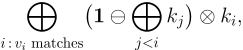
i.e. occurrence  is present and every earlier occurrence is
absent; the worlds that differ only in the later occurrences collapse
into that one term. This is exact even when the group’s elements are
not mutually exclusive, and runs in
is present and every earlier occurrence is
absent; the worlds that differ only in the later occurrences collapse
into that one term. This is exact even when the group’s elements are
not mutually exclusive, and runs in  time per group
(
time per group
( the group size). In other semirings (why-provenance,
sr_formula, counting, the security semiring…) the later occurrences
do not collapse, and ProvSQL enumerates the possible worlds of each
matching occurrence explicitly, which is exponential in the number of
occurrences that follow it.
Comparing any other aggregate (min, max, sum…) with a text
constant is not implemented and raises an error, since its
possible-world value is not decided occurrence by occurrence.
CASE over aggregates
A searched CASE whose WHEN guards are aggregate comparisons and whose
branches are aggregates is a guarded selection over aggregates: which branch
is taken depends on the (uncertain) input provenance, so the result is itself an
aggregate-carrier agg_token.
SELECT district,
       CASE WHEN sum(pm25) > 300 THEN max(pm25)
            WHEN avg(pm25) > 50   THEN avg(pm25)
            ELSE 0 END AS headline
FROM readings GROUP BY district;
The result flows onward exactly like a bare aggregate: its cell displays as
value (*) where the value is the CASE evaluated on the actual data
(the branch selected when every input tuple is present), and
expected, variance, and moment report the
distribution of the selected value over the possible worlds. Evaluation is
exact (no Monte Carlo – correct even under
SET provsql.rv_mc_samples = 0):
![E[\text{pick}^k \mid \text{defined}]
= \frac{\sum_i \Pr(R_i \wedge d_i)\;
E[\text{value}_i^k \mid R_i \wedge d_i]}
{\sum_i \Pr(R_i \wedge d_i)},](../_images/math/ec1db16c3627bcbdcf6bd2d7800b14659f5e8b46.svg)
summed over the first-match regions
 (the
(the
ELSE region is “all guards false”), each conjoined with the branch’s
defined event  – always true for
 sum / count and
constants (the empty group is the real value 0), “some contributing row
present” for min / max / avg, which are NULL on an empty
group. The moment thus conditions on the CASE’s value being defined,
the same convention as a bare min / max, and is NULL only
when the value never is. The regions are mutually exclusive, and
the correlation between a guard and its branch (they share input tuples) is
carried by the conditioning, exactly as in HAVING. This covers branches
that are a single aggregate (sum / count / min / max), a numeric
constant (ELSE 0), or a nested CASE; an avg branch is exact
when it depends on at most 20 input tuples (see
provsql.rv_mc_samples), and takes the
Monte-Carlo path otherwise.
A branch that is an arithmetic combination of aggregates
(THEN sum(y) + sum(z)) has no exact closed form – the region probabilities
stay exact, but that branch’s conditional moment is estimated by Monte Carlo
unless it depends on at most 20 input tuples, so it may need
provsql.rv_mc_samples > 0. (This is the same limitation the moment surface
has for a bare sum(x) + sum(y).)
COALESCE(aggregate, constant) is tracked through the same gate, being the
CASE it means:
SELECT district, COALESCE(sum(pm25), 0) AS total
FROM readings GROUP BY district;
--  =  CASE WHEN sum(pm25) IS NOT NULL THEN sum(pm25) ELSE 0 END
The guard is the one HAVING sum(pm25) IS NOT NULL lowers to, so the value
is the aggregate in every world where a row it reads a value from is present,
and the constant in the worlds where the group exists without one (all its
rows null-valued, as the padded rows of an outer join are). Two arguments and
a default that holds no aggregate of its own – a constant, a grouping column, an
expression over them, all of which are the same in every world. A default that
is itself an aggregate, or a third argument, leaves the COALESCE to be read
as a plain value.
GREATEST and LEAST of an aggregate and such an expression are tracked
the same way, being the CASE they mean:
SELECT district, GREATEST(sum(pm25), 2) AS floored
FROM readings GROUP BY district;
--  =  CASE WHEN sum(pm25) IS NULL THEN 2 WHEN 2 IS NULL THEN sum(pm25)
--          WHEN sum(pm25) > 2 THEN sum(pm25) ELSE 2 END
The two NULL guards are SQL’s reading of a NULL argument as no value
rather than as an unknown – GREATEST(NULL, 2) is 2 – which a bare
CASE WHEN a > b would get wrong, its unknown comparison falling to the
ELSE. Two arguments, and an argument that is not a plain value has to be
one whose NULL-ness has a reading: an aggregate of a kind that is NULL
exactly when it reads no value (count, sum, avg, min, max,
choose, stddev_pop, var_pop, the bitwise and Boolean ones),
or arithmetic over such aggregates, GREATEST(sum(pm25) * 2, 9), which is
NULL where one of its operands is.
An argument may itself be one of these guarded expressions – a nested
GREATEST, a COALESCE inside a LEAST – and so may the aggregate
side of a comparison, in a HAVING or in the guard of a CASE the query
writes:
SELECT district FROM readings GROUP BY district
HAVING GREATEST(sum(pm25), 2) > 3;
A comparison whose operand is a guarded selection is expanded, on the probability side, into the comparisons of its arms:

which is exact: one arm is selected in each world, so the terms are mutually
exclusive, and each arm comparison is an ordinary one – an aggregate against
the other operand, which the closed-form evaluators and the possible-world
enumeration resolve as they always have. A comparison between two constants
is decided in the expansion itself. Without it the guard would reach the
Boolean translation as a value gate, which no semiring operation combines. NULLIF is the same kind of reading, NULLIF(a, b) being
CASE WHEN a = b THEN NULL ELSE a END, and is tracked where the compared
value holds no aggregate of its own:
SELECT district, NULLIF(sum(pm25), 0) AS nonzero
FROM readings GROUP BY district;
--  =  CASE WHEN sum(pm25) = 0 THEN NULL ELSE sum(pm25) END
where a NULL sum makes the guard unknown, so the ELSE gives it back and
NULLIF answers NULL there, as SQL does.
Aggregates as Window Functions
cume_dist() is tracked as well, being the ratio of two counts it is defined
to be: the rows up to the current row’s peers, over the rows of the partition.
Both are aggregates over frames determined by values, so the ratio is read in
every world, and it prints what SQL prints. percent_rank() is not yet –
it is (rank - 1) / (count - 1), whose zero denominator for a single row
needs a guard that is read as a plain value today – nor are ntile and the
offset windows (lag, lead), whose value is decided by which rows are
there rather than by their values.
An aggregate used as a window function, f(x) OVER (…), is tracked
as the aggregate of a group is. Each output row keeps the provenance of
its input row, and the value becomes an agg_token over the rows of
the frame: in each possible world, it is f applied to the rows of
the frame that are present in that world. FILTER clauses and the
aggregates of Aggregate Functions are supported.
SELECT name, dept, salary,
       sum(salary) OVER (PARTITION BY dept) AS dept_total,
       count(*) OVER (PARTITION BY dept ORDER BY salary DESC) AS at_least_as_paid
FROM employees;
As for the aggregates of a grouped subquery, a comparison on the value in an enclosing query goes into the provenance of the row. Here, the probability of each row is that the employee is present and that at most three present employees of the department, the employee included, earn at least as much:
SELECT name, probability_evaluate(provenance())
FROM (SELECT name,
             count(*) OVER (PARTITION BY dept ORDER BY salary DESC) AS k
      FROM employees) t
WHERE k <= 3;
This requires the frame to be determined by the values of the rows, not
by their positions: in a world where some rows are absent, “the previous
row” is the previous row that is present, which differs from one world
to the next. The frames tracked are those of a window without
ORDER BY, RANGE frames (including the default frame of a window
with ORDER BY, the rows up to the current one and its peers),
GROUPS frames whose bounds are UNBOUNDED or CURRENT ROW, and
ROWS frames that span the whole partition, with any EXCLUDE
clause. A frame that excludes the current row may be empty while the
row exists: a count is then 0, the other aggregates NULL.
The ranking functions rank, dense_rank and row_number are
tracked too (on PostgreSQL 11 and later): the rank of a row is one plus
the number of present rows strictly before it, its dense rank one plus
the number of distinct ordering values of these rows. Selecting the
first rows of each partition then gives each row the probability of
being among them:
SELECT name, dept, probability_evaluate(provenance())
FROM (SELECT name, dept,
             rank() OVER (PARTITION BY dept ORDER BY salary DESC) AS rk
      FROM employees) t
WHERE rk <= 3;
For probabilities, such a comparison of a rank with a constant is
evaluated without enumerating possible worlds, as a
HAVING count(*) <= k is. ORDER BY … LIMIT k is read in the same way (see
ORDER BY, LIMIT and OFFSET). row_number is tracked as rank,
which it equals when the ORDER BY of the window leaves no ties;
with ties, which SQL itself does not order, the value shown and tracked
is the rank, and a WARNING says so.
The other window functions still run, with a WARNING: each row
keeps the provenance of its input row, and the value is an opaque
scalar. These are ntile, percent_rank, cume_dist, the offset
functions (lag, lead, first_value, last_value,
nth_value), ROWS and GROUPS frames with an offset, and the
windows over aggregate results other than the ranks below (an aggregate
over them).
Ranking the groups of an aggregation
rank(), dense_rank() and row_number() over an ORDER BY
that reads an aggregate result – the aggregates of the query’s own
GROUP BY, or the aggregate columns of a subquery – are tracked:
SELECT tag, count(*) AS n, rank() OVER (ORDER BY count(*) DESC)
FROM posttags GROUP BY tag;
The value ranked on varies between worlds, so the groups before a group
do too, and the frame machinery above, which reads the ordering values
of the database as it is, does not apply. The rank is read instead as
the number of groups that come before the group, itself included, which
compares the two aggregate results for each pair of groups: a group’s
rank is then an aggregate result of its own, whose distribution
expected and the others report. ORDER BY an aggregate
with a LIMIT is the filter of that rank (see ORDER BY, LIMIT and OFFSET), so the
top k groups are those that are among the first k in a world.
dense_rank() counts the distinct values instead of the groups, so it
reads the values of the aggregate as data: the aggregate is exploded into
one row per value it takes (see Grouping by the value of an aggregate), those values
are deduplicated over the whole relation, and the rank of a group counts
the ones up to its own value. The deduplication is done once, for every
partition at once, and only the counting is per row: this keeps it out of
a correlated subquery, which ProvSQL does not track when it groups rows
of its own. A dense_rank over an aggregate whose values cannot be
exploded, a sum() for instance, keeps the untracked window above,
with its WARNING.
ORDER BY on a window value sorts on its displayed value.
All the rows of a partition share the gate of a whole-partition window,
which is also the gate of the corresponding GROUP BY. A frame that
moves with the current row has a gate per row, with as many children as
the frame has rows: the circuit of a running aggregate is quadratic in
the size of the partition.
Aggregates of aggregate results
An aggregate of the aggregate results of a subquery is supported when it is
of the same kind: sum over a sum or a count, max over a
max, min over a min. It is then the aggregate of the rows of
the groups, each contributing with the provenance of its group row times its
own, as semimodule scalar multiplication gives, in every semiring; and
count over a count counts the groups:
SELECT dept, sum(n) AS employees          -- = count(*) per dept
FROM (SELECT dept, city, count(*) AS n FROM employees
      GROUP BY dept, city) t
GROUP BY dept;
Any other aggregate of an aggregate result (avg of a count, max
of a sum, an aggregate of an arithmetic expression over aggregates) is
tracked in a second way: the contribution of each row carries the gate of
the inner aggregate rather than a value, so the value of the outer
aggregate is read in every possible world:
SELECT avg(n) AS employees_per_city
FROM (SELECT city, count(*) AS n FROM employees GROUP BY city) t;
The value displayed is the one plain SQL computes, on the data as it is, as
for any aggregate; what is read per world is what the probabilities and the
moments are computed over. Such a value is no constant of the database, so
the closed forms do not apply to it: a probability or a moment over it is
computed by enumerating the possible worlds of the input tuples, which is
exact while they are few (possible-worlds-aggregates, see
'sq-rewrite', 'bounded-jw', 'reachability'), and estimated by sampling beyond that. So
expected(avg(n)) is the average of the counts of the cities present in
each world, not the average of the counts the database happens to hold.
An aggregate that reads such a result in a FILTER, an ORDER BY or a
DISTINCT of its own, or whose inner value is not numeric, reads it on
the data as it is instead, and reports that reading once for the statement
(see Parts Evaluated as Plain SQL).
Functions of an aggregate result
round, floor, ceil (and its synonym ceiling), abs,
ln, exp, sqrt and power (and its synonym pow, with an
exponent that is not itself an aggregate result) of an
aggregate result are carried as operations of its gate, so the value stays
tracked and is read in every possible world:
SELECT city, round(avg(salary), 2) AS average
FROM employees GROUP BY city;
The value displayed is the one plain SQL computes, as for any aggregate, and
a probability or a moment over it is computed per world: expected(floor(
avg(x))) is the average of the floors, which is not the floor of the
average. A comparison on such a value is read per world too, and in a
HAVING the groups where it can hold in no world are dropped, so the rows
are SQL’s. Written outside the aggregation – a WHERE on a derived table’s
aggregate, a scalar subquery – the necessary condition cannot be built at that
level, and such a row is kept with a provenance of zero: it says of itself that
no world holds it.
Any other function reads the value of the aggregate on the data as it is and
reports that reading once for the statement (see Parts Evaluated as Plain SQL); an
explicit cast asks for it. A stored column of such an expression has type
agg_token, which has no order of its own – its value is one per world –
so an ORDER BY on it outside the query that built it needs an explicit
cast, or a second column carrying the cast value.
Grouping by the value of an aggregate
The value of an aggregate is not one value of the database but one per possible world, so grouping rows by it, or deduplicating on it, is no operation on the data as it is. ProvSQL reads it as the explosion of the aggregate into one row per value it takes over the worlds, each annotated by the condition that it takes that value:
SELECT n, count(*) AS cities          -- how many cities have n employees
FROM (SELECT city, count(*) AS n FROM employees GROUP BY city) t
GROUP BY n;
A city whose count is 1 or 2 over the worlds gives two rows, one per value, with the provenance of counting that many; the two are mutually exclusive, and exactly one of them is there in each world where the city is. Grouping, deduplicating or uniting on the column is then an operation on data like any other, and the row of a value has the probability that some group takes it.
The value is read the same way wherever it is read as data: from a
subquery, as above, or at the level of the aggregation itself. A
SELECT DISTINCT count(*) ... GROUP BY city computes its aggregation in
a subquery and deduplicates the values above it, and a UNION (non-ALL)
explodes the aggregate of each of its arms and deduplicates over the
values of all of them:
SELECT count(*) FROM employees GROUP BY city
UNION
SELECT count(*) FROM employees WHERE remote GROUP BY city;
EXCEPT and INTERSECT work the same way, and show why the explosion
is done in each arm rather than on the result of the set operation: a
difference matches the rows it removes on their values, so both arms have
to hold values of the database before they are compared. A city counted
alike in both arms cancels, one counted differently does not:
SELECT count(*) FROM employees GROUP BY city
EXCEPT
SELECT count(*) FROM employees WHERE remote GROUP BY city;
A set operation whose other arm aggregates nothing at that column is
refused: only the values of a whole column, exploded in every arm, are
matched together. UNION ALL keeps every row and needs none of this.
An aggregate over exploded rows – the count(*) above – is an
aggregate over rows that are uncertain like any others: its displayed
value is the one of the database as it is, and expected and
the other moments are taken over the worlds where the row is.
The explosion applies to the aggregates whose values can be enumerated: a
count(), which takes every number of the rows it counts – zero
included where a row it does not count, such as the null-padded row of an
outer join, can be the only one there – a min(), a max() or a
choose, which take one of the values they aggregate, and a
sum() over an integer column, which takes one of its subset sums (equal
sums collapsing, so three rows of 1 give three values and not eight).
A sum() over a column that is not an integer is refused, and with it
avg(): the value of a summation is read back through the evaluator’s own
arithmetic, that of a double, and a subset sum of numbers that are not
integers is not the number that arithmetic reaches – 0.1 + 0.2
comparing unequal to 0.3 would drop a row silently rather than report
anything. A string_agg() takes one value per ordering. Grouping by one
of those is refused with SQLSTATE 0A000, and the plain value, said
explicitly with a cast, groups as plain SQL does:
SELECT total::numeric, count(*)        -- the plain value, not tracked
FROM (SELECT city, sum(salary) AS total FROM employees GROUP BY city) t
GROUP BY total::numeric;
NULL is itself one of the values, for an aggregation over the whole table:
it gives its row in every world, including the world holding none of the rows
it reads, and its sum (min, max, choose) is NULL
there. That row is annotated by no row contributing – the comparison
count(x) = 0 over the same argument – so it is the answer of exactly the
worlds where SQL returns it. A grouped aggregation needs no such value: a group
without a row is no group, and its row is absent rather than NULL. A
count needs none either, being 0 rather than NULL over no row.
A NULL contribution is refused as well: whether the result is NULL
is then a value of its own, which a comparison of the aggregate with a
value cannot express. An aggregate of more than a thousand rows is
refused too, an explosion multiplying the rows by the number of values.
The explosion of an aggregate into the values it takes is not the one of the next section, which explodes it into the rows it aggregates.
Reading the truth of a comparison
A comparison of an aggregate against a constant has one truth per world in
the same way, so reading one in the select list, or as the condition of a
CASE whose branches are not aggregates, explodes each row into the truths
it takes:
SELECT city, count(*) > 5 AS crowded FROM employees GROUP BY city;
SELECT city, CASE WHEN count(*) > 5 THEN 'crowded' ELSE 'quiet' END
FROM employees GROUP BY city;
Each city gives the row where the comparison holds, annotated with the provenance of it holding, and the row where it does not – and, where the aggregate can have no value, the third row of SQL’s unknown, annotated with the provenance of the group existing without a value to compare. A row whose truth holds in no world has probability zero, which is ProvSQL’s reading of an absent row, and the ones provably so are dropped outright.
IS NULL and IS NOT NULL of an expression over aggregates are read the
same way, the value they test having one value per world and so being null in
some and not in others:
SELECT city, sum(salary) IS NULL AS no_salary
FROM employees GROUP BY city;
Two rows rather than three – a value either is null in a world or is not, so
there is no unknown – and a division is a case the reading does not reach: it
is null where its divisor reads zero, which is no operand’s nullness, and that
one is refused by name rather than answered. Read on the agg_token instead,
such a test would answer from the token, which is there whenever the row is, and
so report NOT NULL of a value that is null.
In the condition of a HAVING, or as a sort key, none of this applies: the
first is already the provenance of the group, and a sort key is not an answer –
it orders the rows on the data as it is, as an ORDER BY on the value of an
aggregate does.
The comparison is the condition the annotation carries, so no value of the
aggregate has to be enumerated: unlike grouping by the value, this works for
a sum() over any column and for an avg(). It applies to count,
sum, avg, min, max and choose compared against a
constant, with or without a GROUP BY: an aggregation without one has its
row even in the world where the table is empty, and that world keeps it, in the
row of the truth the comparison has there (count(*) > 1 is false over no
row, sum(x) > 1 unknown). A comparison between two aggregates, one against
a column, one over an aggregate whose NULL says something else than “no
value” (stddev, NULL over a single row), and one in a query that also
computes a window function are read as plain values instead, with the warning
that says so. A comparison in HAVING needs none of this: it is already
the provenance of the group.
Joining and exploding aggregated provenance
A column produced by an aggregate has the internal agg_token type.
Two facilities let such a column take part in further provenance-aware
processing.
A JOIN whose condition equates an agg_token column with an
ordinary (non-aggregate) column is rewritten automatically at plan time:
the aggregated relation is replaced by a subquery that explodes the
aggregate into one row per contributing child, recombining the child’s
value and provenance, so the join then runs as a plain text = text
comparison with provenance correctly propagated. This reads the value of
the aggregate as one of the values it aggregates, which only holds for
choose: exploding the result of any other aggregate (a
count, whose rows each contribute 1) is refused.
-- agg.sample is an aggregate (agg_token) column; lookup.name is text
SELECT agg.city, lookup.name, provenance()
FROM (SELECT city, choose(position ORDER BY name) AS sample FROM employees GROUP BY city) agg
JOIN lookup ON agg.sample = lookup.name;
The same explosion is available explicitly through the
explode_table function, which rewrites a stored table in place,
turning its agg_token column into one row per child with the matching
value and provenance:
CREATE TABLE grouped AS
  SELECT city, choose(position ORDER BY name) AS sample FROM employees GROUP BY city;
SELECT explode_table('grouped', 'sample');
Grouping Sets
GROUPING SETS, CUBE, and ROLLUP
are read as the UNION ALL of one GROUP BY per grouping set: each
group has the provenance it has in that GROUP BY, and the empty set
() is an aggregation without GROUP BY, whose single row is always
there.