Conditioning
ProvSQL can compute conditional probabilities, distributions, and
expectations: the answer to a query given that some other event is known
to hold. The single entry point is the conditioning operator |, read as
“given”: A | B means “A given B”. It works identically over the
three carriers ProvSQL tracks – discrete events, continuous
random_variable values, and probabilistic agg_token aggregates –
and it is exact and correlation-aware: the conditional is computed
from the shared provenance circuit, so events that overlap are accounted for
without any independence assumption or hand-written
inclusion–exclusion.
This chapter documents the operator and its variants. For the underlying probability machinery see Probabilities, for the continuous surface see Continuous Distributions, and for a worked, end-to-end tour see Case Study: ProvSQL as a Probability Calculator.
What conditioning means
For two Boolean events A and B, A | B denotes the conditional
probability in the textbook sense, Bayes’ rule:
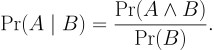
ProvSQL realises this by building a terminal conditioned gate over the two
provenance tokens, whose probability evaluators read as exactly that ratio.
Because gates are addressed by content, a base tuple shared between A and
B is literally the same input gate in both circuits, so the joint
 is computed over the real overlap – the conditional
is correct even when
is computed over the real overlap – the conditional
is correct even when A and B are correlated.
Two conventions follow from the definition:
Conditioning on a certain or absent event is a no-op.
A | BreturnsAunchanged whenBis the certain event or isNULL( ).
).Nested conditioning folds as a sequential Bayesian update:
(A | B) | Cis the same asA | (B ∧ C). The conditioned gate never nests; it stays one level deep with the evidence accumulated.
The operator family
| comes in a binary and a unary (prefix) form, each accepting either a
provenance token or a Boolean predicate on the right.
Binary value | evidence – conditioning a value
The binary operator conditions one value – a discrete event token, a
random_variable, or an agg_token – on an evidence event, and
returns a new conditioned value of the same carrier. The right operand is
either a provenance token,
-- P(disease | positive) over a shared screening model
SELECT probability_evaluate(disease | positive)
FROM (SELECT (SELECT provenance() FROM screening WHERE disease  GROUP BY ()) AS disease,
             (SELECT provenance() FROM screening WHERE positive GROUP BY ()) AS positive) e;
or a Boolean predicate built from random_variable / agg_token
comparisons, which the planner lifts into an evidence gate for you:
-- a biomarker conditioned on exceeding a referral threshold
WITH r AS (SELECT normal(20, 5) AS x)
SELECT expected(x | (x > 25)) FROM r;
The evidence may also compare the value against another random variable. Conditioning on such an RV-vs-RV comparison is evaluated by a one-dimensional quadrature over the independent operands – exact for uniforms:
-- E[X | X > Y] = 2/3 for two i.i.d. U(0,1); exact with MC disabled
SET provsql.rv_mc_samples = 0;
WITH r AS (SELECT uniform(0,1) AS x, uniform(0,1) AS y)
SELECT expected(x | (x > y)) FROM r;
The dual question – the probability a comparison holds rather than a
conditioned moment – is probability over the predicate:
probability(x > y) for two i.i.d. uniforms is exactly 0.5. See
Continuous Distributions for the comparison-event surface.
The evidence side may itself be a comparison rather than a pre-built
token, so a conditional probability over two comparison events is
written directly: probability((A) | (B)) is the correlation-aware
 . For example, with
x ~ Normal(1500, 400) and the nested events {x >= 2000} ⊂
{x >= 1000}:
WITH r AS (SELECT normal(1500, 400) AS x)
SELECT probability((x >= 2000) | (x >= 1000)) FROM r;  -- 0.1181
Both comparisons share the x leaf, so the joint keeps the
dependence (it is not Pr(A)·Pr(B)); comparisons against constants on
one distribution are resolved analytically and stay exact even at
provsql.rv_mc_samples = 0.
The same holds when a shared random variable is compared against other random variables rather than constants – e.g. conditioning on which of several variables is largest. Both the probability and the moment sides are exact (no Monte Carlo):
WITH r AS (SELECT uniform(0,1) x, uniform(0,1) y, uniform(0,1) z)
SELECT probability((x > y) | (x > z))          AS pr,      -- 0.6667
       expected(x | (x > y AND x > z))         AS cond_e,  -- 0.75
       variance(x | (x > y AND x > z))         AS cond_v   -- 0.0375
FROM r;
The event x > y AND x > z says x is the largest of the three, so
x conditioned on it is beta(3,1) (mean 3/4, variance
3/80). ProvSQL evaluates these by marginalising each independent
partner variable analytically, leaving a one-dimensional integral over
the shared variable – exact for the uniform case and high-accuracy
otherwise.
The result of value | evidence is terminal: a conditioned value may
only be conditioned further, never combined into a larger plus /
times / monus / aggregate gate.
On the token carrier (plain uuid values), the function spelling of
the binary operator is cond (target, evidence),
interchangeable with target | evidence; the random_variable and
agg_token carriers back their | with
random_variable_cond and agg_token_cond
respectively.
Unary | evidence – conditioning a whole tuple
Written as a term in the SELECT list (with no left operand), | evidence
is a whole-tuple directive: it conditions the output provenance of every
row of the query on the evidence, then is stripped from the visible
projection. The function spelling is given (evidence),
the same as the prefix | evidence.
-- condition every output row on "obesity is present", in one directive
SELECT factor, probability_evaluate(provenance()) AS p_given_obesity
FROM (
  SELECT factor, | (SELECT provenance() FROM risk WHERE factor = 'obesity')
  FROM risk
) s
ORDER BY factor;
Here the | (...) term contributes no column; instead each surviving row’s
provenance becomes provenance() | <evidence>. Over the correlation model
of case study 8 this returns 1 for obesity itself
(an event given itself is certain) and each independent factor’s prior
unchanged (insulin_resistance 0.6, high_salt 0.7).
The evidence is evaluated per output row and may reference the row’s own columns, so each tuple can be conditioned on its own evidence – the typical use being a correlated sub-select:
-- each patient's row conditioned on that same patient testing positive
SELECT p.id, p.name,
       | (SELECT provenance() FROM tests t
          WHERE t.patient_id = p.id AND t.result = 'positive')
FROM patients p;
The unary predicate form | (predicate) works the same way, with the
evidence written as a Boolean combination of random_variable /
agg_token comparisons.
Note
The unary given / | directive conditions the whole-tuple
existence event (the row’s provenance token), not the value of any
random_variable or agg_token column you happen to select. To
condition a value – to truncate a distribution, say – use the binary
value | evidence form. The unary directive is only accepted in a plain
per-row SELECT; it is rejected on an aggregated, grouped, DISTINCT,
or set-operation (UNION / EXCEPT …) query, where the individual
tokens should be conditioned with the binary | instead.
Negating an event – ! event
The prefix ! operator (function spelling provenance_not
(event)) is the complement of a Boolean provenance event: !x holds
in exactly
the worlds where x does not, so probability_evaluate(!x) is
 . Unlike the conditioned gate,
 ! is an ordinary
m-semiring expression – Boolean negation,  underneath – so it composes freely under
 times / plus; the one thing
it refuses is a conditioned (terminal) token.
Its natural use with conditioning is a denial constraint: restricting a
query to the worlds where some forbidden pattern does not occur. The
violation event W is just an ordinary query – no hand-built gates –
aggregated to a single token with provenance() ... GROUP BY (), and the
query is conditioned on its negation, Q | !W:
-- P(booking 1 is present | no two overlapping bookings of the same room)
WITH w AS (
  SELECT provenance() AS violation        -- W = "some overlapping pair exists"
  FROM bookings a JOIN bookings b
    ON a.id < b.id AND a.room = b.room
       AND a.lo < b.hi AND b.lo < a.hi
  GROUP BY ())
SELECT probability_evaluate(
         (SELECT provenance() FROM bookings WHERE id = 1) | !w.violation)
FROM w;
The constraint can be any query: a forbidden pattern expressed as a query
becomes a denial constraint by conditioning on the negation of “the pattern
occurs”, so !W is the event “no violation” and Q | !W restricts Q
to exactly the worlds the constraint admits. This is the MarkoViews
construction [Jha and Suciu, 2012] – conditioning a probabilistic
database on the event that no constraint is violated. ! is also useful on
its own, wherever the complement of an event is wanted
(probability_evaluate(!a), a AND NOT b as times(a, !b)).
The three carriers
Discrete events
A Boolean provenance token stands for the event “this row exists”. Conditioning one token on another yields a conditional probability:
-- base-rate fallacy: a positive screening test, P(disease | positive)
SELECT probability_evaluate(disease | positive) AS disease_given_pos
FROM (SELECT (SELECT provenance() FROM screening WHERE disease  GROUP BY ()) AS disease,
             (SELECT provenance() FROM screening WHERE positive GROUP BY ()) AS positive) e;
--  ≈ 0.1538
Random variables
Conditioning a random_variable produces another random_variable – the
conditional distribution – whose mean, variance, and range you read with
expected, variance, and support:
WITH r AS (SELECT normal(20, 5) AS x)
SELECT expected(x | (x > 25))     AS cond_mean,      -- ≈ 27.6
       variance(x | (x > 25))     AS cond_variance,  -- ≈ 5  (was 25)
       (support(x | (x > 25))).lo AS lowest_value    -- 25  (truncated floor)
FROM r;
Conditioning on a threshold predicate truncates the distribution and renormalises it; the result is a value in its own right that you can select, store, or hand onward. See Continuous Distributions for the closed-form truncation table (Normal, Uniform, Exponential) and the Monte-Carlo fallback for other shapes.
Probabilistic aggregates
When the rows being aggregated are themselves uncertain, the total is an
agg_token. Conditioning it on an observation gives a conditional
expectation:
-- expected regional total, given that the high-count day really happened
SELECT expected(total | (SELECT provenance() FROM cases WHERE n = 4))
FROM casesum WHERE region = 'North';
The aggregate-specific spelling expected (aggregate, condition)
(see Probabilities) is the same operation; the | operator is the
uniform way to write it across all three carriers.
In ProvSQL Studio
Studio’s evaluation strip exposes
conditioning interactively: the Condition on input takes an
evidence provenance UUID, auto-presetting to a clicked row’s own provenance,
with an adjacent Conditioned by badge that lights up while the
result is being conditioned on it – click the badge to toggle the
conditioning off (an unconditional result) and back on. Distribution
profiles, moments, and probabilities all honour it,
so the truncated histogram of a conditioned random_variable and the
conditional mean of an agg_token are visible in the canvas. See
ProvSQL Studio for the panel and case study 6 for it in
use.
See also
Probabilities – the probability methods and the
expected(aggregate, condition)form.Continuous Distributions – conditioning
random_variablevalues and the truncation table.Case Study: ProvSQL as a Probability Calculator – a five-problem tour driving the
|operator across all three carriers.