 |
ProvSQL C/C++ API
Adding support for provenance and uncertainty management to PostgreSQL databases
|
|
ProvSQL C/C++ API
Adding support for provenance and uncertainty management to PostgreSQL databases
|
Abstract base class for (m-)semirings. More...
#include "Semiring.h"
Public Types | |
| typedef V | value_type |
| The carrier type of this semiring. | |
Public Member Functions | |
| virtual value_type | zero () const =0 |
| Return the additive identity \(\mathbb{0}\). | |
| virtual value_type | one () const =0 |
| Return the multiplicative identity \(\mathbb{1}\). | |
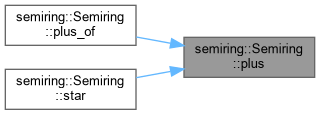
| virtual value_type | plus (const std::vector< value_type > &v) const =0 |
| Apply the additive operation to a list of values. | |
| virtual value_type | times (const std::vector< value_type > &v) const =0 |
| Apply the multiplicative operation to a list of values. | |
| virtual value_type | plus_of (const std::vector< const value_type * > &v) const |
plus over the values v points to, read in place. | |
| virtual value_type | times_of (const std::vector< const value_type * > &v) const |
times over the values v points to, read in place (see plus_of). | |
| virtual value_type | monus (value_type x, value_type y) const =0 |
| Apply the monus (m-semiring difference) operation. | |
| virtual value_type | delta (value_type x) const =0 |
| Apply the \(\delta\) operator. | |
| virtual value_type | cmp (value_type s1, ComparisonOperator op, value_type s2) const |
| Evaluate a comparison gate. | |
| virtual value_type | semimod (value_type x, value_type s) const |
| Apply a semimodule scalar multiplication. | |
| virtual value_type | agg (AggregationOperator op, const std::vector< value_type > &s) |
| Evaluate an aggregation gate. | |
| virtual value_type | value (const std::string &s) const |
| Interpret a literal string as a semiring value. | |
| virtual value_type | unmapped_input (const std::string &uuid) const |
Value of a variable leaf (gate_input / gate_mulinput) that the provenance mapping does not name. | |
| virtual value_type | rv (const std::string &spec, const std::vector< value_type > ¶ms) const |
Evaluate a continuous random-variable leaf (gate_rv). | |
| virtual value_type | arith (ArithmeticOperator op, const std::vector< value_type > &children, const std::string &extra) const |
Evaluate an arithmetic gate over scalar children (gate_arith). | |
| virtual value_type | mixture (value_type p, value_type x, value_type y) const |
Evaluate a Bernoulli mixture (gate_mixture, three wires). | |
| virtual value_type | categorical (value_type key, const std::vector< double > &probs, const std::vector< std::string > &outcomes) const |
Evaluate a categorical mixture (gate_mixture over gate_mulinput outcomes). | |
| virtual value_type | guarded_case (const std::vector< value_type > &children) const |
Evaluate a guarded selection (gate_case). | |
| virtual value_type | observe (value_type child, const std::string &datum) const |
Evaluate a latent-variable observation (gate_observe). | |
| virtual value_type | conditioned (const std::vector< value_type > &children) const |
Evaluate a conditioning marker (gate_conditioned). | |
| virtual | ~Semiring ()=default |
| virtual bool | absorptive () const |
Return true if this semiring is absorptive ( \(\mathbb{1} \oplus a = \mathbb{1}\) for all \(a\)). | |
| virtual bool | idempotent () const |
Return true if this semiring is idempotent ( \(a \oplus a = a\) for all \(a\)). | |
| virtual bool | selective () const |
Return true if \(\oplus\) is selective (for all \(a, b\), \(a \oplus b \in \{a, b\}\)). | |
| virtual bool | commutative () const |
Return true if \(\otimes\) is commutative ( \(a \otimes b = b \otimes a\) for all \(a, b\)). | |
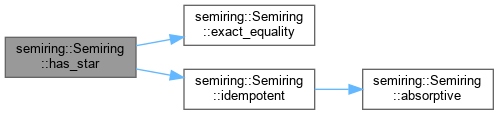
| virtual bool | has_star () const |
Return true if star computes \(a^* = \mathbb{1} \oplus a \oplus a^2 \oplus \cdots\). | |
| virtual value_type | star (const value_type &a) const |
\(a^*\), the sum of the powers of a. | |
| virtual bool | symbolic () const |
Return true if the semiring can name an unknown and record an equation over it (symbolic_unknown, define). | |
| virtual value_type | symbolic_unknown (std::size_t position) const |
| A fresh unknown, as a value. | |
| virtual void | define (const value_type &unknown, const value_type &rhs) const |
Record the equation unknown = rhs. | |
| virtual bool | equal (const value_type &a, const value_type &b) const |
| Equality of the semiring elements two values denote. | |
| virtual bool | exact_equality () const |
Return true if equal decides equality of semiring elements. | |
| virtual bool | exclusive () const |
Return true if the semiring is exclusive: \(a \otimes (\mathbb{1} \ominus a) = \mathbb{0}\). | |
| virtual bool | mul_idempotent () const |
Return true if \(\otimes\) is idempotent: \(a \otimes a = a\). | |
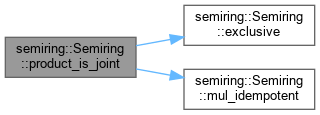
| bool | product_is_joint () const |
| Whether the product of the predicate provenances of two conditions over one family of occurrences is the provenance of their conjunction (and their sum that of their disjunction). | |
| virtual bool | mul_sub_left_distributive () const |
Return true if \(\otimes\) distributes over the monus on the left: \(a \otimes (b \ominus c) = (a \otimes b) \ominus
(a \otimes c)\) for all \(a, b, c\). | |
| virtual bool | compatibleWithBooleanRewrite () const |
Return true if a semiring homomorphism BoolFunc(X) →+* S exists, so the safe-query (Boolean-rewrite) optimisation produces circuits that are semantically faithful when evaluated under this semiring. | |
| virtual bool | certifying () const |
| Whether this semiring builds certified exclusive enumerations (see the three hooks below). | |
| virtual bool | independent_literal (const value_type &) const |
Whether v is an independent literal for certification purposes: a base Bernoulli variable (or a constant), so that distinct literals have disjoint supports and an AND over them is decomposable. | |
| virtual value_type | certified_world_term (const std::vector< value_type > &, const std::vector< value_type > &) const |
Build one complete world term: the conjunction of the present literals and the negations of the missing literals, certified decomposable. | |
| virtual value_type | certified_exclusive_plus (const std::vector< value_type > &) const |
Build the disjunction of pairwise-exclusive disjuncts, certified deterministic. | |
Abstract base class for (m-)semirings.
| V | The carrier type (e.g. bool, unsigned, std::string). |
All pure-virtual methods must be implemented by concrete subclasses.
cmp(), semimod(), agg(), and value() have default implementations that throw SemiringException. Override them in subclasses that support these circuit gate types.
A semiring is absorptive (i.e., \(\mathbb{1} \oplus a = \mathbb{1}\) for all \(a\)) iff absorptive() returns true. Absorptivity implies idempotency ( \(a \oplus a = a\)), which lets the circuit evaluator and the HAVING-semantics machinery deduplicate operands and short-circuit over the multiplicative identity. An absorptive semiring gets its existential MIN / MAX HAVING comparisons (MIN below, MAX above a constant) in a single scan instead of a world enumeration; when its \(\otimes\) also distributes over \(\ominus\) (mul_sub_left_distributive()), so do the other MIN / MAX comparisons.
Definition at line 118 of file Semiring.h.
| typedef V semiring::Semiring< V >::value_type |
The carrier type of this semiring.
Definition at line 122 of file Semiring.h.
|
virtualdefault |
|
inlinevirtual |
Return true if this semiring is absorptive ( \(\mathbb{1} \oplus a = \mathbb{1}\) for all \(a\)).
When true, the circuit evaluator and HAVING-semantics machinery may exploit the resulting idempotency ( \(a \oplus a = a\), implied by absorptivity) to deduplicate children of plus gates and to short-circuit over the multiplicative identity.
A semiring that does not commute (commutative()) is absorptive on both sides of a product: \(a \oplus a \otimes b = a \oplus b \otimes a
= a\), which the absorptive folds of the circuit rely on. Circuits built under an 'absorptive' assumption marker do not keep the order of the query, and require a commutative semiring as well.
false by default; override to return true. Reimplemented in semiring::BestPath, semiring::Boolean, semiring::BoolExpr, semiring::IntervalUnion, semiring::Lukasiewicz, semiring::MinMax, semiring::Subset, semiring::TropicalNonneg, and semiring::Viterbi.
Definition at line 421 of file Semiring.h.

|
inlinevirtual |
Evaluate an aggregation gate.
| op | The aggregation function (COUNT, SUM, MIN…). |
| s | List of child semiring values to aggregate. |
| SemiringException | if not overridden. |
Reimplemented in semiring::Formula.
Definition at line 235 of file Semiring.h.
|
inlinevirtual |
Evaluate an arithmetic gate over scalar children (gate_arith).
| op | The arithmetic operation. |
| children | The values of the gate's wires (for PERCENTILE, interleaved |
| extra | The gate's payload (the fraction for PERCENTILE, empty otherwise). |
| SemiringException | if not overridden. |
Reimplemented in semiring::Formula.
Definition at line 303 of file Semiring.h.
|
inlinevirtual |
Evaluate a categorical mixture (gate_mixture over gate_mulinput outcomes).
| key | The value of the mixture's key (its gate_input wire). |
| probs | Probability of each outcome. |
| outcomes | Textual payload of each outcome, parallel to probs. |
| SemiringException | if not overridden. |
Reimplemented in semiring::Formula.
Definition at line 340 of file Semiring.h.
|
inlinevirtual |
Build the disjunction of pairwise-exclusive disjuncts, certified deterministic.
Only called when certifying() is true; the default throws.
Reimplemented in semiring::BoolExpr.
Definition at line 744 of file Semiring.h.
|
inlinevirtual |
Build one complete world term: the conjunction of the present literals and the negations of the missing literals, certified decomposable.
Only called when certifying() is true; the default throws.
Reimplemented in semiring::BoolExpr.
Definition at line 732 of file Semiring.h.
|
inlinevirtual |
Whether this semiring builds certified exclusive enumerations (see the three hooks below).
The HAVING possible-worlds machinery (provsql_having) enumerates, for a comparison over a group aggregate, the complete valuations of the group's contributors that satisfy the predicate. Those disjuncts partition the worlds – the OR is deterministic and each world term an AND of literals over distinct contributors, decomposable – i.e., the enumeration is a d-DNNF by construction. A circuit-building semiring can persist that knowledge as the d-DNNF certificate (the same mark the bounded-treewidth reachability route emits), letting the linear certificate-aware evaluators handle the result; scalar semirings have nothing to mark.
false by default (the hooks below then go unused and the default constructions are used). Reimplemented in semiring::BoolExpr.
Definition at line 707 of file Semiring.h.
|
inlinevirtual |
Evaluate a comparison gate.
| s1 | Left operand. |
| op | Comparison operator. |
| s2 | Right operand. |
| SemiringException | if not overridden. |
Reimplemented in semiring::Formula.
Definition at line 211 of file Semiring.h.
|
inlinevirtual |
Return true if \(\otimes\) is commutative ( \(a \otimes b = b \otimes a\) for all \(a, b\)).
A product gate keeps its factors in the order of the query (the order of the FROM clause for a join), which a non-commutative semiring reads as it is: the regular expressions of Regex concatenate words in that order. The equations of a recursive query then have the recursive relation on a definite side of each coefficient; Gaussian elimination (GenericCircuit::solveFixSystem) needs it on the same side throughout, and refuses a non-commutative semiring otherwise.
true by default; override to return false. Reimplemented in semiring::BestPath, semiring::Regex, and semiring::TropicalPaths.
Definition at line 487 of file Semiring.h.
|
inlinevirtual |
Return true if a semiring homomorphism BoolFunc(X) →+* S exists, so the safe-query (Boolean-rewrite) optimisation produces circuits that are semantically faithful when evaluated under this semiring.
The compiled-semiring dispatcher consults this predicate before evaluating a circuit whose root gate carries PROVSQL_ROOT_TAG_BOOLEAN_REWRITE. Returning false on a tagged circuit raises CircuitException.
Defaults to false: a new semiring whose author has not yet verified the homomorphism is fail-closed by construction. Subclasses with a verified homomorphism (currently Boolean, BoolExpr, Formula, and IntervalUnion) override to return true. The justification (Lean-proof reference) belongs in a comment next to each override; see the src/semiring/ headers.
Reimplemented in semiring::Boolean, semiring::BoolExpr, semiring::Counting, semiring::Formula, semiring::How, semiring::IntervalUnion, semiring::Lukasiewicz, semiring::MinMax, semiring::Subset, semiring::Tropical, semiring::Viterbi, semiring::Which, and semiring::Why.
Definition at line 685 of file Semiring.h.
|
inlinevirtual |
Evaluate a conditioning marker (gate_conditioned).
| children | The gate's wires: joint is the materialised times(target, evidence). |
| SemiringException | if not overridden. |
Reimplemented in semiring::Formula.
Definition at line 392 of file Semiring.h.
|
inlinevirtual |
Record the equation unknown = rhs.
| unknown | A value returned by symbolic_unknown. |
| rhs | Its right-hand side, over unknowns of the same kind. |
Reimplemented in semiring::Formula.
Definition at line 564 of file Semiring.h.
|
pure virtual |
Apply the \(\delta\) operator.
| x | Input value. |
Implemented in semiring::BestPath, semiring::Boolean, semiring::BoolExpr, semiring::Counting, semiring::Formula, semiring::How, semiring::IntervalUnion, semiring::Lukasiewicz, semiring::MinMax, semiring::Regex, semiring::Subset, semiring::Tropical, semiring::TropicalPaths, semiring::Viterbi, semiring::Which, and semiring::Why.
|
inlinevirtual |
Equality of the semiring elements two values denote.
== on value_type by default; overridden where a value is a handle on the element, not the element itself (a multirange Datum passed by reference, compared by its contents).
Reimplemented in semiring::IntervalUnion.
Definition at line 577 of file Semiring.h.

|
inlinevirtual |
Return true if equal decides equality of semiring elements.
False for a carrier that is a handle on a structure built during evaluation (a gate of the Boolean circuit BoolExpr builds, whose equivalence with another is intractable to decide) or a syntactic rendering (Formula): two equal elements may then compare unequal. The equation-system solver iterates to a fixpoint only where it can tell that one is reached, and otherwise runs the number of rounds absorption guarantees to suffice.
true by default; override to return false. Reimplemented in semiring::BoolExpr, semiring::Formula, semiring::Regex, and semiring::TropicalPaths.
Definition at line 594 of file Semiring.h.

|
inlinevirtual |
Return true if the semiring is exclusive: \(a \otimes (\mathbb{1} \ominus a) = \mathbb{0}\).
Equivalently \(a \otimes (\mathbb{1} \ominus (a \oplus b)) =
\mathbb{0}\), the form the worlds of a family take: a world's annotation and the absence of what it holds cancel. Lean exclusive.
false by default; override to return true only with a proof. Reimplemented in semiring::Boolean, semiring::BoolExpr, semiring::Counting, semiring::IntervalUnion, semiring::Subset, and semiring::Which.
Definition at line 608 of file Semiring.h.

|
inlinevirtual |
Evaluate a guarded selection (gate_case).
| children | The gate's wires, |
| SemiringException | if not overridden. |
Reimplemented in semiring::Formula.
Definition at line 359 of file Semiring.h.
|
inlinevirtual |
Return true if star computes \(a^* = \mathbb{1} \oplus a \oplus a^2 \oplus \cdots\).
With a star, a cyclic linear equation system has its least solution computed by Gaussian elimination (node elimination; Ramusat, Maniu & Senellart, EDBT 2021, after Lehmann 1977), in a semiring that is not absorptive: counting extended with \(\infty\), min-plus with \(-\infty\), why- and which-provenance.
The default holds for an idempotent semiring with exact equality, whose star the default star iterates to, the partial sums only growing; they stop where the carrier has finitely many elements above \(\mathbb{1}\) reachable from \(a\) (sets of sets of input tuples, ...).
Reimplemented in semiring::Counting, semiring::Regex, semiring::Tropical, and semiring::TropicalPaths.
Definition at line 507 of file Semiring.h.
|
inlinevirtual |
Return true if this semiring is idempotent ( \(a \oplus a = a\) for all \(a\)).
Absorptivity implies idempotence, so the default forwards to absorptive(); override to return true in a semiring that is idempotent without being absorptive (why- and which-provenance, where \(\oplus\) is set union).
The HAVING machinery (provsql_having in having_semantics.hpp) uses it for the monotone comparisons, those whose valid worlds are closed under supersets (MIN below, MAX above a constant, COUNT above a constant, SUM above a constant over non-negative values, bool_or = true, bool_and = false): over such a family the monus factors cancel from the possible-world sum, which is then the plain \(\oplus\)-sum of the products of the present annotations (Lean Having.witness_identity in provenance-lean/Provenance/Having.lean, which assumes idempotence only). The enumeration stays exhaustive; absorptivity is what further collapses it to the minimal worlds.
absorptive() by default; override to return true only with a proof (the Lean *.idempotent lemmas). Reimplemented in semiring::Regex, semiring::TropicalPaths, semiring::Which, and semiring::Why.
Definition at line 449 of file Semiring.h.


|
inlinevirtual |
Whether v is an independent literal for certification purposes: a base Bernoulli variable (or a constant), so that distinct literals have disjoint supports and an AND over them is decomposable.
Only consulted when certifying() is true.
false by default. Reimplemented in semiring::BoolExpr.
Definition at line 721 of file Semiring.h.
|
inlinevirtual |
Evaluate a Bernoulli mixture (gate_mixture, three wires).
| p | The Bernoulli event's value. |
| x | The value taken when the event holds. |
| y | The value taken otherwise. |
| SemiringException | if not overridden. |
Reimplemented in semiring::Formula.
Definition at line 322 of file Semiring.h.
|
pure virtual |
Apply the monus (m-semiring difference) operation.
| x | Minuend. |
| y | Subtrahend. |
Implemented in semiring::BestPath, semiring::Boolean, semiring::BoolExpr, semiring::Counting, semiring::Formula, semiring::How, semiring::IntervalUnion, semiring::Lukasiewicz, semiring::MinMax, semiring::Regex, semiring::Subset, semiring::Tropical, semiring::TropicalPaths, semiring::Viterbi, semiring::Which, and semiring::Why.
|
inlinevirtual |
Return true if \(\otimes\) is idempotent: \(a \otimes a = a\).
Not to be confused with idempotent(), which is about \(\oplus\). Lean mulIdempotent.
false by default; override to return true only with a proof. Reimplemented in semiring::Boolean, semiring::BoolExpr, semiring::IntervalUnion, semiring::Subset, and semiring::Which.
Definition at line 621 of file Semiring.h.

|
inlinevirtual |
Return true if \(\otimes\) distributes over the monus on the left: \(a \otimes (b \ominus c) = (a \otimes b) \ominus
(a \otimes c)\) for all \(a, b, c\).
Together with absorptivity, this is the hypothesis under which the HAVING machinery (provsql_having in having_semantics.hpp) may replace the possible-world enumeration of a non-existential MIN / MAX comparison (MIN above, MAX below a constant, or either equal to one) by its single-scan closed form (Lean Having.minScan_correct / Having.maxScan_correct in provenance-lean/Provenance/HavingMinMax.lean); the existential comparisons need absorptivity alone (Lean Having.sum_ann_meet in provenance-lean/Provenance/Having.lean). Holds in the Boolean, counting, tropical, Viterbi, Łukasiewicz and interval-union semirings; fails in the security (min-max) semiring, which is absorptive but not distributive, and in Why / Which / How.
false by default; override to return true only with a proof (the Lean *.mul_sub_left_distributive lemmas). Reimplemented in semiring::BestPath, semiring::Boolean, semiring::BoolExpr, semiring::Counting, semiring::IntervalUnion, semiring::Lukasiewicz, semiring::Subset, semiring::Tropical, and semiring::Viterbi.
Definition at line 663 of file Semiring.h.
|
inlinevirtual |
Evaluate a latent-variable observation (gate_observe).
| child | The observed leaf's value. |
| datum | The observed value, as text. |
| SemiringException | if not overridden. |
Reimplemented in semiring::Formula.
Definition at line 374 of file Semiring.h.
|
pure virtual |
Return the multiplicative identity \(\mathbb{1}\).
Implemented in semiring::BestPath, semiring::Boolean, semiring::BoolExpr, semiring::Counting, semiring::Formula, semiring::How, semiring::IntervalUnion, semiring::Lukasiewicz, semiring::MinMax, semiring::Regex, semiring::Subset, semiring::Tropical, semiring::TropicalPaths, semiring::Viterbi, semiring::Which, and semiring::Why.

|
pure virtual |
Apply the additive operation to a list of values.
| v | Ordered list of operands (empty list should return zero()). |
Implemented in semiring::BestPath, semiring::Boolean, semiring::BoolExpr, semiring::Counting, semiring::Formula, semiring::How, semiring::IntervalUnion, semiring::Lukasiewicz, semiring::MinMax, semiring::Regex, semiring::Subset, semiring::Tropical, semiring::TropicalPaths, semiring::Viterbi, semiring::Which, and semiring::Why.
|
inlinevirtual |
plus over the values v points to, read in place.
GenericCircuit::evaluate passes the values of a gate's children this way rather than copied into a vector. The default copies them and calls plus; a semiring whose values may be large (Formula) overrides it.
| v | Ordered list of pointers to the operands. |
Reimplemented in semiring::Formula.
Definition at line 162 of file Semiring.h.

|
inline |
Whether the product of the predicate provenances of two conditions over one family of occurrences is the provenance of their conjunction (and their sum that of their disjunction).
The provenance of a selection on aggregates is a sum over the worlds of the family they read. Taken condition by condition and multiplied, it is that sum exactly when the semiring is exclusive with an idempotent \(\otimes\) (Lean predProvOf_mul_predProvOf): the HAVING machinery then keeps the conditions apart, with their closed forms, and resolves them jointly otherwise (provsql_having). Counting is exclusive, and its \(\otimes\) is not idempotent.
Definition at line 638 of file Semiring.h.
|
inlinevirtual |
Evaluate a continuous random-variable leaf (gate_rv).
| spec | The gate's distribution encoding ("normal:2.5,0.5"), where a parameter written "$i" is wired rather than literal (a latent / compound leaf). |
| params | The values of the gate's wires, indexed as the "$i" references; empty for an all-literal leaf. |
| SemiringException | if not overridden. |
Reimplemented in semiring::Formula.
Definition at line 282 of file Semiring.h.
|
inlinevirtual |
Return true if \(\oplus\) is selective (for all \(a, b\), \(a \oplus b \in \{a, b\}\)).
In an idempotent semiring this is the same as a total natural order; in general it is stronger (the counting semiring has a total natural order, but \(a + b\) is neither \(a\) nor \(b\)). In a selective absorptive semiring (a selective dioid, in Gondran & Minoux's terms), the least solution of a cyclic equation system (a recursive query, see GenericCircuit::solveFixSystem) is found by Dijkstra's algorithm, generalised to semirings (Ramusat, Maniu & Senellart, EDBT 2021): absorption makes extending a derivation never improve it, and selectivity lets the best unsettled value be final.
false by default; override to return true. Reimplemented in semiring::BestPath, semiring::Boolean, semiring::Lukasiewicz, semiring::MinMax, semiring::Tropical, and semiring::Viterbi.
Definition at line 469 of file Semiring.h.
|
inlinevirtual |
Apply a semimodule scalar multiplication.
| x | Provenance value. |
| s | Scalar value. |
| SemiringException | if not overridden. |
Reimplemented in semiring::Formula.
Definition at line 223 of file Semiring.h.
|
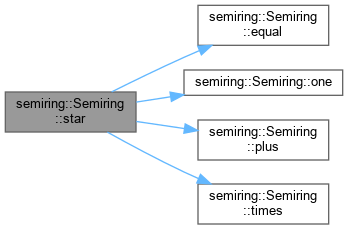
inlinevirtual |
\(a^*\), the sum of the powers of a.
By default, iterates \(s \leftarrow \mathbb{1} \oplus a \otimes s\) from \(\mathbb{1}\) until it stops changing, which an idempotent semiring with finitely many partial sums ensures.
Reimplemented in semiring::BestPath, semiring::Counting, semiring::Regex, semiring::Tropical, and semiring::TropicalPaths.
Definition at line 518 of file Semiring.h.
|
inlinevirtual |
Return true if the semiring can name an unknown and record an equation over it (symbolic_unknown, define).
A symbolic semiring renders the provenance rather than evaluating it; where a recursion derives a tuple through itself, the least solution of its equations is an infinite sum, which such a semiring renders as the equations themselves (see GenericCircuit::solveFixSystem).
false by default; override, with the two methods below. Reimplemented in semiring::Formula.
Definition at line 540 of file Semiring.h.
|
inlinevirtual |
A fresh unknown, as a value.
| position | 1-based position of the unknown among its system's unknowns: the index a gate_fixpoint reading it stores in info1, and the name ProvSQL Studio gives it, so a rendering can use the same name. |
Reimplemented in semiring::Formula.
Definition at line 553 of file Semiring.h.
|
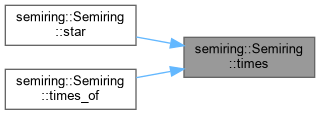
pure virtual |
Apply the multiplicative operation to a list of values.
| v | Ordered list of operands (empty list should return one()). |
Implemented in semiring::BestPath, semiring::Boolean, semiring::BoolExpr, semiring::Counting, semiring::Formula, semiring::How, semiring::IntervalUnion, semiring::Lukasiewicz, semiring::MinMax, semiring::Regex, semiring::Subset, semiring::Tropical, semiring::TropicalPaths, semiring::Viterbi, semiring::Which, and semiring::Why.
|
inlinevirtual |
times over the values v points to, read in place (see plus_of).
| v | Ordered list of pointers to the operands. |
Reimplemented in semiring::Formula.
Definition at line 177 of file Semiring.h.

|
inlinevirtual |
Value of a variable leaf (gate_input / gate_mulinput) that the provenance mapping does not name.
The absent-mapping convention: such a leaf contributes no provenance, i.e. the multiplicative identity, which is what every proper semiring wants and what this default returns. A semiring that renders the circuit rather than evaluating it overrides this to identify the leaf instead – \(\mathbb{1}\) would not merely be anonymous there, it would be absorbed by the enclosing times and take the structure with it. BooleanCircuit::toString does the same for the Boolean-expression rendering (its x<id> fallback).
| uuid | The leaf gate's UUID, in canonical text form. |
Reimplemented in semiring::Formula.
Definition at line 267 of file Semiring.h.

|
inlinevirtual |
Interpret a literal string as a semiring value.
Used for gate_value gates whose payload is a string.
| s | Literal string. |
| SemiringException | if not overridden. |
Reimplemented in semiring::Formula.
Definition at line 248 of file Semiring.h.
|
pure virtual |
Return the additive identity \(\mathbb{0}\).
Implemented in semiring::BestPath, semiring::Boolean, semiring::BoolExpr, semiring::Counting, semiring::Formula, semiring::How, semiring::IntervalUnion, semiring::Lukasiewicz, semiring::MinMax, semiring::Regex, semiring::Subset, semiring::Tropical, semiring::TropicalPaths, semiring::Viterbi, semiring::Which, and semiring::Why.