 |
ProvSQL C/C++ API
Adding support for provenance and uncertainty management to PostgreSQL databases
|
|
ProvSQL C/C++ API
Adding support for provenance and uncertainty management to PostgreSQL databases
|
SQL entry points for the joint-width UCQ compiler. More...
#include "postgres.h"#include "fmgr.h"#include "funcapi.h"#include "miscadmin.h"#include "access/htup_details.h"#include "access/xact.h"#include "catalog/pg_type.h"#include "executor/spi.h"#include "utils/array.h"#include "utils/builtins.h"#include "utils/resowner.h"#include "utils/uuid.h"#include "compatibility.h"#include "provsql_utils.h"#include "c_cpp_compatibility.h"#include "JointEncoding.h"#include "UCQJointCompiler.h"#include "CircuitFromMMap.h"#include "CertifiedDDMaterialize.h"#include "GenericCircuit.h"#include "provsql_utils_cpp.h"#include <algorithm>#include <cmath>#include <limits>#include <map>#include <string>#include <vector>
Go to the source code of this file.
Functions | |
| Datum | ucq_joint_compile_stats (PG_FUNCTION_ARGS) |
| PostgreSQL-callable entry point: UCQ probability plus compilation statistics (the three width columns and the structural stats). | |
| Datum | ucq_joint_materialize_tracked (PG_FUNCTION_ARGS) |
| PostgreSQL-callable entry point: compile the UCQ over correlated inputs and materialise its certified d-D into the store, returning the root provenance token. | |
| Datum | ucq_joint_compile_stats_tracked (PG_FUNCTION_ARGS) |
| PostgreSQL-callable entry point: correlated UCQ probability plus compilation statistics (the three width columns substantiate Prop. | |
| static bool | jwComputeCache (Datum descriptor, const std::vector< unsigned > &head_vars, JwAnswerCache *cache) |
Gather + single-DP materialise all answers into cache. | |
| Datum | ucq_joint_provenance_answer (PG_FUNCTION_ARGS) |
| Per-answer joint-width provenance via the single top-down DP. | |
SQL entry points for the joint-width UCQ compiler.
Exposes UCQJointCompiler (see UCQJointCompiler.h) to SQL. The compiler's job ends at the certified d-D circuit; probability / Shapley / expectation are the standard evaluation on the materialised token, so the SQL surface is materialisation, not probability:
ucq_joint_provenance_answer(): the planner-substituted per-answer entry point. On the first call of a query it gathers the facts once (ucq_joint_gather), runs the single top-down DP, and materialises every answer's d-D into the store, caching head -> token in fn_extra; each output group is then an O(1) lookup – one gather + one decomposition + one sweep for the whole GROUP BY.ucq_joint_materialize_tracked(): materialise the Boolean (existence) d-D of a UCQ over real provenance tokens, returning its root token.ucq_joint_compile_stats(): the same compilation returning the probability together with the three width columns (joint width, data-only and circuit-only degeneracy lower bounds) that substantiate thesis Prop. 4.2.11 empirically, and the structural statistics; the columnar form takes the query and facts as flat parallel arrays.Element ids are dense integers assigned by the gather with a dictionary shared across relations (so join-compatible values match).
Definition in file ucq_joint_evaluate.cpp.
|
static |
Gather + single-DP materialise all answers into cache.
Runs inside a subtransaction (the caller wraps it): a SQL error from the gather (e.g. an unsupported token type for which the joint route declines) propagates as an ereport and is caught by the caller's PG_CATCH; a compiler decline (joint width too large) is a C++ exception caught here and signalled by returning false. Returns true and fills cache on success.
Definition at line 882 of file ucq_joint_evaluate.cpp.

| Datum ucq_joint_compile_stats | ( | PG_FUNCTION_ARGS | ) |
PostgreSQL-callable entry point: UCQ probability plus compilation statistics (the three width columns and the structural stats).
Definition at line 728 of file ucq_joint_evaluate.cpp.
| Datum ucq_joint_compile_stats_tracked | ( | PG_FUNCTION_ARGS | ) |
PostgreSQL-callable entry point: correlated UCQ probability plus compilation statistics (the three width columns substantiate Prop.
4.2.11: a correlated instance can have small data and circuit widths but large joint width).
Definition at line 801 of file ucq_joint_evaluate.cpp.
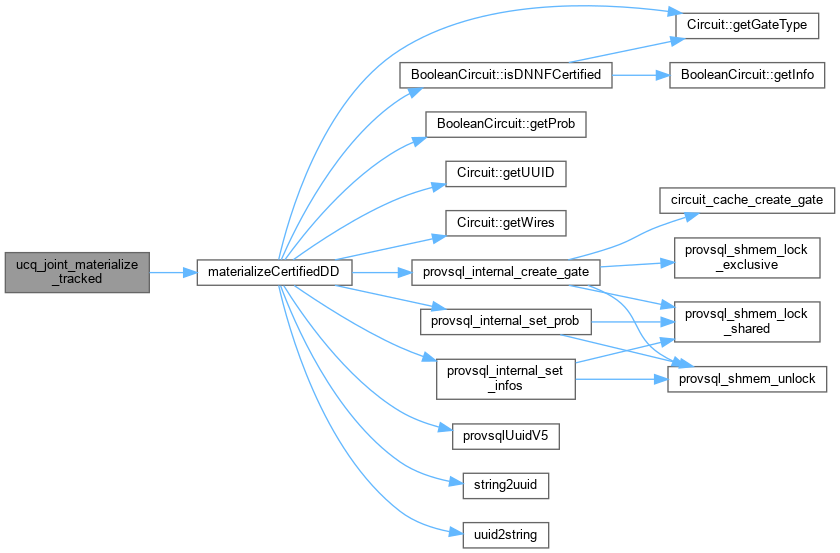
| Datum ucq_joint_materialize_tracked | ( | PG_FUNCTION_ARGS | ) |
PostgreSQL-callable entry point: compile the UCQ over correlated inputs and materialise its certified d-D into the store, returning the root provenance token.
This is the architecturally-primary route: the joint-width compiler's job is to build the deterministic, decomposable circuit; the answer – probability, Shapley, expectation, any provenance-store evaluation – is then obtained through the single standard entry point on the returned token (e.g. probability_evaluate(token)), exploiting the d-D certificate for linear-time evaluation. Unlike the reachability route, the token is NOT wrapped in the 'absorptive' marker: the d-D is the exact Boolean provenance of the (non-recursive) UCQ.
Definition at line 776 of file ucq_joint_evaluate.cpp.
| Datum ucq_joint_provenance_answer | ( | PG_FUNCTION_ARGS | ) |
Per-answer joint-width provenance via the single top-down DP.
See ucq_joint_provenance_answer in provsql.common.sql.
Definition at line 982 of file ucq_joint_evaluate.cpp.
