 |
ProvSQL C/C++ API
Adding support for provenance and uncertainty management to PostgreSQL databases
|
|
ProvSQL C/C++ API
Adding support for provenance and uncertainty management to PostgreSQL databases
|
Phase C of the joint-width UCQ compiler: a UCQ-specialised homomorphism-type DP that runs directly over a tree decomposition of the joint encoding, emitting a certified d-D (deterministic, decomposable circuit) by construction. More...
#include <cstddef>#include <map>#include <unordered_map>#include <utility>#include <vector>#include "JointEncoding.h"#include "TreeDecomposition.h"#include "dDNNF.h"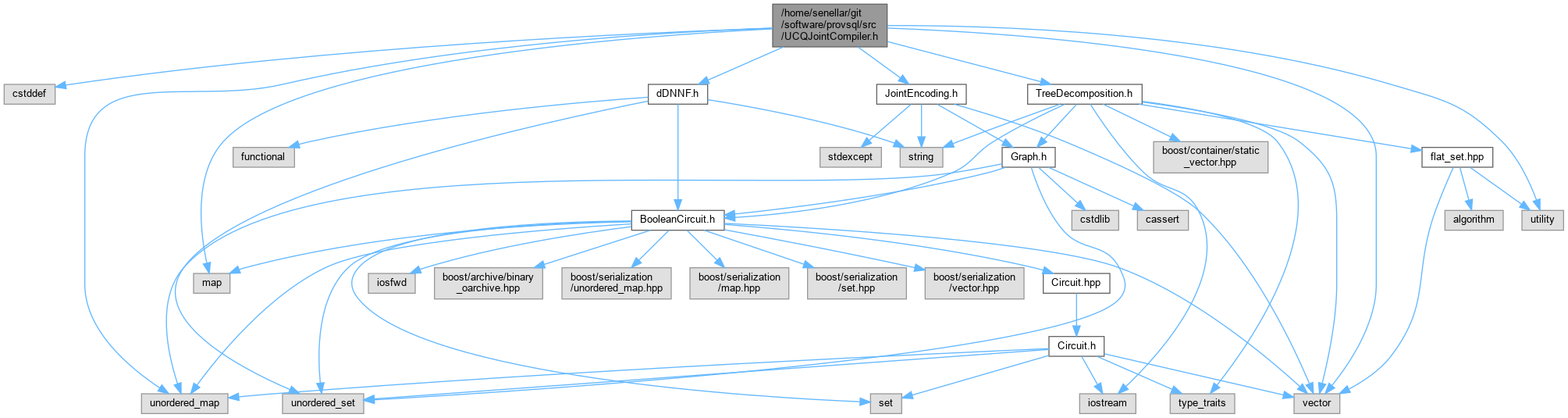
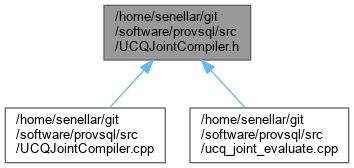
Go to the source code of this file.
Classes | |
| struct | Atom |
| One atom of a conjunctive query: a relation symbol applied to query variables. More... | |
| struct | CQ |
| One conjunctive query (a disjunct of the UCQ). More... | |
| struct | UCQ |
| A union of conjunctive queries. More... | |
| class | UCQJointCompiler |
| Compiles a Boolean UCQ over a joint encoding into a certified d-D, along a tree decomposition of the joint graph. More... | |
| struct | UCQJointCompiler::Stats |
| Structural statistics of a compilation, for diagnostics and tests. More... | |
| struct | UCQJointCompiler::Result |
| A compiled UCQ: the d-D and its statistics. More... | |
| struct | UCQJointCompiler::AnswerRoot |
| Per-answer evaluation by a single top-down DP (data-graph regime). More... | |
| struct | UCQJointCompiler::AnswerCircuit |
Phase C of the joint-width UCQ compiler: a UCQ-specialised homomorphism-type DP that runs directly over a tree decomposition of the joint encoding, emitting a certified d-D (deterministic, decomposable circuit) by construction.
This is the data-side counterpart of ProvSQL's circuit-side treewidth exploitation, and the UCQ counterpart of ReachabilityCompiler: a bag-by-bag dynamic program whose state carries, for each disjunct, the set of partial homomorphisms realised by the facts of the processed subtree (the correlated regime additionally carries in-bag gate valuations). It is the operational form of the thesis's \(\exists T\, q''(T) \wedge q_{wf}(T)\) rewriting (Amarilli, PhD thesis tel-01345836, Prop. 4.2.9): rather than guessing the set T of true gates with a second-order variable, the DP enumerates per-bag valuations, with mutual exclusivity giving determinism for free.
Each transition emits d-D gates directly:
No knowledge-compilation step is therefore needed: the result feeds straight to dDNNF::probabilityEvaluation() (the marginal of an irrelevant world variable folds to a unit factor, exactly as in the reachability compiler, so the strictly-non-smooth circuit still evaluates correctly). For a joint encoding of width \(k\) and a UCQ whose disjuncts have at most \(e\) enumerating variables, the DP state is bounded by a function of \(k\) and \(e\) alone, giving exact probability of a #P-hard UCQ in time linear in the data.
The exponential parameter is the number of enumerating variables (existential join variables outside the key/FD determination closure), not n_vars; the design target is queries with at most 4-5 of them.
Definition in file UCQJointCompiler.h.