 |
ProvSQL C/C++ API
Adding support for provenance and uncertainty management to PostgreSQL databases
|
|
ProvSQL C/C++ API
Adding support for provenance and uncertainty management to PostgreSQL databases
|
Compiles s-t reachability over a probabilistic edge relation into a d-D, along a tree decomposition of the data graph. More...
#include "ReachabilityCompiler.h"
Classes | |
| struct | EdgeRow |
| One row of the edge relation. More... | |
| struct | Stats |
| Structural statistics of a compilation, for diagnostics and tests. More... | |
| struct | Result |
| A compiled reachability query: the d-D and its statistics. More... | |
| struct | VertexRoot |
| One vertex's reachability circuit in an all-targets compilation. More... | |
| struct | AllResult |
| An all-targets compilation: one shared d-D, one root per reachable vertex. More... | |
| struct | VertexHopRoot |
| One (vertex, walk length) circuit of a bounded-hop compilation. More... | |
| struct | AllHopsResult |
| A bounded-hop all-targets compilation. More... | |
| struct | AnyReachAllResult |
| A multi-set any-reach compilation: one shared circuit, one root per target set. More... | |
| struct | SourceArc |
| One source of a multi-source compilation. More... | |
Static Public Member Functions | |
| static Result | compile (const std::vector< EdgeRow > &rows, unsigned long source, unsigned long target, bool directed, std::size_t max_states=DEFAULT_MAX_STATES) |
Compile s-t reachability over rows into a d-D. | |
| static AllResult | compileAll (const std::vector< EdgeRow > &rows, unsigned long source, bool directed, std::size_t max_states=DEFAULT_MAX_STATES) |
| Compile the reachability circuits of every vertex in one pass. | |
| static AllResult | compileAll (const std::vector< EdgeRow > &rows, const std::vector< SourceArc > &sources, bool directed, std::size_t max_states=DEFAULT_MAX_STATES) |
Multi-source variant of compileAll(). | |
| static AllHopsResult | compileAllHops (const std::vector< EdgeRow > &rows, unsigned long source, bool directed, unsigned hop_bound, std::size_t max_states=DEFAULT_MAX_STATES) |
Bounded-hop variant of compileAll(): per-(vertex, exact walk length) circuits for every length up to hop_bound. | |
| static AllHopsResult | compileAllHops (const std::vector< EdgeRow > &rows, const std::vector< SourceArc > &sources, bool directed, unsigned hop_bound, std::size_t max_states=DEFAULT_MAX_STATES) |
| Multi-source bounded-hop compilation. | |
| static Result | compileAnyReach (const std::vector< EdgeRow > &rows, const std::vector< SourceArc > &sources, const std::vector< unsigned long > &set, bool directed, std::size_t max_states=DEFAULT_MAX_STATES) |
| Compile "some vertex of @p set is reachable" into one certified circuit. | |
| static AnyReachAllResult | compileAnyReachAll (const std::vector< EdgeRow > &rows, const std::vector< SourceArc > &sources, const std::vector< std::vector< unsigned long > > &sets, bool directed, std::size_t max_states=DEFAULT_MAX_STATES) |
Multi-set variant of compileAnyReach(): one shared circuit, one root per target set. | |
| static Result | compileCoverReach (const std::vector< EdgeRow > &rows, const std::vector< SourceArc > &sources, const std::vector< unsigned long > &set, bool directed, std::size_t max_states=DEFAULT_MAX_STATES) |
| Compile "every vertex of @p set is reachable" (k-terminal / coverage reachability) into one certified circuit. | |
| static AnyReachAllResult | compileCoverReachAll (const std::vector< EdgeRow > &rows, const std::vector< SourceArc > &sources, const std::vector< std::vector< unsigned long > > &sets, bool directed, std::size_t max_states=DEFAULT_MAX_STATES) |
Multi-set variant of compileCoverReach(): one shared (content-deduplicated) circuit, one root per set, as compileAnyReachAll(). | |
Static Public Attributes | |
| static constexpr std::size_t | DEFAULT_MAX_STATES = 100000 |
| Default bound on the number of DP states at a single decomposition node. | |
| static constexpr unsigned | MAX_HOP_BOUND = 62 |
Maximum supported hop bound for compileAllHops(). | |
Compiles s-t reachability over a probabilistic edge relation into a d-D, along a tree decomposition of the data graph.
Definition at line 74 of file ReachabilityCompiler.h.
|
static |
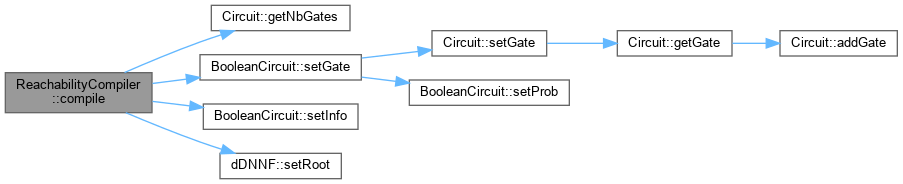
Compile s-t reachability over rows into a d-D.
| rows | Edge tuples (vertex IDs, provenance token, probability). |
| source | Source vertex s. |
| target | Target vertex t. |
| directed | If false, every edge contributes both arcs (undirected connectivity). |
| max_states | Bound on the DP state count per node. |
| TreeDecompositionException | if the data treewidth exceeds TreeDecomposition::MAX_TREEWIDTH. |
| ReachabilityCompilerException | on unsupported input shapes or when max_states is exceeded. |
Definition at line 1851 of file ReachabilityCompiler.cpp.
|
static |
Multi-source variant of compileAll().
Reachability is from a virtual super-source whose arcs to the sources are gated by the source tuples' tokens (or always present for certain sources); a vertex's circuit therefore computes "some
present source reaches it". Everything else is as in compileAll(); the super-source itself is not reported in the roots.
| rows | Edge tuples. |
| sources | Source arcs (at least one). |
| directed | If false, every edge contributes both arcs. |
| max_states | Bound on the DP state count per node. |
Definition at line 1768 of file ReachabilityCompiler.cpp.
|
static |
Compile the reachability circuits of every vertex in one pass.
Two sweeps over the tree decomposition – bottom-up per-subtree state tables, then a top-down "rest of the graph" pass – yield, for each vertex read at its elimination bag, the deterministic OR over compatible (below, above) state pairs whose closure connects the source to it. Total circuit size stays linear in the number of edges for fixed data treewidth: gates are shared across the per-vertex roots. This matches the semantics of the recursive-query relation reach: one root per vertex reachable in the all-edges-present world (vertices certainly unreachable are omitted).
| rows | Edge tuples (vertex IDs, provenance token, probability). |
| source | Source vertex s. |
| directed | If false, every edge contributes both arcs. |
| max_states | Bound on the DP state count per node. |
| TreeDecompositionException | / ReachabilityCompilerException as for compile(). |
Definition at line 1758 of file ReachabilityCompiler.cpp.

|
static |
Multi-source bounded-hop compilation.
The virtual super-source's arcs contribute walk length zero, so the reported lengths count edges of the underlying graph only.
| rows | Edge tuples. |
| sources | Source arcs (at least one). |
| directed | If false, every edge contributes both arcs. |
| hop_bound | Maximum walk length (at most MAX_HOP_BOUND). |
| max_states | Bound on the DP state count per node. |
Definition at line 1789 of file ReachabilityCompiler.cpp.
|
static |
Bounded-hop variant of compileAll(): per-(vertex, exact walk length) circuits for every length up to hop_bound.
Same DP, richer state: the relation entries are sets of achievable walk lengths (bitmasks capped at hop_bound) instead of single reachability bits, composed in the capped min-plus-set semiring (Kleene closure with diagonal star). States still partition the worlds of the introduced edge variables, so determinism and decomposability hold by the same argument; the price is the larger state space, guarded by max_states as before.
| rows | Edge tuples. |
| source | Source vertex. |
| directed | If false, every edge contributes both arcs. |
| hop_bound | Maximum walk length (at most MAX_HOP_BOUND). |
| max_states | Bound on the DP state count per node. |
Definition at line 1778 of file ReachabilityCompiler.cpp.

|
static |
Compile "some vertex of @p set is reachable" into one certified circuit.
Same DP, with the state extended by one bit per domain position – "this position reaches some @p set vertex within the processed
part" – folded under closure and projection, so the single acceptance bit (at the source's position, over the root's table) is read in one bottom-up sweep. This is the deterministic circuit for the OR of the per-vertex reachability roots over set – which, as an OR of correlated events (shared edges), could not otherwise be marked: it serves cross-vertex aggregations ("is some vertex of
this region reachable") the per-vertex roots cannot.
| rows | Edge tuples. |
| sources | Source arcs (at least one). |
| set | The target vertex set (need not intersect the graph; an absent vertex contributes nothing). |
| directed | If false, every edge contributes both arcs. |
| max_states | Bound on the DP state count per node. |
Definition at line 1800 of file ReachabilityCompiler.cpp.
|
static |
Multi-set variant of compileAnyReach(): one shared circuit, one root per target set.
The shared prelude – variable grouping, tree decomposition of the data graph, bag assignments, literal gates – is built once; one bottom-up sweep then runs per set, with content-deduplicated gate emission, so the parts of the circuit a set's seeds do not touch are literally shared across sets (the per-set sweeps re-derive the same gates). This is the engine behind cross-vertex aggregation planting, where one query yields many groups over the same graph.
| rows | Edge tuples. |
| sources | Source arcs (at least one). |
| sets | The target vertex sets (at least one; an absent vertex contributes nothing). |
| directed | If false, every edge contributes both arcs. |
| max_states | Bound on the DP state count per node. |
Definition at line 1815 of file ReachabilityCompiler.cpp.

|
static |
Compile "every vertex of @p set is reachable" (k-terminal / coverage reachability) into one certified circuit.
Same DP, with the state extended by the pending rescuer-set antichain: a forgotten target vertex not yet reached by the source pends on the boundary positions that reach it (its rescuers), the sets staying closed under the relation, shrinking losslessly at forgets, discharged when the source reaches them and absorbed by the empty (reject) set; acceptance, after a final collapse onto the source domain, is the empty antichain. Worlds map to one state each, so the circuit is a certified d-D like the rest of the family: probability evaluation gives k-terminal reliability, and absorptive-semiring evaluation is exact too – nonnegative min-plus gives the cost of the cheapest covering subgraph (directed Steiner cost).
| rows | Edge tuples. |
| sources | Source arcs (at least one). |
| set | The target vertex set; a vertex absent from the graph is unreachable, so the result is constant false. |
| directed | If false, every edge contributes both arcs. |
| max_states | Bound on the DP state count per node. |
Definition at line 1825 of file ReachabilityCompiler.cpp.
|
static |
Multi-set variant of compileCoverReach(): one shared (content-deduplicated) circuit, one root per set, as compileAnyReachAll().
Definition at line 1840 of file ReachabilityCompiler.cpp.

|
staticconstexpr |
Default bound on the number of DP states at a single decomposition node.
The state space at a node is the set of reachable transitively-closed relations over at most MAX_TREEWIDTH+3 elements; it is bounded for fixed treewidth but can still be large near the treewidth cap, so a guard keeps compilation from exhausting memory on adversarial data.
Definition at line 179 of file ReachabilityCompiler.h.
|
staticconstexpr |
Maximum supported hop bound for compileAllHops().
Length sets are bitmasks over walk lengths 0..bound in a 64-bit word; the driver falls back to the generic fixpoint above this.
Definition at line 187 of file ReachabilityCompiler.h.