 |
ProvSQL C/C++ API
Adding support for provenance and uncertainty management to PostgreSQL databases
|
|
ProvSQL C/C++ API
Adding support for provenance and uncertainty management to PostgreSQL databases
|
Abstract per-family continuous distribution. More...
#include "Distribution.h"
Public Member Functions | |
| virtual | ~Distribution ()=default |
| virtual bool | meanIsAffine () const |
Whether mean() is an affine function of the raw parameters | |
| virtual bool | isDiscrete () const |
Whether the family is discrete (integer-valued), so a point event X = c carries positive mass. | |
| virtual DistSupport | support () const =0 |
| Natural support interval of X. | |
| virtual bool | integrationRange (double &lo, double &hi) const =0 |
| Finite window [lo, hi] covering essentially all of X's mass, for numerical quadrature. | |
| virtual std::pair< double, double > | plotRange (double trunc_lo, double trunc_hi) const =0 |
| Plot x-window given optional truncation bounds (±infinity means "unbounded on that side"); used by the SVG curve renderer. | |
| virtual double | sample (std::mt19937_64 &rng) const =0 |
| Draw one sample using the shared MC generator. | |
| virtual std::optional< double > | quantile (double p) const |
| Inverse CDF \(Q(p) = F^{-1}(p)\) for \(p \in (0, 1)\). | |
| virtual std::optional< double > | truncatedRawMoment (double lo, double hi, unsigned k) const |
Closed-form raw moment \(E[X^k \mid lo < X < hi]\) of the distribution truncated to | |
| virtual std::optional< std::vector< double > > | sampleTruncated (std::mt19937_64 &rng, double lo, double hi, unsigned n) const |
Draw n rejection-free samples of X conditioned on lo < X < hi (±infinity for a semi-infinite side). | |
| virtual std::optional< double > | iidOrderStatMean (std::size_t n, bool isMax) const |
Closed-form mean of the max / min of n i.i.d. | |
| virtual std::unique_ptr< Distribution > | affine (double a, double b) const =0 |
Closed-form location-scale transform a·X + b within the family. | |
| std::unique_ptr< Distribution > | scale (double c) const |
Closed-form c·X (affine with no offset). | |
| std::unique_ptr< Distribution > | negate () const |
Closed-form -X (affine with coefficient -1). | |
| virtual std::string | serialise () const =0 |
The on-disk gate_rv extra text encoding (e.g. | |
| virtual std::optional< double > | asDirac () const |
The point-mass value when the parameters make the distribution degenerate (a Dirac), std::nullopt for a proper distribution. | |
Identity (parameters, for the i.i.d. equality test) | |
| virtual const DistributionFamily & | family () const =0 |
| The family's interned registry descriptor. | |
| virtual double | p1 () const =0 |
| virtual double | p2 () const =0 |
Closed-form moments | |
| virtual double | mean () const =0 |
| E[X]. | |
| virtual double | variance () const =0 |
| Var(X). | |
| virtual double | rawMoment (unsigned k) const =0 |
| E[X^k]. | |
Density / distribution | |
| virtual double | pdf (double x) const =0 |
| f(x); NaN if the family declines | |
| virtual double | cdf (double x) const =0 |
| F(x); NaN if the family declines. | |
Abstract per-family continuous distribution.
Concrete subclasses (Normal / Uniform / Exponential / Erlang / Gamma) hold the two parameters and implement the family-specific closed forms. The methods below are the family-local ones (pairwise closure / comparison rules live in separate registries, not here).
Definition at line 48 of file Distribution.h.
|
virtualdefault |
|
pure virtual |
Closed-form location-scale transform a·X + b within the family.
Returns the transformed distribution when the family is closed under these coefficients, nullptr when it is not: Exponential / Erlang decline a <= 0 (the support flips) and any non-zero offset (a shifted Erlang leaves the family); every family declines a == 0 (a Dirac is not in-family – the constant-fold path is responsible for pure constants).
|
inlinevirtual |
The point-mass value when the parameters make the distribution degenerate (a Dirac), std::nullopt for a proper distribution.
Only Normal reports one (σ == 0, e.g. after an underflowing scale fold); the simplifier collapses such a result to a plain constant. Families whose degenerate forms are still sampled as-is (Uniform(a, a)) do not report.
Definition at line 238 of file Distribution.h.
|
pure virtual |
F(x); NaN if the family declines.

|
pure virtual |
|
inlinevirtual |
Closed-form mean of the max / min of n i.i.d.
copies of X.
E[max] = a + (b-a)·n/(n+1), E[min] = a + (b-a)/(n+1).E[min] = 1/(nλ), E[max] = H_n/λ (harmonic number), for λ > 0.std::nullopt when the family has no elementary order-statistic mean (Normal, Erlang – those need the 1-D layer-cake quadrature) or the parameters are degenerate, so the caller falls back to quadrature / Monte Carlo.
Definition at line 192 of file Distribution.h.
|
pure virtual |
Finite window [lo, hi] covering essentially all of X's mass, for numerical quadrature.
Returns false (leaving lo / hi untouched) when the parameters are degenerate.

|
inlinevirtual |
Whether the family is discrete (integer-valued), so a point event X = c carries positive mass.
Default false (continuous). The discrete families (Poisson, Binomial) override to true. It is the authoritative, per-family signal – not inferred – that a point observation / conditioning event on a leaf of this family is feasible (a continuous point event is measure-zero, so it is only meaningful as a likelihood weight, never as a rejection interval). pdf() already returns the pmf for a discrete family, so the density-weight path needs no special case beyond this classification.
Definition at line 102 of file Distribution.h.
|
pure virtual |
E[X].
|
inlinevirtual |
Whether mean() is an affine function of the raw parameters (p1, p2) – i.e.
mean = c0 + c1·p1 + c2·p2.
Default false. A family whose mean is a linear combination of its parameters (Normal μ, Uniform (a+b)/2, inverse-Gaussian μ) overrides to true. This is the authoritative signal the latent- variable evaluator uses to keep the expectation of a compound (token- parameterised) leaf EXACT: when the mean is affine, \(E[X] = E[\mathrm{mean}(\theta)] = \mathrm{mean}(E[\theta])\) by linearity of expectation (no independence assumption), so the evaluator recurses into the parameter wires instead of falling back to Monte Carlo. Families with a nonlinear mean (Exponential 1/λ, Gamma k/λ, ...) keep the default and decline.
Definition at line 87 of file Distribution.h.
|
inline |
Closed-form -X (affine with coefficient -1).
Definition at line 217 of file Distribution.h.

|
pure virtual |
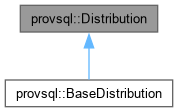
Implemented in provsql::BaseDistribution.
|
pure virtual |
Implemented in provsql::BaseDistribution.
|
pure virtual |
f(x); NaN if the family declines
|
pure virtual |
Plot x-window given optional truncation bounds (±infinity means "unbounded on that side"); used by the SVG curve renderer.
|
inlinevirtual |
Inverse CDF \(Q(p) = F^{-1}(p)\) for \(p \in (0, 1)\).
std::nullopt when the family has no elementary inverse CDF (Erlang), so "unsupported" cannot be silently consumed – callers branch on availability explicitly. Normal uses the Beasley-Springer-Moro rational approximation (~1e-7 accuracy, ample for sampling); Uniform / Exponential invert exactly. Behaviour at the endpoints is the family's (BSM diverges; clamp p strictly inside (0, 1) before calling).
Definition at line 141 of file Distribution.h.
|
pure virtual |
E[X^k].
|
pure virtual |
Draw one sample using the shared MC generator.
|
inlinevirtual |
Draw n rejection-free samples of X conditioned on lo < X < hi (±infinity for a semi-infinite side).
Each family uses its own exact scheme (interval intersection for Uniform, memorylessness / stable inverse-CDF for Exponential, inverse-CDF transform for Normal). std::nullopt when the family has no scheme (Erlang: needs the inverse regularised incomplete gamma) or the truncation is degenerate / parameters invalid, so the caller's MC-rejection fallback can emit its usual diagnostics.
Definition at line 173 of file Distribution.h.
|
inline |
Closed-form c·X (affine with no offset).
Definition at line 212 of file Distribution.h.

|
pure virtual |
The on-disk gate_rv extra text encoding (e.g.
"normal:2.5,0.5"), inverse of parse_distribution_spec.
|
pure virtual |
Natural support interval of X.
|
inlinevirtual |
Closed-form raw moment \(E[X^k \mid lo < X < hi]\) of the distribution truncated to [lo, hi] (±infinity for a semi-infinite side).
std::nullopt when the family has no closed form (Erlang: needs the regularised lower incomplete gamma) or the truncation is degenerate (mass below a numerical floor), so the caller falls through to MC rejection. k is at least 1 (the caller short-circuits k = 0).
Definition at line 156 of file Distribution.h.
|
pure virtual |
Var(X).