 |
ProvSQL C/C++ API
Adding support for provenance and uncertainty management to PostgreSQL databases
|
|
ProvSQL C/C++ API
Adding support for provenance and uncertainty management to PostgreSQL databases
|
In-memory catalog of the external tools ProvSQL can invoke. More...
#include <string>#include <utility>#include <vector>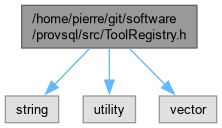

Go to the source code of this file.
Classes | |
| struct | provsql::ToolRecord |
| One registered external tool. More... | |
| class | provsql::ToolRegistry |
| The process-local registry singleton. More... | |
Namespaces | |
| namespace | provsql |
Functions | |
| std::string | provsql::expandCommandTemplate (const std::string &tpl, const std::string &binary, const std::string &in, const std::string &out, const std::vector< std::pair< std::string, std::string > > &extra={}) |
| Expand a command template into a runnable shell command line. | |
| ToolRegistry & | provsql::tool_registry () |
Shorthand for ToolRegistry::instance(). | |
In-memory catalog of the external tools ProvSQL can invoke.
ProvSQL shells out to several knowledge compilers / model counters / visualisers (d4, d4v2, c2d, minic2d, dsharp, ganak, weightmc, graph-easy). Rather than compiling the set of tools, their executable names, and which one is preferred for a given operation in as string literals scattered across many call sites, this registry holds a single in-memory table of provsql::ToolRecord, so the dispatchers query metadata instead of testing literals.
The registry is seeded at first use with the tools ProvSQL knows about, with their default invocations and a default preference order, so a fresh backend works out of the box with no registration call. An administrator may then add / repoint / reorder / disable tools at run time through the SQL surface (provsql.register_tool, provsql.unregister_tool, provsql.set_tool_enabled, provsql.set_tool_preference, and the read-only provsql.tools view).
tdkc tool deliberately uses no external tool, so it does not link this registry: every reference to it in BooleanCircuit.cpp is guarded by #ifndef TDKC. Keep this header free of any PostgreSQL or external-tool dependency so it stays a self-contained piece of metadata. Definition in file ToolRegistry.h.