 |
ProvSQL C/C++ API
Adding support for provenance and uncertainty management to PostgreSQL databases
|
|
ProvSQL C/C++ API
Adding support for provenance and uncertainty management to PostgreSQL databases
|
Decomposition-aligned compilation of two-terminal reachability over bounded-treewidth data into a d-D. More...
#include <cstddef>#include <stdexcept>#include <string>#include <vector>#include "dDNNF.h"#include "TreeDecomposition.h"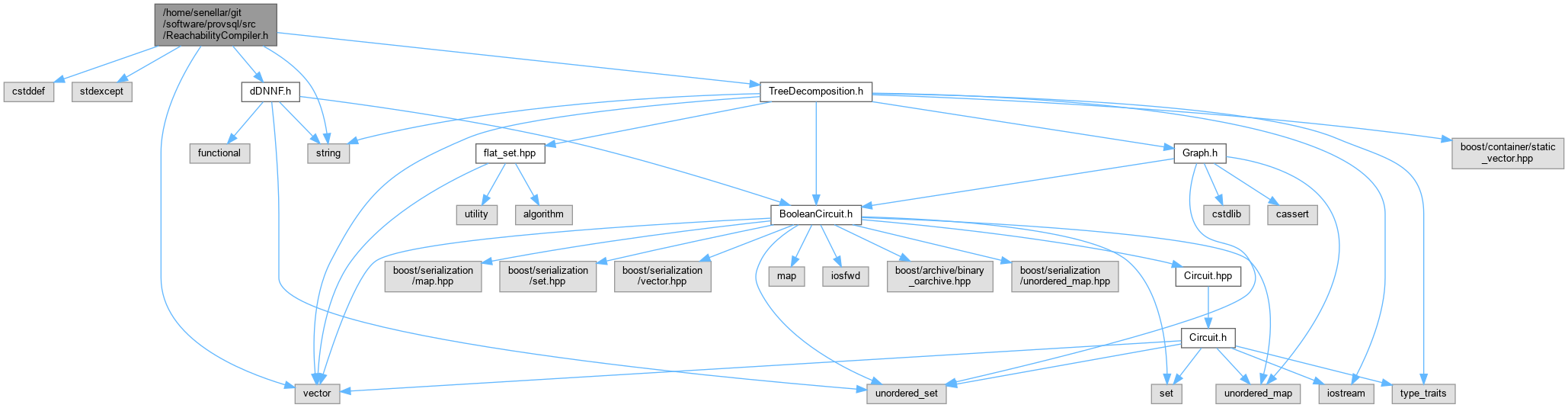
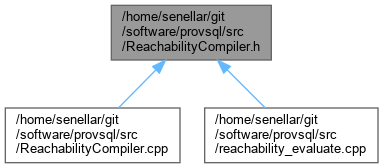
Go to the source code of this file.
Classes | |
| class | ReachabilityCompilerException |
| Exception thrown when reachability compilation fails. More... | |
| class | ReachabilityCompiler |
| Compiles s-t reachability over a probabilistic edge relation into a d-D, along a tree decomposition of the data graph. More... | |
| struct | ReachabilityCompiler::EdgeRow |
| One row of the edge relation. More... | |
| struct | ReachabilityCompiler::Stats |
| Structural statistics of a compilation, for diagnostics and tests. More... | |
| struct | ReachabilityCompiler::Result |
| A compiled reachability query: the d-D and its statistics. More... | |
| struct | ReachabilityCompiler::VertexRoot |
| One vertex's reachability circuit in an all-targets compilation. More... | |
| struct | ReachabilityCompiler::AllResult |
| An all-targets compilation: one shared d-D, one root per reachable vertex. More... | |
| struct | ReachabilityCompiler::VertexHopRoot |
| One (vertex, walk length) circuit of a bounded-hop compilation. More... | |
| struct | ReachabilityCompiler::AllHopsResult |
| A bounded-hop all-targets compilation. More... | |
| struct | ReachabilityCompiler::AnyReachAllResult |
| A multi-set any-reach compilation: one shared circuit, one root per target set. More... | |
| struct | ReachabilityCompiler::SourceArc |
| One source of a multi-source compilation. More... | |
Decomposition-aligned compilation of two-terminal reachability over bounded-treewidth data into a d-D.
Implements the data-side counterpart of ProvSQL's circuit-side treewidth exploitation: instead of building a provenance circuit along the relational-algebra plan (whose treewidth can grow with the instance size) and decomposing it afterwards, the provenance of s-t reachability is built along a tree decomposition of the data graph itself, in the spirit of the provenance refinement of Courcelle's theorem (Amarilli, Bourhis & Senellart, ICALP 2015 / ICDT 2017).
The construction is a bag-by-bag dynamic program whose state at a decomposition node is the transitively-closed reachability relation over the bag's vertices augmented with the two terminals s and t (equivalently, the standard DP over the decomposition obtained by adding s and t to every bag). Each transition emits d-D gates directly:
No knowledge-compilation step is therefore needed: the result is fed straight to dDNNF::probabilityEvaluation(). For data of treewidth \(k\) the d-D has size linear in the number of edges (times a function of \(k\) only), which yields linear-time exact computation of two-terminal network reliability – a #P-hard problem in general – on bounded-treewidth probabilistic graphs, including cyclic graphs that the recursive-query fixpoint cannot handle.
Directed reachability and undirected connectivity are both supported: the DP state is a reachability relation (not a partition), so the undirected case is simply the directed case with each edge contributing both arcs.
Definition in file ReachabilityCompiler.h.