 |
ProvSQL C/C++ API
Adding support for provenance and uncertainty management to PostgreSQL databases
|
|
ProvSQL C/C++ API
Adding support for provenance and uncertainty management to PostgreSQL databases
|
Phase A of the joint-width UCQ compiler: assemble the joint graph of the data and its correlation structure, and the per-fact gating information the homomorphism DP consumes. More...
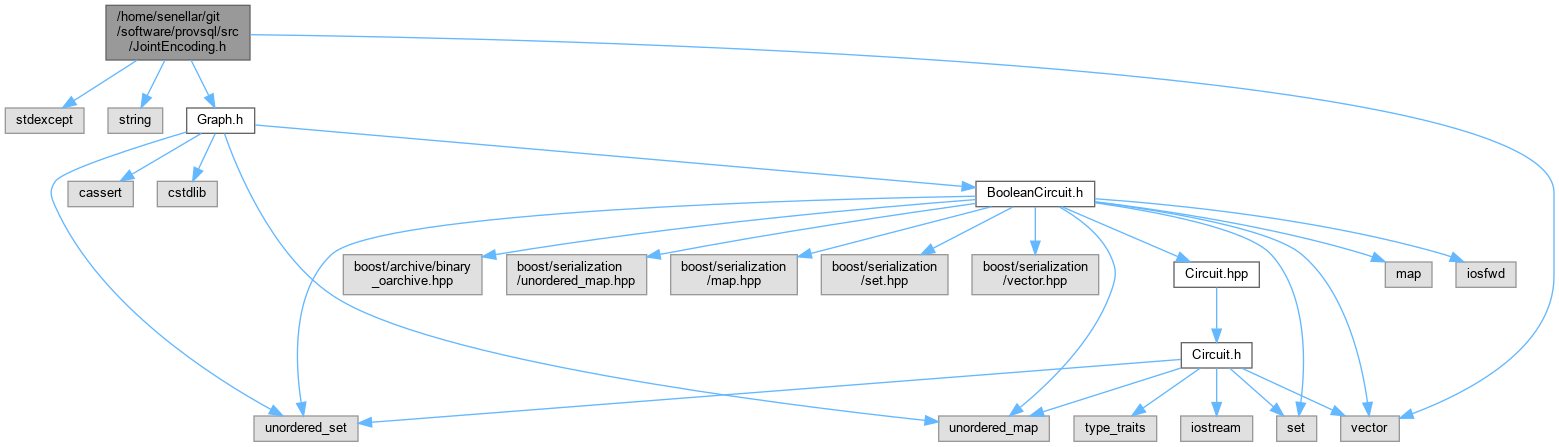
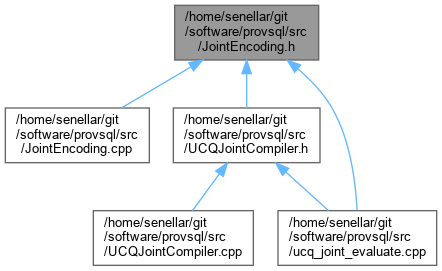
Go to the source code of this file.
Classes | |
| class | JointCompilerException |
| Exception thrown when joint-width compilation cannot proceed. More... | |
| struct | FactRow |
| One row of an atom's relation, as handed in by the SQL layer. More... | |
| struct | SliceGate |
| One node of the extracted circuit slice (correlated regime). More... | |
| struct | Fact |
| A deduplicated fact participating in the DP. More... | |
| struct | Event |
| One independent Bernoulli world variable. More... | |
| class | JointEncoding |
| The joint encoding of an instance: facts, world events, and the joint graph the screen and the DP run over. More... | |
Enumerations | |
| enum class | FactGateKind { CERTAIN , INDEP , GATE } |
| How a fact's presence is gated in a possible world. More... | |
| enum class | SliceGateType { INPUT , AND , OR , NOT } |
| Gate kind of a circuit-slice node (correlated regime). More... | |
Phase A of the joint-width UCQ compiler: assemble the joint graph of the data and its correlation structure, and the per-fact gating information the homomorphism DP consumes.
The joint-width compiler (see UCQJointCompiler.h) evaluates an arbitrary UCQ – including the queries that are #P-hard under the Dalvi-Suciu dichotomy – exactly, in time tractable whenever the joint treewidth of the data and its correlation structure is bounded (Amarilli, PhD thesis tel-01345836, §4.2; Amarilli, Bourhis & Senellart, arXiv:1511.08723 App. D). The screen must run on the joint graph and nothing weaker: thesis Prop. 4.2.11 exhibits instances with tw(data)=1 and tw(circuit)=0 that are still #P-hard, all the hardness living in the fact-to-gate mapping.
JointEncoding builds that graph. In the data-graph regime (every fact gated by an independent gate_input, pairwise-distinct tokens – the §3.5 fast path) the joint graph is exactly the Gaifman graph of the facts and the screen is the data treewidth, which is the sound screen there (no correlation edges exist for Prop. 4.2.11 to exploit). Correlated inputs – facts whose provenance tokens are internal gates over shared events – additionally contribute the circuit slice's vertices and wires (handled by the gate machinery); their shared event leaves become real shared vertices, so the co-occurrence cliques of Prop. 4.3.2 arise automatically.
Definition in file JointEncoding.h.
|
strong |
How a fact's presence is gated in a possible world.
The data-graph fast path uses only CERTAIN and INDEP; the correlated regime adds GATE (presence is the value of an internal gate of the shared circuit slice).
Definition at line 78 of file JointEncoding.h.
|
strong |
Gate kind of a circuit-slice node (correlated regime).
The slice is normalised to arity ≤ 2 (a fan-in-k AND/OR becomes a balanced binary tree of fresh gates), so AND/OR have exactly two children and NOT exactly one; INPUT leaves carry a probability.
| Enumerator | |
|---|---|
| INPUT | |
| AND | |
| OR | |
| NOT | |
Definition at line 91 of file JointEncoding.h.