 |
ProvSQL C/C++ API
Adding support for provenance and uncertainty management to PostgreSQL databases
|
|
ProvSQL C/C++ API
Adding support for provenance and uncertainty management to PostgreSQL databases
|
The family-agnostic side of the Distribution hierarchy: the registries (family descriptors / factories, pairwise comparator and closure rules), their dispatch drivers, and the generic comparator quadrature fallback.
More...
#include "DistributionCommon.h"#include <cmath>#include <map>#include <string>#include <tuple>#include <utility>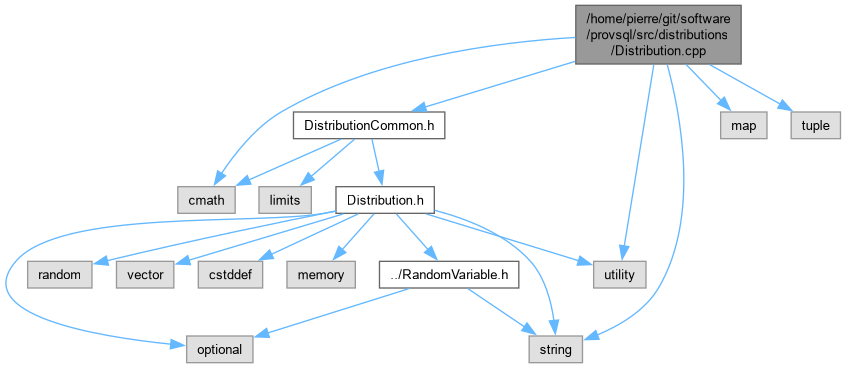
Go to the source code of this file.
Namespaces | |
| namespace | provsql |
Functions | |
| double | provsql::numericQuantile (const Distribution &d, double p) |
Numeric inverse CDF: monotone bisection of cdf() over the family's integration window. | |
| std::unique_ptr< Distribution > | provsql::makeDistribution (const DistributionSpec &spec) |
Construct the per-family Distribution for a parsed spec. | |
ComparatorRuleRegistry – pairwise §B.2 closed forms | |
Closed-form \(P(X < Y)\) for an ordered pair of independent RV families. On continuous distributions every ordered comparator reduces to \(P(X < Y)\) or its complement, so rules are keyed on the family pair alone (no operator in the key). Pairwise behaviour deliberately stays out of the | |
| void | provsql::registerComparatorRule (const char *x, const char *y, ComparatorRule rule) |
| Register the \(P(X < Y)\) closed form for a family pair. | |
| double | provsql::comparatorPairLess (const Distribution &X, const Distribution &Y) |
| \(P(X < Y)\) for two independent RVs. | |
ClosureRuleRegistry – pairwise family-closure folds on PLUS | |
Closed-form folds of a sum of independent scalar terms into a single distribution (Normal + Normal, same-rate Exponential / Erlang chains). Like the comparator rules, pairwise behaviour stays out of the A rule receives the whole term list rather than reducing pairwise so its accumulation arithmetic (e.g. one variance sum with a single final square root) is not perturbed by intermediate re-serialisation. | |
| void | provsql::registerClosureRule (const char *x, const char *y, ClosureRule rule) |
| Register the sum-closure rule for a family pair (name-token keyed, like the comparator rules). | |
| void | provsql::registerProductRule (const char *x, const char *y, ProductRule rule) |
| Register the product-closure rule for a family pair (name-token keyed, like the sum-closure rules). | |
| void | provsql::registerTransformRule (const char *transform, const char *family, TransformRule rule) |
Register the image rule for transform ("ln" / "exp" / ...; the evaluator maps its arith opcodes to these names, keeping this registry opcode-free) applied to family. | |
| std::unique_ptr< Distribution > | provsql::closeProductFactors (const std::vector< const Distribution * > &factors) |
Fold a product of independent factors into a single distribution when a registered closure covers every family present (same first-vs-each dispatch as closePlusTerms); nullptr on any miss. | |
| std::unique_ptr< Distribution > | provsql::closeTransform (const char *transform, const Distribution &x) |
The image distribution of transform applied to x, when a registered rule covers x's family; nullptr otherwise. | |
| std::unique_ptr< Distribution > | provsql::closePlusTerms (const std::vector< ClosureTerm > &terms) |
Fold PLUS(terms) into a single distribution when a registered closure covers every family in the sum. | |
ConjugateRuleRegistry – exact conjugate-prior posterior updates | |
One-observation Bayesian updates for conjugate prior/likelihood pairs: the exact posterior of a latent, wired into one parameter slot of an observed leaf, stays in the prior's family with updated parameters. The conjugate-posterior recogniser ( Like the comparator / closure registries, the rules stay out of the | |
| void | provsql::registerConjugateRule (const char *likelihood_family, int wired_param, const char *prior_family, const ConjugateRule &rule) |
Register the conjugate update for observations of likelihood_family whose parameter wired_param (0 = p1, 1 = p2) is the latent, against a prior of prior_family. | |
| const ConjugateRule * | provsql::lookupConjugateRule (const std::string &likelihood_family, int wired_param, const std::string &prior_family) |
Look up the conjugate rule for (likelihood family, wired parameter position, prior family); nullptr on a miss. | |
DistributionRegistry – family descriptor table | |
Family implementations self-register their descriptor at static initialisation: the on-disk name token (the part before the colon in a
| |
| void | provsql::registerDistributionFamily (const DistributionFamily &descriptor) |
| Register a family; called by the registrar at static init. | |
| std::vector< const DistributionFamily * > | provsql::listDistributionFamilies () |
| Every registered family, sorted by name token. | |
| const DistributionFamily * | provsql::lookupDistributionFamily (const std::string &name) |
| Look up a family by its on-disk name token. | |
The family-agnostic side of the Distribution hierarchy: the registries (family descriptors / factories, pairwise comparator and closure rules), their dispatch drivers, and the generic comparator quadrature fallback.
The per-family closed forms live in one file per family next to this one (normal.cpp, uniform.cpp, exponential.cpp, erlang.cpp); each registers itself at static initialisation, so adding a family means adding a file – nothing here changes.
Definition in file Distribution.cpp.