 |
ProvSQL C/C++ API
Adding support for provenance and uncertainty management to PostgreSQL databases
|
|
ProvSQL C/C++ API
Adding support for provenance and uncertainty management to PostgreSQL databases
|
Enumerate tuple subsets satisfying an aggregate HAVING predicate. More...
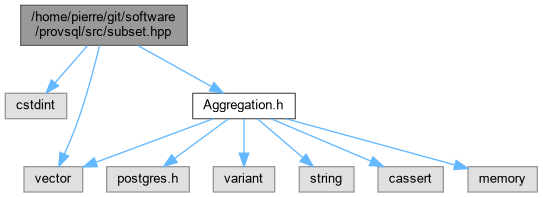
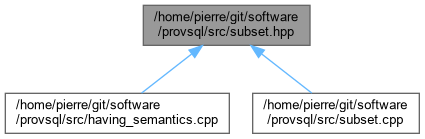
Go to the source code of this file.
Typedefs | |
| using | mask_t = std::vector<bool> |
| A bitmask over \(n\) tuples representing one possible world. | |
Functions | |
| std::vector< mask_t > | enumerate_valid_worlds (const std::vector< long > &values, long constant, ComparisonOperator op, AggregationOperator agg_kind, bool enumerate, bool &upset, bool is_scalar=false) |
Enumerate all subsets of n tuples satisfying an aggregate predicate. | |
| bool | agg_cmp_holds_in_world (const std::vector< long > &values, const mask_t &present, long constant, ComparisonOperator op, AggregationOperator agg_kind) |
Canonical per-world decision: does agg(present) op constant hold in the world where exactly the present tuples are present? | |
| std::vector< mask_t > | enumerate_array_agg_worlds (const std::vector< std::string > &vals, const std::vector< std::string > &target, bool want_equal) |
Enumerate the non-empty worlds whose ordered present elements equal (want_equal true) or differ from (want_equal false) target. | |
| std::vector< mask_t > | enumerate_array_agg_pair_worlds (const std::vector< std::size_t > &lbits, const std::vector< std::string > &lvals, const std::vector< std::size_t > &rbits, const std::vector< std::string > &rvals, std::size_t nbits, bool want_equal) |
Enumerate the worlds where the arrays of two array_agg() aggregates are equal (want_equal) or differ. | |
Enumerate tuple subsets satisfying an aggregate HAVING predicate.
For aggregate provenance evaluation, ProvSQL needs to determine which subsets of base tuples produce a group-aggregate value that satisfies the HAVING condition. This header declares the enumerate_valid_worlds() function that enumerates all such subsets ("valid worlds") as bitmasks.
A world is represented as a mask_t = std::vector<bool> of length \(n\), where bit \(i\) is true iff tuple \(i\) is present in that world. The function returns all worlds where the aggregate of the present tuples' values satisfies the given comparison.
Definition in file subset.hpp.
| using mask_t = std::vector<bool> |
A bitmask over \(n\) tuples representing one possible world.
mask_t[i] is true iff tuple \(i\) is present in this world.
Definition at line 29 of file subset.hpp.
| bool agg_cmp_holds_in_world | ( | const std::vector< long > & | values, |
| const mask_t & | present, | ||
| long | constant, | ||
| ComparisonOperator | op, | ||
| AggregationOperator | agg_kind ) |
Canonical per-world decision: does agg(present) op constant hold in the world where exactly the present tuples are present?
The single source of truth for "value of @c agg θ k in one world", shared by the all-worlds expansion (the exhaustive enumerator builds its world set from this predicate) and by any sampler that draws one world (so sample and expand agree by construction).
Enforces the empty-group exclusion: a world with no present tuple makes the predicate false (SQL evaluates HAVING only on groups that exist, so an all-absent group never satisfies it – even for e.g. sum(x) >= -5 or min(x) <= k). Otherwise it aggregates the present tuples' values with agg_kind and applies op against constant on the integer grid (the caller having scaled numeric / decimal-float domains; see matchAggCmp).
| values | Per-tuple aggregate contribution (scaled to a common grid). |
| present | Which tuples are present in this world (same length). |
| constant | Right-hand side of the comparison, on the same grid. |
| op | Comparison operator. |
| agg_kind | Aggregation function. |
true iff a non-empty group's aggregate satisfies op. Definition at line 360 of file subset.cpp.


| std::vector< mask_t > enumerate_array_agg_pair_worlds | ( | const std::vector< std::size_t > & | lbits, |
| const std::vector< std::string > & | lvals, | ||
| const std::vector< std::size_t > & | rbits, | ||
| const std::vector< std::string > & | rvals, | ||
| std::size_t | nbits, | ||
| bool | want_equal ) |
Enumerate the worlds where the arrays of two array_agg() aggregates are equal (want_equal) or differ.
A world is a subset of the contributing tuples of both aggregates, which may share tuples: lbits and rbits give, for each element of the left and the right array, the bit of the tuple it comes from, among nbits. A side with no present tuple is NULL, which no comparison satisfies, so those worlds are left out.
| lbits | Bit of each element of the left array, in its order. |
| lvals | Element texts of the left array, in its order. |
| rbits | Bit of each element of the right array, in its order. |
| rvals | Element texts of the right array, in its order. |
| nbits | Number of tuples the worlds range over. |
| want_equal | true for =, false for <>. |
Definition at line 465 of file subset.cpp.
| std::vector< mask_t > enumerate_array_agg_worlds | ( | const std::vector< std::string > & | vals, |
| const std::vector< std::string > & | target, | ||
| bool | want_equal ) |
Enumerate the non-empty worlds whose ordered present elements equal (want_equal true) or differ from (want_equal false) target.
The general array_agg() HAVING pipeline: no aggregate-specific shortcut, just an exhaustive scan that compares, in each world, the array of present tuples' element texts (kept in the aggregate's input order) against the constant array. Element values are compared as their text representations, so any element type is supported for = / <>.
| vals | Per-tuple element text (in the aggregate's input order). |
| target | The constant array's element texts. |
| want_equal | true for =, false for <>. |
Definition at line 495 of file subset.cpp.
| std::vector< mask_t > enumerate_valid_worlds | ( | const std::vector< long > & | values, |
| long | constant, | ||
| ComparisonOperator | op, | ||
| AggregationOperator | agg_kind, | ||
| bool | enumerate, | ||
| bool & | upset, | ||
| bool | is_scalar = false ) |
Enumerate all subsets of n tuples satisfying an aggregate predicate.
For each subset \(W \subseteq \{0, \ldots, n-1\}\) of the tuples, computes the aggregate of their values, tests the predicate \(\text{agg}(W) \;\mathit{op}\; \text{constant}\), and includes \(W\) in the result if the predicate holds.
| values | Aggregate contribution of each tuple (one value per tuple). |
| constant | The constant on the right-hand side of the comparison. |
| op | Comparison operator (=, ≠, <, ≤, >, ≥). |
| agg_kind | Aggregation function (SUM, COUNT, MIN, MAX…). |
| enumerate | If false, only determine whether the set of valid worlds is an upset; the returned vector may be empty. |
| upset | Output: set to true if the set of valid worlds forms an upset (upward-closed set), false otherwise. |
| is_scalar | Scalar (no GROUP BY) aggregation: the output row exists even in the empty world, so the empty subset is also tested against the predicate. |
Definition at line 425 of file subset.cpp.
