 |
ProvSQL C/C++ API
Adding support for provenance and uncertainty management to PostgreSQL databases
|
|
ProvSQL C/C++ API
Adding support for provenance and uncertainty management to PostgreSQL databases
|
Why-provenance semiring (set of witness sets). More...
#include <cstring>#include <set>#include <sstream>#include <string>#include <vector>#include <algorithm>#include "Semiring.h"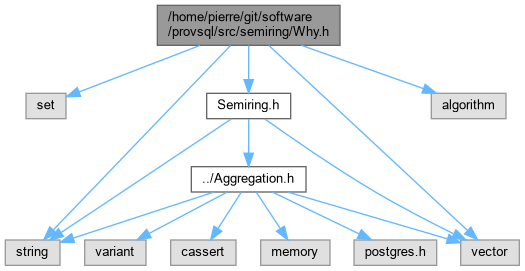
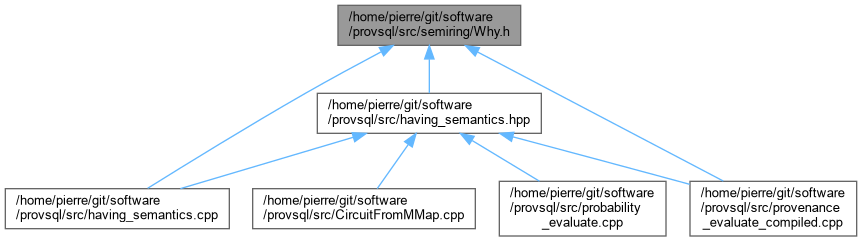
Go to the source code of this file.
Classes | |
| class | semiring::Why |
| Why-provenance semiring. More... | |
Namespaces | |
| namespace | semiring |
Typedefs | |
| using | semiring::label_t = std::string |
| A single label identifying a base tuple. | |
| using | semiring::label_set = std::set<label_t> |
| A witness: a set of labels that collectively justify one derivation. | |
| using | semiring::why_provenance_t = std::set<label_set> |
| Why-provenance value: the full set of all witnesses. | |
Why-provenance semiring (set of witness sets).
The why-provenance semiring represents provenance as a set of witness sets. Each witness set is a set of base-tuple labels that together "witness" one derivation of the query result. The full provenance is the collection of all such witness sets.
Formally, the carrier type is \(\mathcal{P}(\mathcal{P}(\text{Labels}))\), implemented as why_provenance_t = std::set<std::set<std::string>>.
Operations:
zero() → ∅ (no derivations)one() → {∅} (one derivation requiring no witnesses)plus() → union of input setstimes() → pairwise concatenation (Cartesian product of witnesses)monus() → remove elements of \(y\) from \(x\)delta() → support indicator ( \(\mathbb{0}\) if empty, \(\mathbb{1}\) otherwise)This semiring is idempotent (set union is idempotent: \(a \oplus a = a\)), but not absorptive in the \(\mathbb{1} \oplus a = \mathbb{1}\) sense used by absorptive(): \({\{\emptyset\}} \cup \{\{x\}\} = \{\emptyset, \{x\}\} \neq \{\emptyset\}\).
instSemiringWithMonusWhy, with proofs of Why.idempotent, Why.not_absorptive, and Why.not_mul_sub_left_distributive. Definition in file Why.h.