 |
ProvSQL C/C++ API
Adding support for provenance and uncertainty management to PostgreSQL databases
|
|
ProvSQL C/C++ API
Adding support for provenance and uncertainty management to PostgreSQL databases
|
Which-provenance (lineage) m-semiring. More...
#include <cstring>#include <optional>#include <set>#include <sstream>#include <string>#include <vector>#include "Semiring.h"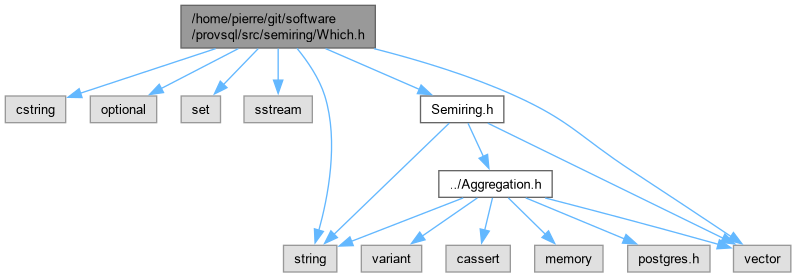
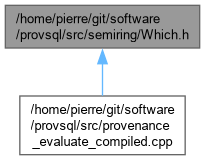
Go to the source code of this file.
Classes | |
| class | semiring::Which |
| Which-provenance (lineage) semiring. More... | |
Namespaces | |
| namespace | semiring |
Typedefs | |
| using | semiring::which_provenance_t = std::optional<std::set<std::string> > |
| Which-provenance value: a set of labels, or \(\bot\) (empty optional). | |
Which-provenance (lineage) m-semiring.
The which-provenance semiring (also known as lineage) records, for each derivation of a result tuple, the set of base-tuple labels that contributed to it. Unlike why-provenance, only one such set is tracked per gate: the union of all witnesses across all derivations.
Formally, the carrier set is \(\mathcal{P}(\text{Labels}) \uplus \{\bot\}\), where \(\bot\) (the additive identity) represents "no derivation". Implemented as which_provenance_t = std::optional<std::set<std::string>> (an empty optional is \(\bot\)).
Operations:
zero() → \(\bot\) (no derivations)one() → \(\emptyset\) (a derivation requiring no witnesses)plus() → union of witness sets; \(\bot\) acts as identitytimes() → union of witness sets; \(\bot\) is absorbingmonus() → set difference, \(\bot\) when \(x \subseteq y\)delta() → support indicator ( \(\bot \mapsto \bot\), \(x \mapsto \emptyset = \mathbb{1}\))The semiring is idempotent (set union is idempotent: \(a \oplus a = a\)) but not absorptive in the \(\mathbb{1} \oplus a = \mathbb{1}\) sense used by absorptive(): \(\emptyset \oplus \{x\} = \{x\} \neq \emptyset\). Times also does not left-distribute over monus as long as the label universe is non-empty.
instSemiringWithMonusWhich, with proofs of Which.idempotent, Which.not_absorptive, and Which.not_mul_sub_left_distributive. Definition in file Which.h.