 |
ProvSQL C/C++ API
Adding support for provenance and uncertainty management to PostgreSQL databases
|
|
ProvSQL C/C++ API
Adding support for provenance and uncertainty management to PostgreSQL databases
|
Min-max and max-min m-semirings over PostgreSQL enum types.
More...
#include "fmgr.h"#include "catalog/pg_enum.h"#include "utils/catcache.h"#include "utils/fmgroids.h"#include "utils/syscache.h"#include "utils/lsyscache.h"#include "access/htup_details.h"#include <vector>#include <stdexcept>#include "Semiring.h"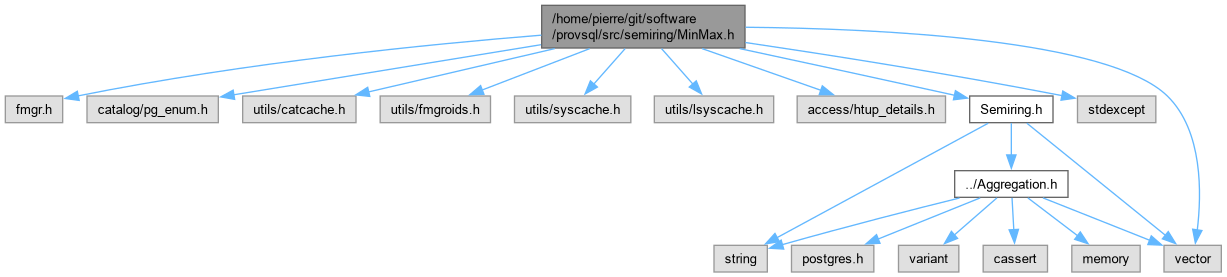
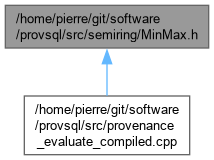
Go to the source code of this file.
Classes | |
| class | semiring::MinMax |
Min-max / max-min m-semiring with Datum carrier over a PostgreSQL enum type. More... | |
Namespaces | |
| namespace | semiring |
Min-max and max-min m-semirings over PostgreSQL enum types.
The min-max m-semiring associates each gate with an enum value drawn from a bounded linear order (the pg_enum.enumsortorder of the carrier enum type). Two instantiations are provided through a single class:
reverse = false): \(\oplus = \min\), \(\otimes = \max\), \(\mathbb{0} = \top\), \(\mathbb{1} =
\bot\). This is the security / access-control shape: alternative derivations combine to the least sensitive label, and joins combine to the most sensitive label.reverse = true): \(\oplus = \max\), \(\otimes = \min\), \(\mathbb{0} = \bot\), \(\mathbb{1} =
\top\). This is the fuzzy / availability / trust-level shape: alternatives combine to the most permissive label, and joins combine to the strictest label.Operations (described for MinMax; MaxMin is symmetric):
zero() → \(\top\) (largest enum value by sortorder)one() → \(\bot\) (smallest enum value by sortorder)plus() → enum-min over operands (empty list → zero())times() → enum-max over operands (empty list → one())monus() → \(\mathbb{0}\) if \(x \le_S y\), else \(x\), where \(\le_S\) is the semiring orderdelta() → identity (preserves the lattice value of the support so that aggregated groups carry the meaningful classification of contributing rows rather than a flattened one())Absorptivity: absorptive() returns true. With inputs in the bounded order, \(\mathbb{1} \oplus a = a \oplus \mathbb{1} = \mathbb{1}\) in both instantiations.
pg_enum.enumsortorder via the ENUMTYPOIDNAME syscache. Element comparison goes through F_ENUM_CMP via OidFunctionCall2, which handles the typecache lookup internally.instSemiringWithMonusMinMax (and MaxMin = MinMax(OrderDual)). Definition in file MinMax.h.