 |
ProvSQL C/C++ API
Adding support for provenance and uncertainty management to PostgreSQL databases
|
|
ProvSQL C/C++ API
Adding support for provenance and uncertainty management to PostgreSQL databases
|
Łukasiewicz fuzzy m-semiring over \([0,1]\). More...
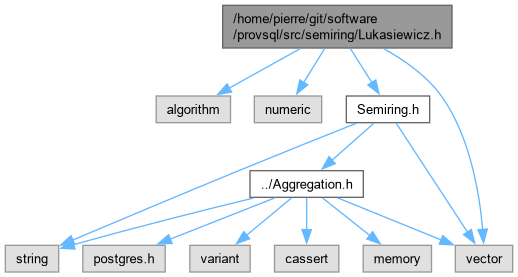
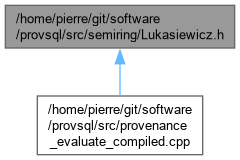
Go to the source code of this file.
Classes | |
| class | semiring::Lukasiewicz |
The Łukasiewicz fuzzy m-semiring over double. More... | |
Namespaces | |
| namespace | semiring |
Łukasiewicz fuzzy m-semiring over \([0,1]\).
The Łukasiewicz m-semiring ( \([0,1]\), \(\max\), \(\otimes_{\text{Ł}}\), 0, 1) is used to model graded-truth provenance: input gates carry degree-of-evidence values in \([0,1]\), \(\oplus = \max\) keeps the strongest alternative, and \(\otimes_{\text{Ł}}(a,b) = \max(a + b - 1, 0)\) is the Łukasiewicz t-norm, the bounded-loss conjunction.
Operations:
zero() → 0one() → 1plus() → maximum of all operands (empty list → 0)times() → \(\max(\sum_i a_i - (n-1), 0)\) for \(n\) operands (empty list → 1)monus() → 0 if \(a \le b\), \(a\) otherwisedelta() → 1 if x is non-zero, else 0Absorptivity: absorptive() returns true. With inputs in \([0,1]\), \(\mathbb{1} \oplus a = \max(1, a) = 1\). The circuit evaluator may exploit the resulting idempotency to deduplicate operands.
Compared to Viterbi (which uses \(a \cdot b\) for ⊗): the Łukasiewicz t-norm preserves crisp truth ( \(0.7 \otimes 1 = 0.7\)) and does not collapse long conjunctions to near-zero, making it the standard fuzzy choice for graded but non-probabilistic conjunctions.
instSemiringWithMonusLukasiewicz, with proofs of Lukasiewicz.absorptive, Lukasiewicz.idempotent, and Lukasiewicz.mul_sub_left_distributive. Definition in file Lukasiewicz.h.