 |
ProvSQL C/C++ API
Adding support for provenance and uncertainty management to PostgreSQL databases
|
|
ProvSQL C/C++ API
Adding support for provenance and uncertainty management to PostgreSQL databases
|
How-provenance m-semiring (canonical polynomial provenance ℕ[X]). More...
#include <cstring>#include <map>#include <sstream>#include <string>#include <vector>#include "Semiring.h"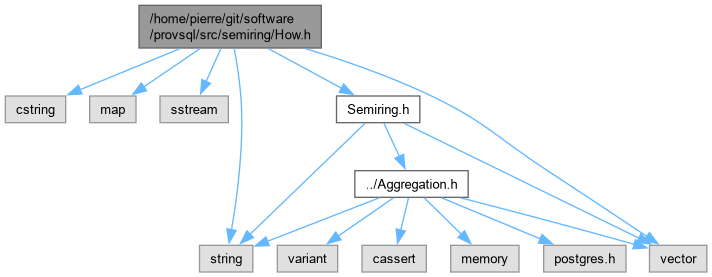
Go to the source code of this file.
Classes | |
| class | semiring::How |
| How-provenance m-semiring over \(\mathbb{N}[X]\). More... | |
Namespaces | |
| namespace | semiring |
Typedefs | |
| using | semiring::how_label_t = std::string |
| A single label identifying a base tuple. | |
| using | semiring::how_monomial_t = std::map<how_label_t, unsigned> |
| A monomial: each variable mapped to its (positive) exponent. | |
| using | semiring::how_provenance_t = std::map<how_monomial_t, unsigned> |
| How-provenance value: each monomial mapped to its (positive) coefficient. | |
How-provenance m-semiring (canonical polynomial provenance ℕ[X]).
The how-provenance semiring is the universal commutative semiring for provenance [Green, Karvounarakis, Tannen, Provenance Semirings, PODS'07]: every commutative-semiring provenance value can be obtained from the how-provenance polynomial by the unique homomorphism that substitutes each input label with its semiring image.
The carrier is the multivariate polynomial semiring \(\mathbb{N}[X]\) over the set \(X\) of base-tuple labels: each value is a multiset of multisets of labels, equivalently a sum of monomials with non-negative integer coefficients. We store it in canonical sum-of-products form as std::map<std::map<std::string,unsigned>,unsigned>: the outer map sends a monomial (variable→exponent) to its coefficient, and ordered containers give canonical equality on semantically-equal polynomials, which is the value-add over sr_formula.
Operations:
zero() → \(0\) (empty polynomial)one() → \(1\) (the constant 1, monomial of degree 0)plus() → polynomial addition (coefficient-wise sum)times() → polynomial multiplication (Cauchy product)monus() → coefficient-wise truncated subtraction (per the Lean coeff_sub theorem)delta() → \(0\) if \(x = 0\), else \(1\) (support indicator, mirroring Counting::delta)This semiring is not idempotent and not absorptive (absorptive() returns false), so the evaluator does not deduplicate plus operands. It also does not satisfy left-distributivity of multiplication over monus, contradicting an earlier claim in the literature; see Lean How.not_idempotent, How.not_absorptive, and How.not_mul_sub_left_distributive.
MvPolynomial X ℕ SemiringWithMonus instance, with proofs of How.universal, How.not_idempotent, How.not_absorptive, and How.not_mul_sub_left_distributive. Definition in file How.h.