 |
ProvSQL C/C++ API
Adding support for provenance and uncertainty management to PostgreSQL databases
|
|
ProvSQL C/C++ API
Adding support for provenance and uncertainty management to PostgreSQL databases
|
Symbolic representation of provenance as a human-readable formula. More...
#include <numeric>#include <vector>#include <string>#include <sstream>#include <iomanip>#include <iterator>#include "Semiring.h"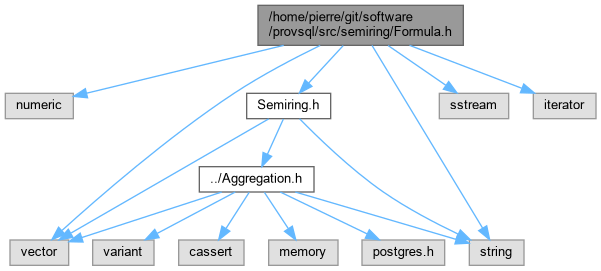
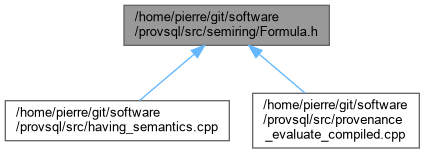
Go to the source code of this file.
Classes | |
| class | semiring::Formula |
Symbolic provenance representation over std::string. More... | |
Namespaces | |
| namespace | semiring |
Functions | |
| template<typename Range, typename Value = typename Range::value_type> | |
| static std::string | join (Range const &elements, const char *const delimiter) |
| Concatenate elements of a range with a delimiter. | |
| static std::string | strip_wrap_if_op (const std::string &s, const std::string &op) |
If s is wrapped in a single matched outer paren pair AND its top-level operator (depth 1, inside that pair) is op, return the inner content; otherwise return s unchanged. | |
| static std::string | format_number (double v) |
| Render a probability for display in a symbolic formula. | |
Symbolic representation of provenance as a human-readable formula.
The Formula pseudo-semiring (std::string, \(\oplus\), \(\otimes\), "𝟘", "𝟙") produces a symbolic representation of provenance using Unicode semiring symbols. It is primarily used for debugging and testing.
Each gate evaluates to a string:
zero() → "𝟘"one() → "𝟙"plus() → "(a ⊕ b ⊕ …)" or just "a" for singletonstimes() → "(a ⊗ b ⊗ …)" or just "a" for singletonsmonus() → "(a ⊖ b)"delta() → "δ(a)" or "δa" if a starts with cmp() → "[s1 op s2]"semimod()→ "x*s"agg() → operator-specific notation (e.g., "min(a,b)")value() → the literal string itselfunmapped_input() → the leaf's abbreviated UUID ("1361b50e…")It also renders the measure-carrier gates that carry no algebraic meaning, and that every proper semiring therefore refuses – being a serialisation of the circuit rather than an evaluation of it, Formula has a faithful rendering for each and refuses nothing:
rv() → "normal(2.5, 0.5)" (wired parameters substituted)arith() → ordinary arithmetic notation ("(a + b)", "ln(a)"…), kept visually distinct from the semiring's \(\oplus\) / \(\otimes\)mixture() → "(p ? x : y)"categorical() → "categorical(κ; 0.3: a, 0.7: b)"guarded_case()→ "case(g → v; else d)"observe() → "observe(x = 2.5)"conditioned() → "(x | c)" Definition in file Formula.h.
|
static |
Render a probability for display in a symbolic formula.
Enough significant digits that the usual decimal probabilities print back as themselves (0.3, not 0.299999), without the full round-trip verbosity of setprecision(17).
Definition at line 125 of file Formula.h.

|
static |
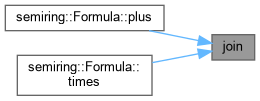
Concatenate elements of a range with a delimiter.
Used internally by Formula::plus(), Formula::times(), and Formula::agg() to build operator-separated strings.
| Range | Any range type with a value_type typedef. |
| Value | Element type (defaults to Range::value_type). |
| elements | The range to join. |
| delimiter | String to insert between adjacent elements. |
delimiter between them. Definition at line 62 of file Formula.h.
|
static |
If s is wrapped in a single matched outer paren pair AND its top-level operator (depth 1, inside that pair) is op, return the inner content; otherwise return s unchanged.
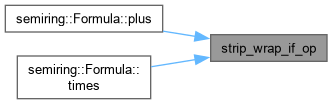
Used by Formula::plus() and Formula::times() to flatten same-op nested gates by associativity: a child "(a ⊕ b)" feeding into a parent plus is unwrapped to "a ⊕ b" so the join produces "a ⊕ b ⊕ c" instead of "(a ⊕ b) ⊕ c". A different top-level op (e.g., a times child) keeps its parens.
Definition at line 88 of file Formula.h.